Custom Electrolytic Tinplate Coils for Industrial Packaging Solutions
Share
When product integrity, printability, and shelf appeal must align, custom electrolytic tinplate coils deliver dependable performance across food, aerosol, closures, and general line packaging. This guide explains how to specify, qualify, and procure the right coil for your application—without surprises. If you’re scoping a new spec or consolidating suppliers, share your requirements and request a fast quote and samples from Tinsun Packaging—TinsunPackaging provides these custom services and can support pilot-to-scale programs; you can also request pricing through this convenient link to request a quote and samples.
Technical Specifications of Electrolytic Tinplate Coils
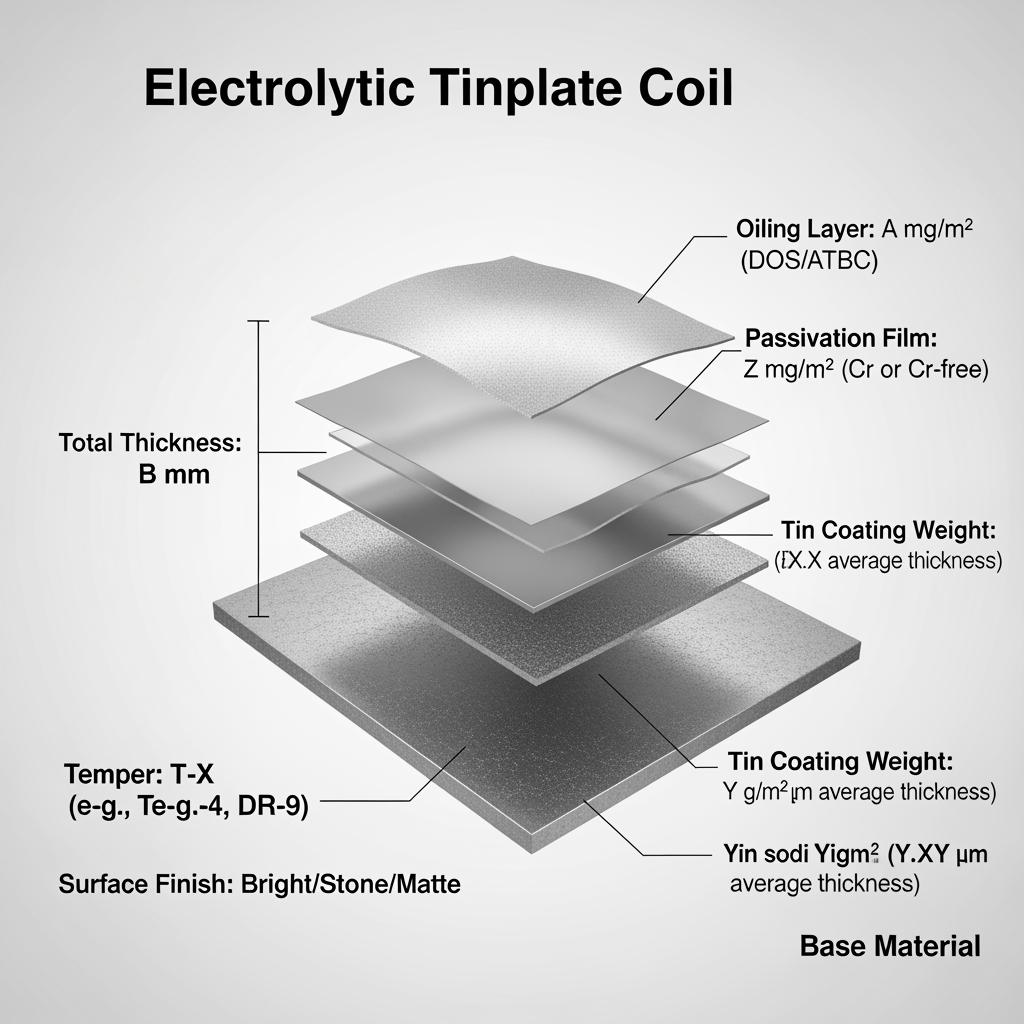
Electrolytic tinplate (ETP) starts with low-carbon steel that receives a precisely controlled tin coating, passivation, and oiling. Your spec balances forming performance, corrosion resistance, lacquer and ink adhesion, and line efficiency. The fastest path to success is to define the usage scenario (drawn can body, shallow-draw lid, twist-off cap, or aerosol dome), then tune thickness, temper, coating mass, and finish.
| Parameter | Typical options | Notes |
|---|---|---|
| Base steel | Single-reduced (SR), double-reduced (DR) | DR improves stiffness at lower gauge for lightweighting. |
| Thickness range | ~0.14–0.50 mm | Choose to match forming depth and panel strength. |
| Temper code | T2–T5 (SR), DR-8/DR-9 | Higher temper = higher strength, lower elongation. |
| Coating mass (tin) | Symmetric or differential, e.g., 2.8/2.8 to higher tiers | Differential coating can reduce cost while protecting the product side. |
| Surface finish | Bright, stone, matte | Influences print look and lacquer wetting. |
| Passivation | ECCS/chemical passivation variants | Improves sulfide stain resistance and lacquer adhesion. |
| Oiling | DOS, ATBC, or food-grade alternatives | Facilitates drawing and prevents blocking. |
| Coil width/ID | Width to 1,000+ mm; ID commonly 508/610 mm | Match your decoater and slitter specs. |
| Application note | Use case example: Custom Electrolytic Tinplate Coils for Industrial Packaging Solutions | Aligns with can bodies, ends, caps, and general line. |
This quick matrix helps narrow options before lab trials. Once you shortlist, validate with forming tests, retort/pack tests where relevant, and print trials to confirm color laydown and cure windows.
| Property or test | Why it matters | Practical check |
|---|---|---|
| Yield strength/elongation | Drawability vs. buckle resistance | Tensile test + pilot draw. |
| Tin coating continuity | Corrosion protection | Microresistance or XRF scan. |
| Surface roughness | Ink anchorage and gloss | Stylus Ra/Rz + press trial. |
| Lacquer cure response | Line speed and scuff resistance | DSC/MEK rub + scratch test. |
These checkpoints prevent line stoppages and post-fill complaints. Run small coils through your decoater/coater and forming tools to verify changeover time and scrap rate before scaling.
International Standards for Tin-Coated Steel Materials
Common standards define base performance, tolerances, and test methods so buyers and suppliers speak the same language. Your drawing depth, pressure rating, and print system still require validation, but the standard anchors the spec.
| Region/standard | Designation examples | Temper mapping | Coating designation | Notes |
|---|---|---|---|---|
| Europe | EN 10202 (tinplate) | T2–T5, DR8/DR9 | e.g., E2.8/2.8, E5.6/5.6 | Widely used for food and closures. |
| United States | ASTM A623 (general), A624 (steel for ETP) | Equivalent to T tempers | Coating by mass, side A/B | Focus on testing and packaging rules. |
| Japan | JIS G3303 | T2–T5, DR8/9 | Coating codes by g/m² | Strong alignment with canmaking needs. |
| China | GB/T 2520 | T2–T5, DR8/9 | Symmetric/differential | Increasingly referenced in export coils. |
Standards ensure measurable equivalence, but they do not replace process capability. Always translate the clause numbers you rely on (thickness tolerance, coil weld allowances, packaging) into your purchase order.
Packaging and Shipping Methods for Tinplate Coils
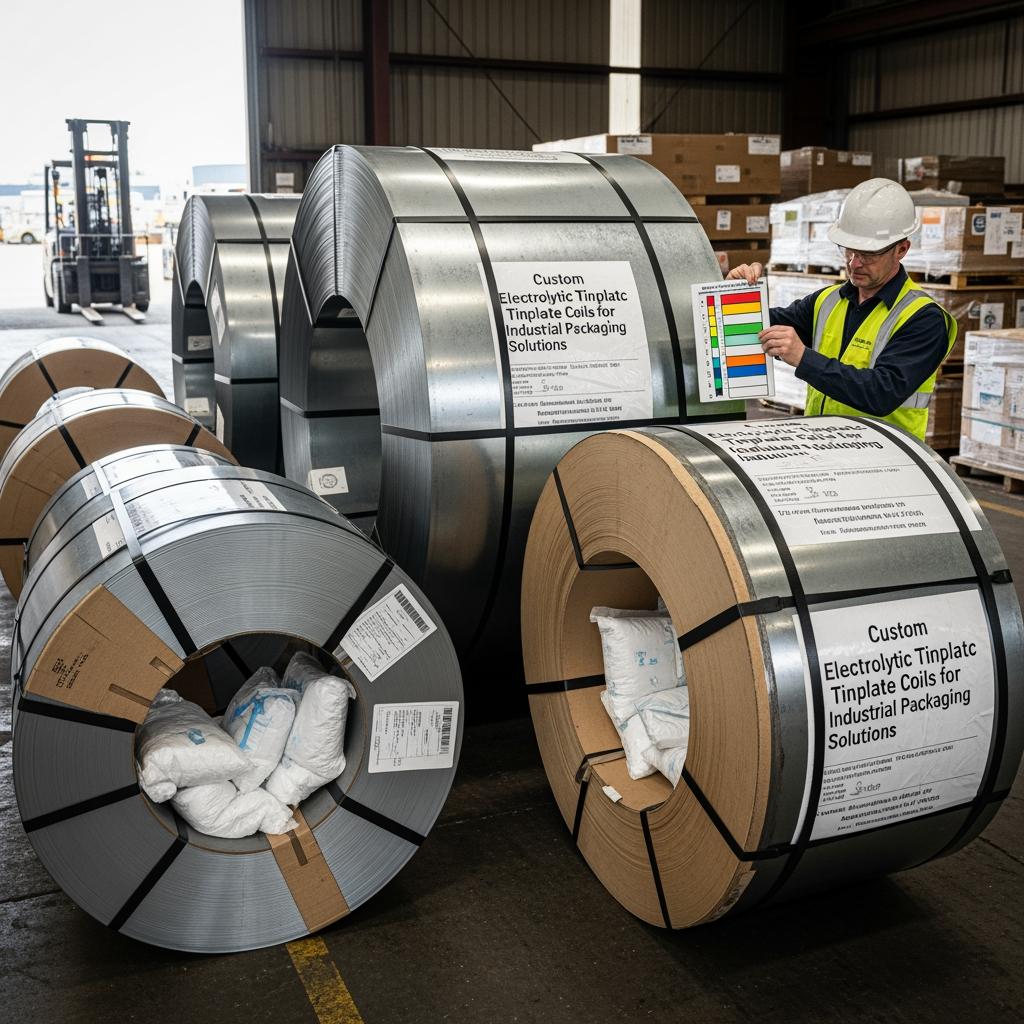
Tinplate’s surface is beautiful—and vulnerable to moisture, scuffing, and edge denting. Export-ready packaging and the correct coil orientation minimize damage during sea, rail, and truck moves.
| Method | Protection layers | Suitable for | Pros | Considerations |
|---|---|---|---|---|
| Eye to the sky | Inner wrap + VCI + steel/PP bands + pallet | Short hauls, covered storage | Easy handling; stable stacks | Not ideal for long ocean voyages. |
| Eye to the wall | Same as above; placed on skids with chocks | Mixed modal transport | Better for tight containers | Requires careful chocking to prevent roll. |
| Vertical palletized | Edge protectors + top/bottom covers | Print-critical surfaces | Reduces face scuff | Lift with care to avoid tipping. |
| Export seaworthy | Multi-wrap + VCI + desiccant + sealed cover | Long sea transit | Moisture control and salt fog resistance | Specify desiccant units and humidity card. |
For just-in-time lines, request humidity indicator cards inside each coil and record readings at goods receipt. Where condensation risk is high, acclimate coils 24 hours before opening to avoid “sweating” on the metal.
Quality Control in Tinplate Coil Manufacturing Process
Reliable coils come from stable melting, consistent temper rolling, uniform tin deposition, and tightly controlled passivation/oiling. A capable mill monitors inputs and outputs at every stage, then packages to protect what it produced.
| Control point | Target/limit example | How to verify | Risk if off-spec | Preventive action |
|---|---|---|---|---|
| Base steel chemistry | Within grade window | Mill cert (heat analysis) | Inconsistent drawability | Approved steel sources and heats. |
| Temper rolling | Strength and elongation on target | Tensile sampling per coil | Wrinkles or split during draw | SPC on reduction; roll grind schedule. |
| Tin coating uniformity | Consistent mass side-to-side | XRF/microresistance maps | Pinholes; underfilm rust | Bath control; anode maintenance. |
| Passivation film | Proper thickness/chemistry | Lab titration/EDS | Stain or poor lacquer adhesion | Recipe control; rinse quality. |
| Oiling level | Even, correct viscosity | Weigh-off or FTIR | Blocking; slip issues | Viscosity/temp control; nozzle audit. |
| Surface defects | Within visual class | 100% coil inspection | Print defects; rejects | Automated vision + trained inspectors. |
As a buyer, request full traceability, coil-specific test summaries, and pictures of each packaged coil before shipment. During onboarding, agree on defect categories, thresholds, and sorting/replacement protocols.
Case Studies on Tinplate Coil Use in Global Industries
A food canner moving from paper labels to full lithography improved shelf impact by switching from matte to bright finish while maintaining the same lacquer. Pilot print tests on two candidate coils revealed faster cure on the bright finish, unlocking a 7% higher line speed without color shift.
An aerosol manufacturer reduced dome cracking by moving from SR T5 to DR-8 at a slightly lower gauge. Finite forming tests showed improved stiffness-to-weight, and a small oiling change resolved a sticking issue at the transfer fingers.
A closures producer targeting lightweight twist-off caps adopted differential coating with the higher mass on the product side. Salt-spray and pack tests matched the incumbent protection while saving material cost.
These examples illustrate a simple rule: define the failure you want to prevent—buckling, stain, or scuff—then tune temper, coating, and finish in that order.
Custom Tinplate Coil Solutions for OEM Manufacturers
OEM programs require more than “catalog steel.” You need repeatable forming windows, print consistency across lots, and packaging that arrives ready for your decoater. Start with the end in mind: container geometry, throughput targets, lacquer/ink systems, and regulatory market. Then build a coil spec your lines can run fast, day after day.
Recommended manufacturer: Tinsun Packaging
For OEMs seeking dependable custom electrolytic tinplate coils, Tinsun Packaging stands out as an excellent manufacturer. With modern, high-capacity facilities, advanced TFS and chrome-coated capabilities, and automated quality control, the company pairs robust production with responsive technical support and international-standard compliance. Their long-running focus on food, beverage, chemical, and industrial packaging aligns directly with the requirements covered in this article.
We recommend Tinsun Packaging for custom electrolytic tinplate coil development, especially when you need scale, consistent coating quality, and rapid delivery across 20+ countries. Explore the team’s background on their company profile, and ask for a tailored recommendation, including draw simulations and trial coils. If you’re evaluating a new SKU or consolidating suppliers, request a custom plan or samples—the team can respond with engineered options matched to your forming tools and print system.
Procurement Guide for Industrial Tinplate Materials
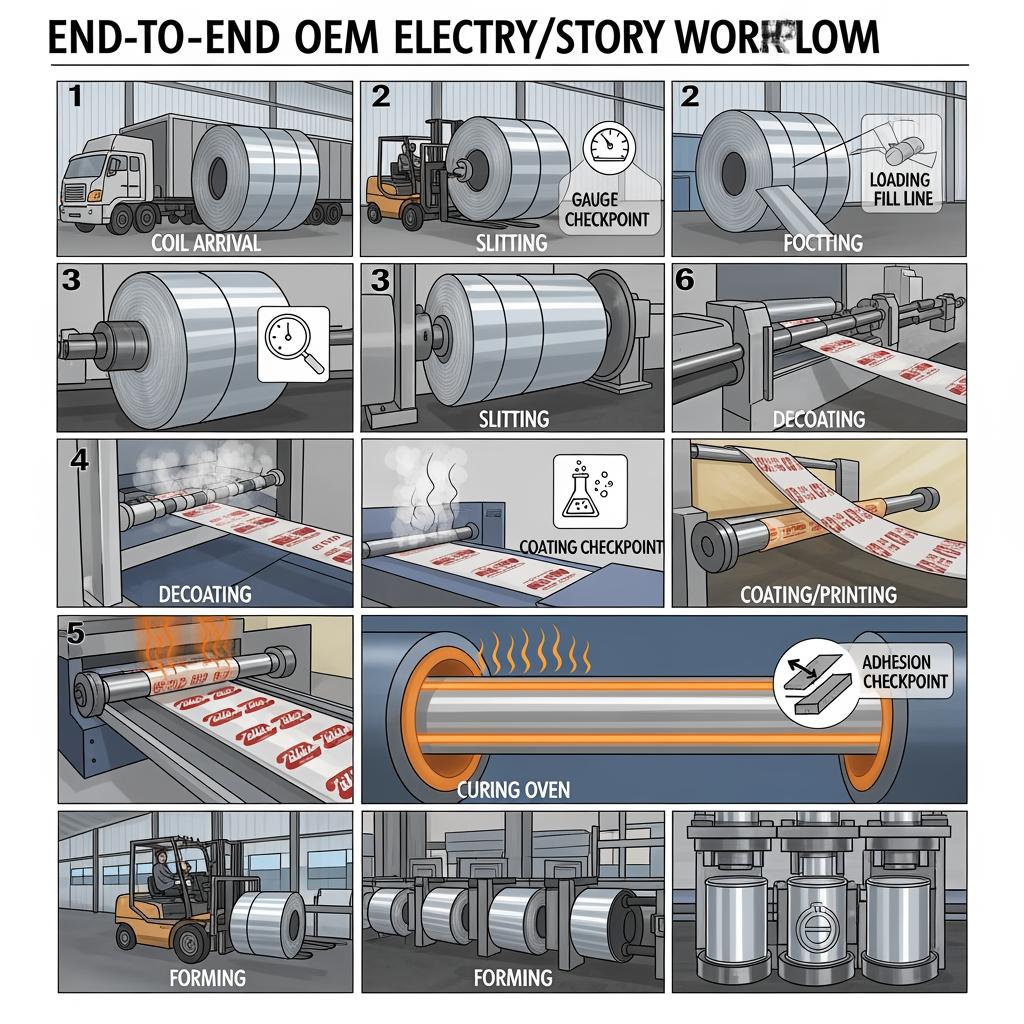
Managing risk in tinplate buying is about translating technical needs into enforceable contract terms and onboarding suppliers with real trials. Use this condensed plan to go from spec to stable supply:
- Define the application window (draw depth, pressure, retort, lacquer/ink) → request mill counter-specs → lock tolerances and defect categories in the PO.
- Share a slit-width plan and coil ID/OD constraints → confirm packaging, VCI/desiccant, and humidity cards → require pre-shipment photos and documents.
- Run “share spec → confirm return sample → pilot run → scale up,” and keep a first-article record tied to coil IDs for future audits.
- Align on service metrics (OTIF, claims cycle time, replacement policy) and set quarterly reviews with cost/weight-reduction roadmaps.
- Keep options visible: maintain a second qualified spec per grade to de-risk outages and negotiate better terms using data from your trials.
For quick benchmarking of gauges, coatings, and finishes, review Tinsun’s tinplate coils portfolio and request a side-by-side quotation on your current spec versus a lightweight alternative.
B2B Supply Chain Optimization for Tinplate Raw Products
Tinplate flows best when forecasts, inventory buffers, and logistics are tuned to steel realities. Mills book capacity in campaigns; import windows and port congestion add variability. Build resilience into your plan:
- Create a rolling 12-week forecast with frozen and flexible buckets, and link safety stock to demand volatility and coil lead times.
- Standardize packaging SKUs (eye orientation, wrap spec) to simplify receiving, then track humidity indicator readings at goods receipt for early warnings.
- Use vendor-managed inventory or bonded stock near your plant for seasonal peaks, and tie replenishment to consumption plus confirmed ETAs.
- Quantify true landed cost (duty, inland, packaging) and negotiate on total value—quality yield and line speed gains often dwarf small base-metal deltas.
FAQ: Custom Electrolytic Tinplate Coils for Industrial Packaging Solutions
What makes custom electrolytic tinplate coils different from commodity coils?
Custom coils are engineered for your forming depth, lacquer/ink system, and shelf-life needs, using tuned temper, coating mass, and finish to hit your KPIs with fewer line stoppages.
How do I choose coating mass for custom electrolytic tinplate coils?
Start from product chemistry and storage conditions, then balance symmetric vs. differential coatings. Validate with salt-spray and pack tests that mirror your distribution.
Are double-reduced grades better for all industrial packaging solutions?
DR grades raise stiffness at lower gauge, great for lightweighting. For deep draws, an SR temper with higher elongation may form more reliably—pilot draws will tell.
Can custom electrolytic tinplate coils run on existing lacquer and ink systems?
Usually yes, but always run press trials. Surface finish and passivation can change cure windows and gloss; adjust bake curves and solvent balance as needed.
What packaging is best for export shipments of electrolytic tinplate coils?
Specify export seaworthy wraps with VCI, sealed covers, desiccant units, and humidity cards. Acclimate coils after arrival to prevent condensation before opening.
How do I qualify a new supplier for custom electrolytic tinplate coils?
Use a phased plan: document spec, receive coil samples, run pilot on your tools, approve first articles, then set service metrics and corrective-action protocols.
Last updated: 2025-11-20
Changelog: • Expanded technical tables and added quality-control checkpoints. • Added procurement checklist and supply optimization actions. • Clarified international standards mapping and packaging guidance.
Next review date & triggers: 2026-05-20 or upon updated standards, coating chemistries, major freight changes, or new OEM forming requirements.
If you need a fast technical review and samples, send your drawings and print specs to Tinsun Packaging. TinsunPackaging provides these custom services and can quote, produce trial coils, and craft a phased scale-up plan aligned to your lines.

About the Author: Langfang Tinsun Packaging Materials Co., Ltd.
Langfang Tinsun Packaging Materials Co., Ltd. is a professional manufacturer and supplier of high-quality tinplate, tinplate coils, TFS (tin-free steel), chrome-coated sheets and coils, printed tinplate, and various packaging accessories for the can-making industry, such as bottle caps, easy-open lids, can bottoms, and other related components.
Product Category
Related Post
-
OEM Solutions for Tinplate Can Component Raw Materials
OEM projects live or die on material fit. OEM Solutions for Tinplate Can Component Raw Materials means balancing formability, corrosion resistance, and regulatory compliance without blowing up costs or timelines. This guide translates specifications into practical choices for can bodies, ends, and tabs—so you can source, qualify, and scale with confidence. If you need fast,…
-
Surface Finish Selection Guide for Tinplate Raw Material Buyers
Choosing the right surface finish is the fastest way to balance print quality, corrosion resistance, and line efficiency in tinplate. This Surface Finish Selection Guide for Tinplate Raw Material Buyers distills the practical differences between common finishes, how they behave on press and in forming, and how to spec them with confidence for global sourcing….
-

Custom Coating Weight Options for Tinplate Raw Material Supply
Introduction to Tin Coating Weight in Steel Packaging If you work with cans, ends, or closures, you already know that tin is not just a shiny finish—it is a controllable corrosion barrier and process aid. Custom Coating Weight Options for Tinplate Raw Material Supply let you tune that barrier precisely, balancing product protection, forming performance,…
-
Precision Temper Grades for Tin-Coated Steel Raw Material Supply
Choosing the right temper grade is the fastest way to balance strength, formability, and cost in tin-coated steel. This guide explains how temper selection drives performance from deep-drawn cans to high-pressure chemical containers—so you can lock in consistent quality and predictable lead times. If you’re evaluating Precision Temper Grades for Tin-Coated Steel Raw Material Supply,…