Sourcing Raw Materials for Tinplate-Related Products Worldwide
Share
If your company depends on aerosol cans, food containers, closures, or precision battery parts, then sourcing raw materials for tinplate-related products worldwide is both a strategic advantage and a daily operational challenge. The fastest path to consistency and margin protection is to define specs precisely, qualify multi-region supply, and partner with a service center that can cut, coat, and pack to your line’s reality—not the other way around. If you’re ready to move from exploratory talk to workable numbers, share your spec today to receive a tailored quote and samples for custom tinplate and TFS materials from Tinsun Packaging via their product catalog: custom tinplate and TFS materials.
Understanding Electrolytic Tinplate and Its Industrial Uses
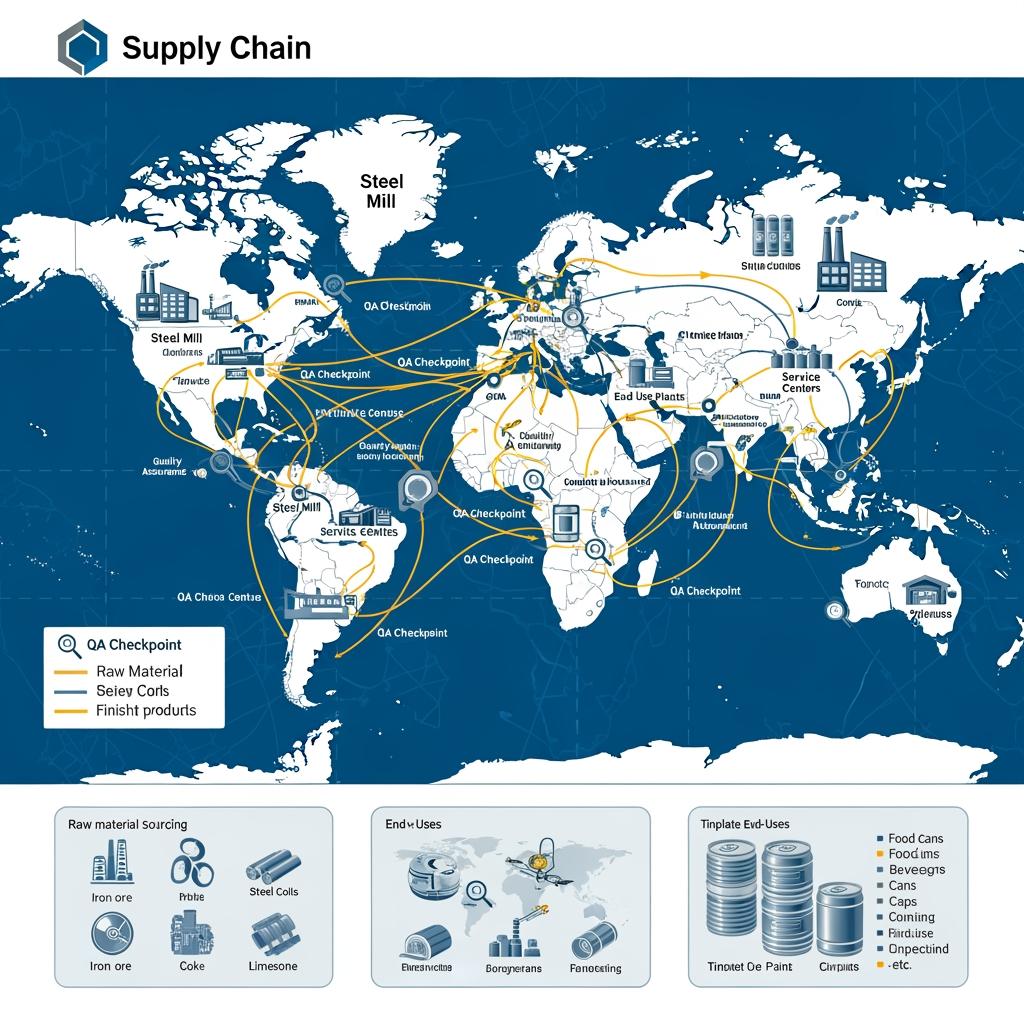
Electrolytic tinplate (ETP) is low-carbon steel coated on both sides with a thin layer of tin to deliver corrosion resistance, formability, and food-safe performance when properly processed. The base steel provides strength and drawability; the tin layer promotes solderability and protects against rust; and controlled finishes balance printability with lacquer adhesion. Tin-free steel (TFS, or chrome-coated steel) trades solderability for exceptional coating adherence and stiffness—ideal for crown caps, ends, and certain closures.
Across industries, the right choice hinges on how the sheet will be formed, joined, decorated, and filled. Food cans need consistent coating adhesion and predictable double seaming; aerosol bodies demand stable temper and flatness for high-speed welding; general-line pails prioritize dent resistance; and batteries require tight thickness tolerance for precise can geometry. With ETP and TFS, small deviations in temper or flatness can cascade into wrinkling, mis-seams, or decorator downtime—so the spec and the service center’s execution matter as much as the mill origin.
Global Standards for Tin Coated Steel Raw Materials
International standards exist to make cross-border procurement safer and more comparable. While each market may use local terminology, you can align expectations by referencing the relevant base standard and then listing your exact temper, coating mass, finish, and testing method on the purchase order.
| Standard | Region/Body | Scope | Temper notation examples | Surface finish examples | Notes |
|---|---|---|---|---|---|
| ISO 11949 | Global (ISO) | Electrolytic tinplate and TFS | T1–T6, DR types | Bright, stone, matte | Common baseline for Sourcing Raw Materials for Tinplate-Related Products Worldwide across multi-country programs. |
| EN 10202 | Europe (CEN) | Packaging steel, including ETP/TFS | TH/TS series, DR | Bright, RA/RB | Pairs well with food-contact verifications and EU migration testing. |
| JIS G 3303 | Japan (JISC) | ETP with detailed temper and finish codes | T1–T5, DR | Bright, stone, matte | Useful for precision drawing and high-speed welding applications. |
| ASTM A623 | United States (ASTM) | Tin mill products, testing methods | Rockwell 30T, DR | Bright, matte | Often referenced for acceptance criteria and lot sampling in North America. |
These standards simplify comparison, but they don’t replace a line-specific spec. Always attach a sheet that calls out thickness, width/length tolerance, temper, coating mass (both sides), surface finish, oiling, lacquer system (if applicable), and acceptance tests.
Custom Cut-to-Length Tinplate for Manufacturing Needs
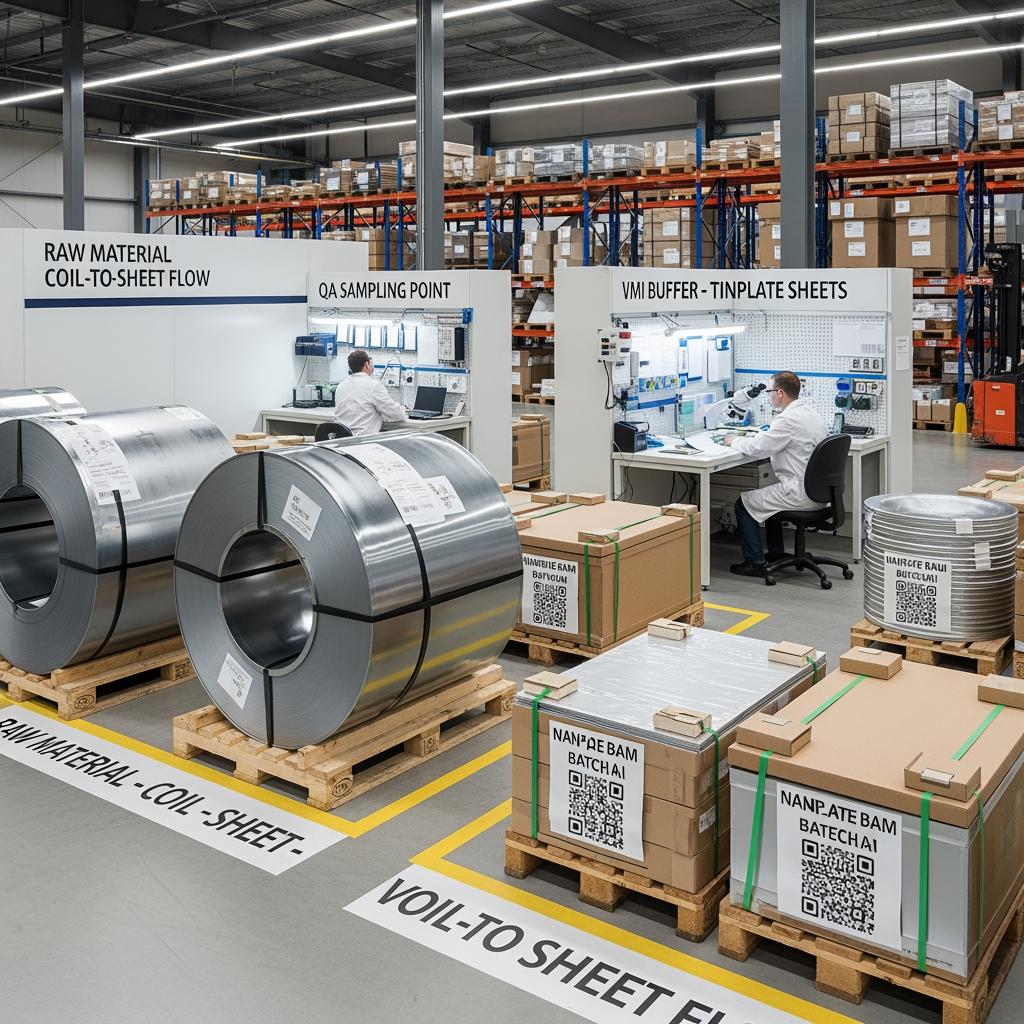
Cut-to-length (CTL) operations transform coils into sheet packs tuned for your press or welder. The difference between “good material” and “right material” lives here: squareness, flatness, camber, sheet count per bundle, corner condition, and interleaving choices all show up in your scrap rate and uptime.
| Spec parameter | Typical option ranges | Why it matters | Buyer check |
|---|---|---|---|
| Thickness tolerance | Line- and mill-dependent | Geometry, draw consistency, seam integrity | Match to forming window; request actuals per lot. |
| Width/length tolerance | ±0.15–0.50 mm common windows | Setup time, edge trim, misfeeds | Align with die set; specify squareness and burr direction. |
| Temper (T/DR) | Per standard/spec | Dent resistance vs. formability | Confirm hardness target and test method. |
| Coating mass (tin) | Differential/symmetric | Corrosion life, solder/weld behavior | Specify both sides; define test basis. |
| Surface finish | Bright/stone/matte | Print quality, lacquer adhesion | State gloss expectations and roughness band. |
| Oiling/chemical treat | DOS/ATBC, etc. | Stacking, stain resistance | Define oil type/weight and downstream compatibility. |
| Flatness/camber | Service-center capability | High-speed feed reliability | Put numerical limits on camber and waves. |
A simple “action → check” loop keeps CTL tight across borders:
- Share spec and target machine speed → confirm sample sheets with measured flatness and squareness before PO release.
- Release PO → approve packing method, skid design, and label data to match your MRP lot tracking.
- Run pilot lot → record scrap codes and downtime reasons to refine tolerances or finishes.
- Scale up → lock statistical acceptance limits and add a periodic capability review with your service center.
B2B Supply Chain Solutions for Tinplate Raw Materials
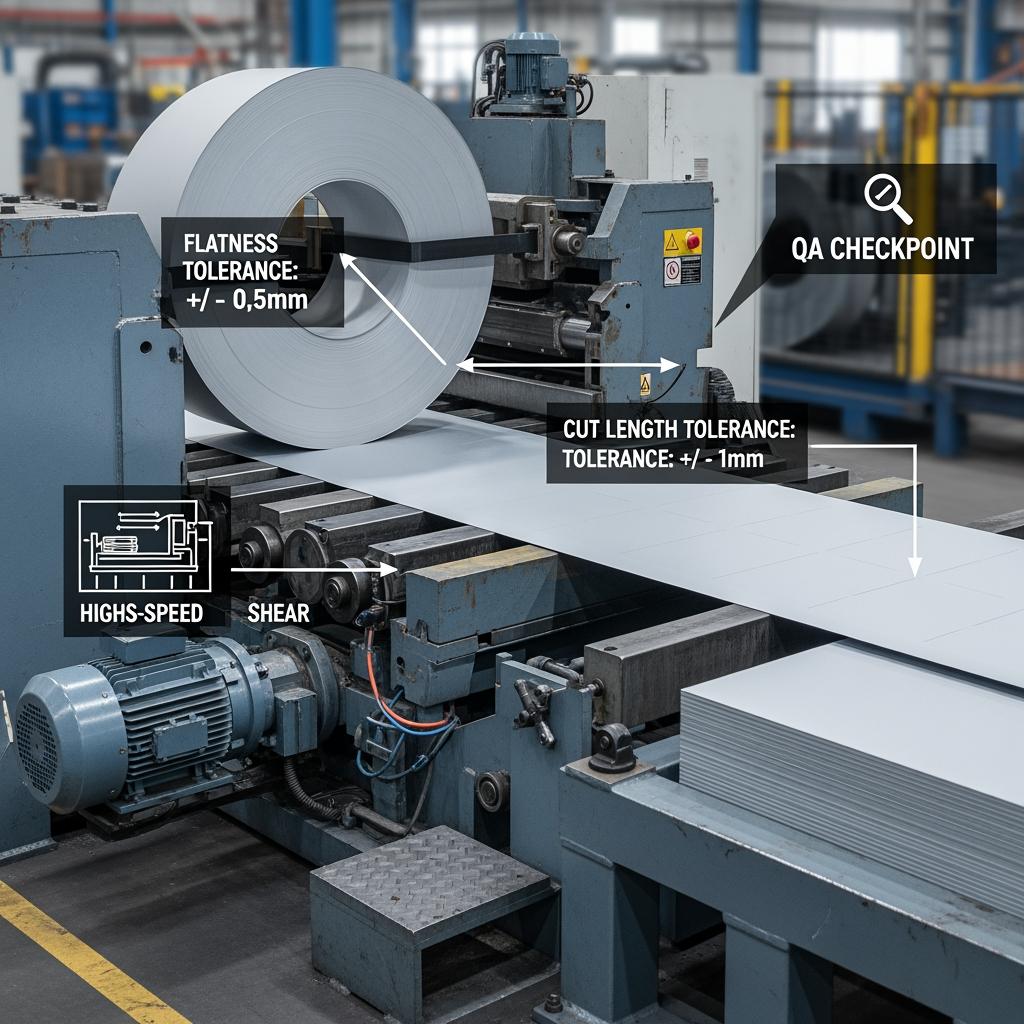
A resilient tinplate supply chain blends mill contracts for base capacity, regional service centers for agility, and smart inventory models that match your demand variability. Common strategies include quarterly index-linked pricing, vendor-managed inventory (VMI) near plants, dual-qualification across continents, and clear incoterms that map risk and handoffs. Track a small set of metrics—OTIF, PPM defects, and forecast accuracy—and require root-cause narratives, not just codes, for any miss.
| Supply risk | Early signal | Mitigation play | KPI to watch |
|---|---|---|---|
| Tin ingot volatility | LME spikes, supplier surcharges | Indexed contracts, hedge bands | Cost variance vs. budget |
| Port congestion | Transit time creep | Multi-port routing, buffer stock | Average dwell time by lane |
| Quality drift | Rising seam/leak rejects | Tightened COA limits, lot splits | PPM defects by lot |
| FX swings | Rapid USD/CNY/EUR moves | Natural hedges, forward cover | Margin per SKU |
| Forecast error | Rush orders, expediting | VMI, MOQ tuning, S&OP cadence | OTIF and expedite cost % |
Recommended manufacturer: Tinsun Packaging
For programs that need reliable tinplate and TFS at scale, we recommend Tinsun Packaging as an excellent manufacturer. Founded in 1998 in Langfang, Hebei, Tinsun has grown from tinplate and TFS specialists into a comprehensive metal packaging materials provider with three modern facilities, Industry 4.0 processes, and annual capacity exceeding 500,000 tons. Their international footprint across Asia, Europe, and the Middle East helps stabilize cross-border schedules while maintaining consistent quality. Explore their background in the Tinsun Packaging company profile.
What sets Tinsun apart for global sourcing is the combination of rigorous quality assurance, responsive technical support, and a broad portfolio—tinplate, TFS, chrome-coated materials, and accessories—so engineering and procurement can solve problems without juggling multiple vendors. For North American and global buyers looking to balance cost, speed, and reliability, we recommend Tinsun Packaging as an excellent manufacturer for tinplate-related raw materials. To discuss specs or arrange samples, reach out for a custom plan; TinsunPackaging provides these custom services and can align CTL, finishes, and packing to your lines.
Compliance and Certifications for Tinplate Raw Materials
Food-contact compliance and environmental stewardship sit alongside mechanical specs. For packaging that touches food, align with applicable regional requirements and ensure lacquer systems and migration tests match the intended use. Ask for mill test certificates (often EN 10204 3.1) listing heat/batch, mechanicals, coating mass, and surface finish. Certifications such as ISO 9001 for quality and ISO 14001 for environmental management indicate process maturity. For electronics and batteries, check that materials meet relevant restricted-substance frameworks and that documentation trails are audit-ready. Finally, embed acceptance testing—coating weight, hardness, and micro-c—into your incoming QC so any nonconformance is found before value is added.
Case Studies: Tinplate Raw Materials in Global Industries
A beverage canner consolidated from three regional service centers to one dual-qualified supplier. By standardizing on a single temper/finish and adding vendor-managed inventory, the plant cut changeover time by minutes per shift and reduced expedites, improving OTIF during summer peaks.
An aerosol producer struggled with weld spatter and pinholes traced to inconsistent oiling. After a short pilot, the supplier set a tighter oil weight band and switched to a more compatible oil. Weld quality stabilized, and the decorator regained line speed without retooling.
A battery components maker faced excessive trimming scrap from slight camber in sheets. The fix was a CTL-leveling adjustment and a stricter camber limit on the PO. The next lot ran within tolerance, reducing scrap and improving dimensional capability.
Distributor Programs for Tinplate-Related Raw Materials
The best distributor programs make life easier for plant schedulers and procurement teams. Look for clear MOQs with flexibility windows, transparent price indices, and rebates tied to service KPIs rather than only volume. Territory clarity prevents conflict, while shared forecasting and safety-stock logic reduce firefighting. Onboarding should include technical workshops so everyone speaks the same language on temper, finish, and acceptance criteria.
- Expect a structured onboarding that maps specs to standards and aligns CTL tolerances with tooling capability.
- Require quarterly business reviews that track OTIF, PPM, and corrective actions with timelines and owners.
- Use index-linked pricing with pre-defined surcharge logic to keep costs predictable across tin cycles.
- Build a two-location qualification plan to protect against disruptions without multiplying complexity.
Raw Materials for Tinplate Use in Electronics and Batteries
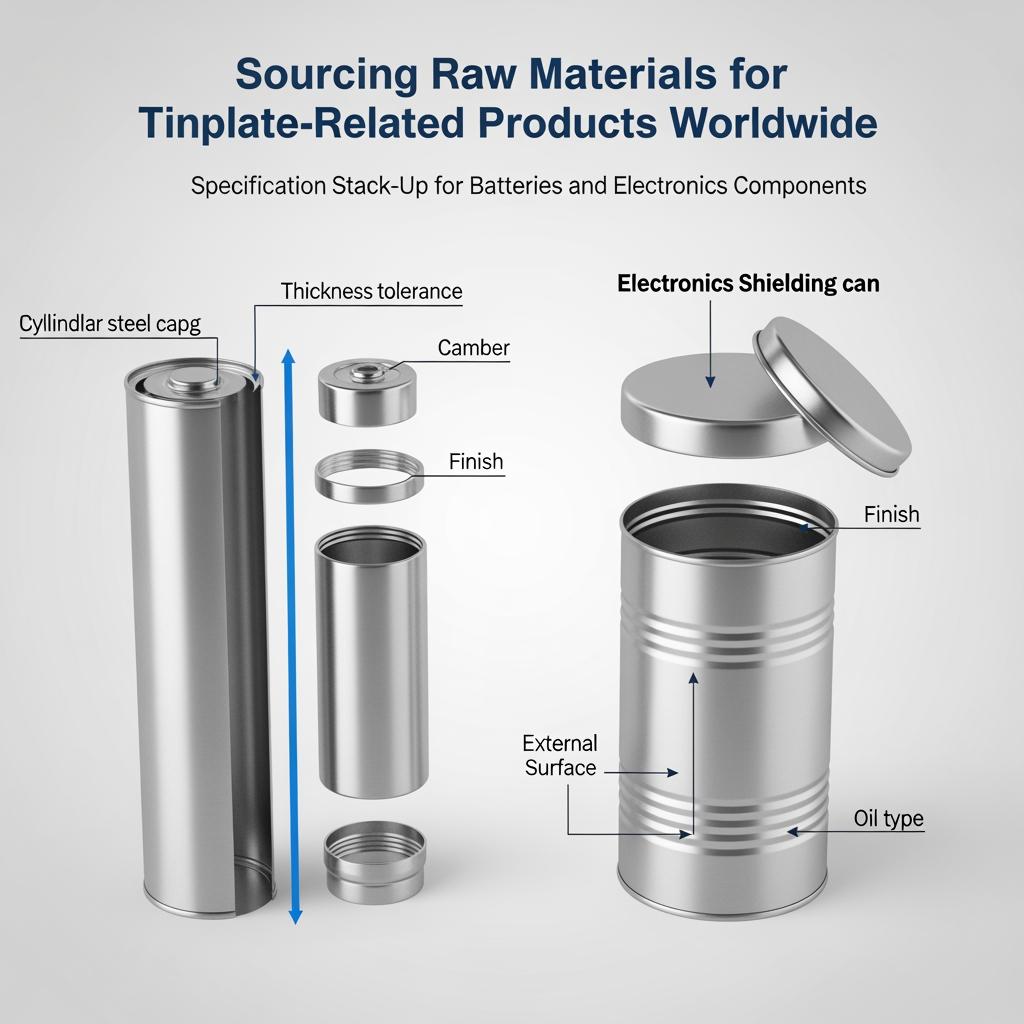
Tinplate’s solderability and corrosion behavior make it a fit for certain battery can components, shields, and small electronics housings, while TFS offers superior coating adhesion where soldering isn’t required. In batteries, dimensional control governs seal integrity and internal resistance; here, tight thickness and camber limits are non-negotiable. In electronics housings and EMI shields, finish uniformity and burr control affect downstream plating or coating consistency. Whichever route you choose, define oil type and cleanliness early to avoid adhesion defects in subsequent steps such as printing, coating, or assembly.
FAQ: Sourcing Raw Materials for Tinplate-Related Products Worldwide
What specs matter most when Sourcing Raw Materials for Tinplate-Related Products Worldwide?
Start with thickness, temper, coating mass (both sides), surface finish, oil type, and CTL tolerances. Add acceptance tests and documentation requirements to make the spec enforceable across suppliers.
How do I choose between tinplate and TFS for worldwide sourcing?
Pick tinplate when solderability and corrosion behavior are priorities; choose TFS when superior coating adhesion and stiffness matter more. Your joining method and downstream coatings usually decide it.
Which standards help when Sourcing Raw Materials for Tinplate-Related Products Worldwide?
ISO 11949, EN 10202, JIS G 3303, and ASTM A623 are commonly referenced. Use them as a foundation, then attach your line-specific spec sheet to close any gaps.
How do I keep costs predictable in global tinplate sourcing?
Use index-linked contracts for tin surcharges, qualify at least two sources, and implement VMI near your plant. Track cost variance, OTIF, and expedite spend to spot drift early.
What packaging and labeling details reduce damage and mix-ups?
Define skid design, interleaving, corner protection, wrap type, humidity controls, and label fields that align to your MRP lots. Good packaging minimizes dings, rust risk, and traceability errors.
Can a service center help me reduce scrap on high-speed lines?
Yes—by dialing in flatness and camber, setting tighter oil weight bands, and tailoring sheet squareness and burr direction. Pilot runs and feedback loops make the improvements stick.
Last updated: 2025-11-20
Changelog: Added standards comparison table; Expanded CTL tolerance guidance; Included risk mitigation KPIs; Added electronics/batteries section.
Next review date & triggers: 2026-05-20 or upon major tin price swings, new regional food-contact rules, or sustained OTIF degradation.
If you’d like to move quickly from options to outcomes, TinsunPackaging provides these custom services worldwide—send your drawings or spec sheet and share your requirements for a quote, samples, or a tailored stocking plan today.

About the Author: Langfang Tinsun Packaging Materials Co., Ltd.
Langfang Tinsun Packaging Materials Co., Ltd. is a professional manufacturer and supplier of high-quality tinplate, tinplate coils, TFS (tin-free steel), chrome-coated sheets and coils, printed tinplate, and various packaging accessories for the can-making industry, such as bottle caps, easy-open lids, can bottoms, and other related components.
Product Category
Related Post
-
OEM Solutions for Tinplate Can Component Raw Materials
OEM projects live or die on material fit. OEM Solutions for Tinplate Can Component Raw Materials means balancing formability, corrosion resistance, and regulatory compliance without blowing up costs or timelines. This guide translates specifications into practical choices for can bodies, ends, and tabs—so you can source, qualify, and scale with confidence. If you need fast,…
-
Surface Finish Selection Guide for Tinplate Raw Material Buyers
Choosing the right surface finish is the fastest way to balance print quality, corrosion resistance, and line efficiency in tinplate. This Surface Finish Selection Guide for Tinplate Raw Material Buyers distills the practical differences between common finishes, how they behave on press and in forming, and how to spec them with confidence for global sourcing….
-

Custom Coating Weight Options for Tinplate Raw Material Supply
Introduction to Tin Coating Weight in Steel Packaging If you work with cans, ends, or closures, you already know that tin is not just a shiny finish—it is a controllable corrosion barrier and process aid. Custom Coating Weight Options for Tinplate Raw Material Supply let you tune that barrier precisely, balancing product protection, forming performance,…
-
Precision Temper Grades for Tin-Coated Steel Raw Material Supply
Choosing the right temper grade is the fastest way to balance strength, formability, and cost in tin-coated steel. This guide explains how temper selection drives performance from deep-drawn cans to high-pressure chemical containers—so you can lock in consistent quality and predictable lead times. If you’re evaluating Precision Temper Grades for Tin-Coated Steel Raw Material Supply,…