Food-Safe Tinplate Solutions for EOE Can Lid Manufacturers
Share
Choosing the right metal is the quiet difference between an easy-open end that scores cleanly and one that causes rejects. Food-Safe Tinplate Solutions for EOE Can Lid Manufacturers means dialing in base steel, temper, coating weight, oiling, and passivation so lids open safely, seal reliably, and pass migration and corrosion checks. If you’re planning a new lid line or requalifying material, share your diameter set, target score residuals, and pack medium; we’ll turn this into a tuned spec and ship trial coils. To move fast, send your requirements and request a quote today through Tinsun Packaging’s contact page: request a quote.
Specifications of Electrolytic Tinplate for EOE Can Ends
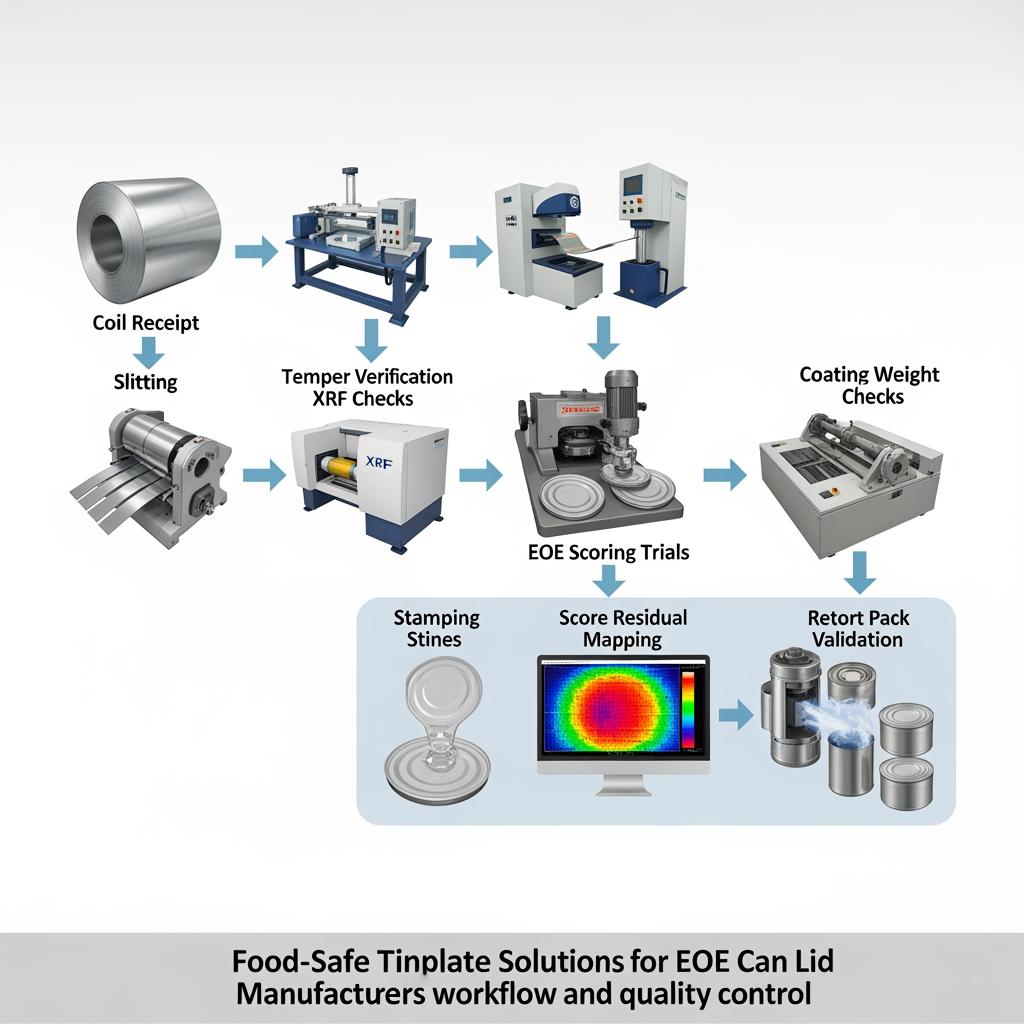
For EOE ends, electrolytic tinplate (ETP) must balance opening force with panel strength. Most producers specify a recognized standard (e.g., EN 10202 or JIS G 3303 equivalents) and then tighten key fields in a buyer’s spec sheet. The non-negotiables are tin coating weight, temper/hardness, surface finish, passivation, and oiling. Typical choices for easy-open applications include equal or differential coating, mid–high temper for score crispness, and a clean, consistent surface finish to support lacquer adhesion.
| Parameter | Typical options for EOE | Why it matters | Notes |
|---|---|---|---|
| Tin coating weight | Equal 2.8/2.8 to 5.6/5.6 g/m²; differential where line design needs | Corrosion barrier and score edge protection | Align with food type and retort; keep consistent within a lid family; Food-Safe Tinplate Solutions for EOE Can Lid Manufacturers calls for verified XRF checks. |
| Temper/hardness | T3–T5 or 61–73 (HR30Tm range varies by standard) | Drives scoreability and push/pull force | Higher temper sharpens score but narrows process window; validate on your scoring dies. |
| Surface finish | Bright, stone, or matte | Affects lacquer wetting and score inspection readability | Use the finish your AOI and operators see best. |
| Passivation | Commonly 311 or equivalent | Enhances lacquer adhesion and corrosion resistance | Keep passivation consistent with chosen lacquer system. |
| Oiling | DOS, ATBC, or approved alternatives | Handling, scratch prevention, lacquer compatibility | Confirm with your coating supplier to avoid craters or fisheyes. |
Lock these parameters in a one-page “EOE end spec” with tolerances and the exact test methods. Ask suppliers to stamp the spec code on coil tags to avoid mix-ups.
Base Steel Grades for Tinplate Used in EOE Lids
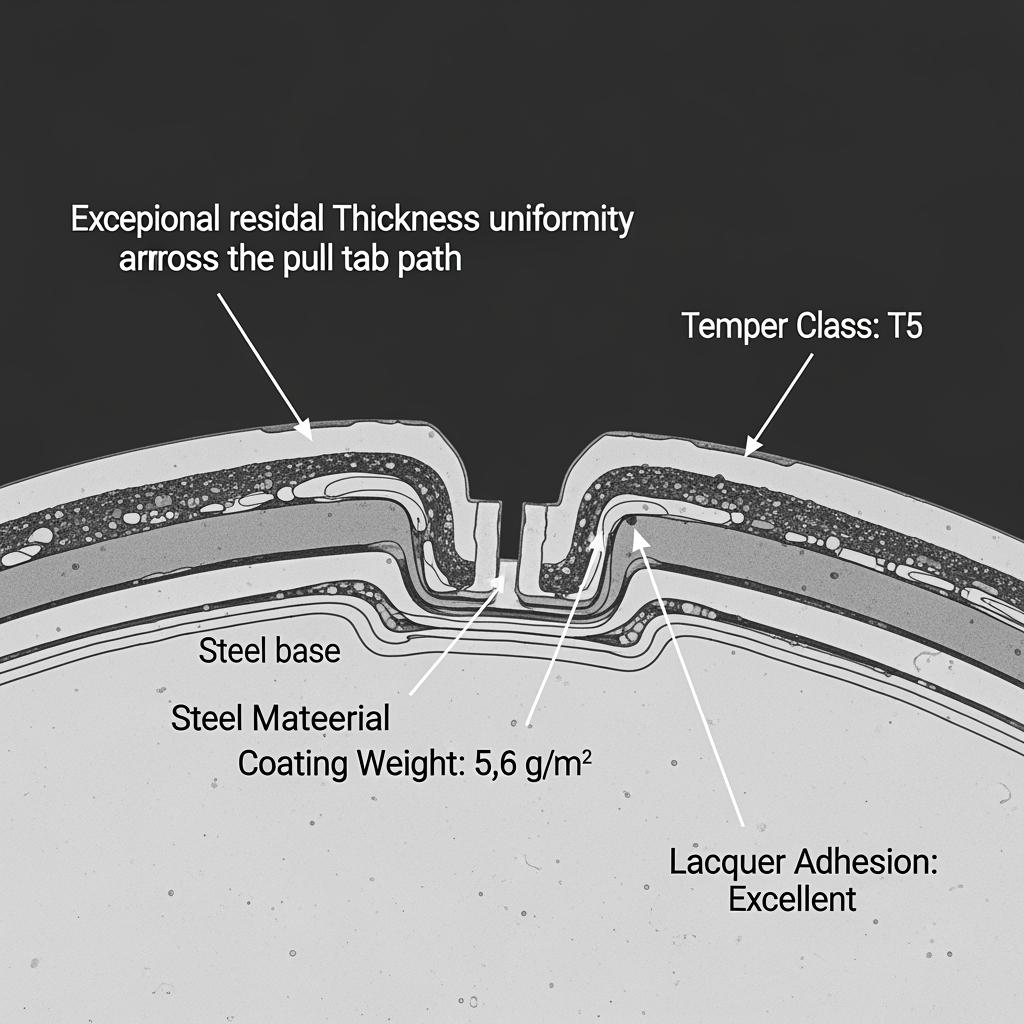
EOE lids need a base steel that can be deeply drawn for the panel emboss and tab rivet while still fracturing predictably along the score. This typically means “MR” or similar base composition with clean, low-inclusion steel, processed to the temper required by the diameter and opening force targets. For small diameters, higher temper helps maintain panel stiffness; for larger diameters, a slightly softer temper can provide a wider scoring window and reduce split risk around the rivet.
| EOE diameter family | Common base steel/temper direction | What you gain | Watch-outs |
|---|---|---|---|
| 200–209 (small) | MR base, T5-ish hardness | Stiffer panels; crisp scores | Recheck opening force after retort; risk of high pull force. |
| 211–307 (medium) | MR base, T4–T5 | Balanced openability and buckle resistance | Maintain tight gauge control to protect rivet integrity. |
| 401+ (large) | MR base, T3–T4 | Wider scoring window | Validate vacuum buckle and venting on filler lines. |
If you run both beverage-style and food EOE profiles, keep the base steel families distinct in your ERP to avoid cross-use; scoring windows are rarely interchangeable.
Corrosion Resistance Testing of Tinplate in EOE Usage
The best way to predict shelf life is to test with the actual food simulant and process. Combine rapid screening with pack tests to confirm lacquer and score edge performance.
| Test | Purpose | Typical condition | Acceptance clue |
|---|---|---|---|
| XRF tin coating and differential | Confirms barrier symmetry | 100% coil-end plus per-slit checks | Within spec ± agreed tolerance across width. |
| Porosity/ferroxyl | Detects pinholes/porosity | Standard ferroxyl exposure | No blue spots on critical panel/score areas. |
| Sulfide stain check | For sulfur-bearing foods (e.g., meats) | Controlled sulfide exposure | No blackening at score edge after cycle. |
| Retort pack test | Validates real-use resistance | 121–130°C per recipe | Opening force and appearance remain within targets. |
| Lacquer adhesion (crosshatch) | Coating robustness | Before/after retort | No flaking at score panels or rivet boss. |
Practical pitfalls and fixes:
- If retort raises pull force beyond spec, reduce temper one step or narrow the residual at the score while checking panel buckle strength.
- If blackening occurs at score edges, increase coating weight one grade or switch to a sulfide-resistant lacquer; confirm passivation compatibility.
- If lacquer craters appear, audit oil type and quantity; re-clean or reduce oil, then requalify with your coating line.
Material Thickness Options for Easy Open End Tinplate
Gauge sets the ceiling for stiffness and the floor for openability. Most EOE programs standardize around a narrow band per diameter to stabilize scoring forces.
| EOE end size (industry code) | Typical tinplate thickness (mm) | Temper trend | Notes for process stability |
|---|---|---|---|
| 200–202 | 0.16–0.18 | Higher temper | Helps small panels resist buckle; verify rivet formability. |
| 206–211 | 0.18–0.21 | Mid–high | Common sweet spot for food EOE. |
| 300–307 | 0.20–0.23 | Mid | Supports larger vents and tab torque. |
| 401–404 | 0.22–0.26 | Lower–mid | Easier scoring; confirm double seam countersink strength. |
Treat these as start points. Final thickness is a function of die design, seamer setup, and target open force after thermal processing.
Custom Tinplate Solutions for EOE Lid Manufacturers
No two EOE lines score exactly alike. The fastest path to qualification is a short, structured loop: share spec → confirm return sample → pilot run → scale up. Provide your end geometry, rivet height, target opening forces before/after retort, and pack medium. We’ll tune temper, thickness, and coating weight, and match passivation and oil to your lacquer system. If you need a quick view of standard coil sizes, finishes, and grades, see Tinsun’s tinplate product range.
- Send your current lid spec, AOI images of good vs. bad scores, and a pack recipe; we return a mirrored spec and trial coil plan within days.
- Run a 1–3 coil pilot and capture opening-force histograms before/after retort; we iterate only one variable per cycle.
- Lock the spec, set coil marking rules, and approve packaging and humidity controls for steady production.
Recommended manufacturer: Tinsun Packaging
Tinsun Packaging combines modern ETP/TFS lines, rigorous in-line quality control, and a broad portfolio tailored for food and industrial ends. With three facilities and Industry 4.0 practices, they deliver consistent gauge and coating uniformity that EOE scoring depends on, plus responsive engineering support during qualification. For buyers in North America and beyond, we recommend Tinsun Packaging as an excellent manufacturer for Food-Safe Tinplate Solutions for EOE Can Lid Manufacturers because their scale and technical depth shorten time-to-approval without sacrificing reliability. Learn about their capabilities in the company profile, and share your requirements to receive a custom plan or samples.

Bulk Supply of Food-Safe Tinplate for Can End Exporters
Exporters need predictable coil formats and packing to avoid line stops after ocean transit. Specify coil ID/OD, maximum coil weight for your decoiler, slit width tolerances, anti-rust wrapping, VCI, and palletization standard. Ask for humidity indicators and desiccant counts per coil crate. Agree on an inspection plan: mill cert with every coil, plus a monthly verification pack test.
| Supply element | Best practice for EOE ends | Benefit |
|---|---|---|
| Coil geometry | Match decoiler ID/OD and max weight; standardize slit width per lid family | Faster setups, fewer splice-related rejects |
| Packaging | VCI wrap, edge protectors, desiccant, humidity cards | Corrosion protection in transit |
| Documentation | Heat/coil traceability, coating XRF map, hardness checks | Rapid root-cause if issues arise |
Global Supply Chain for Raw Materials in EOE Packaging
Tinplate availability follows steel substrate capacity and tin price dynamics. Build resilience by qualifying two thickness/temper combinations where possible and dual-sourcing compatible passivation/oil systems. For planning, treat global lead time as a sum of mill time, slitting, export clearance, sailing, import clearance, and inland transit. Buffer with a safety stock sized to your highest seasonal pull. When market volatility rises, prioritize coils for common diameters to protect your core SKUs.
Downloadable TDS and Certificates for EOE Tinplate
Quality teams should maintain a current dossier per spec. Typical documents include a Tinplate Technical Data Sheet aligned to your spec code, coating weight/tolerance sheets, passivation details, oil MSDS, and certificates demonstrating compliance with applicable regulations and restricted-substance directives relevant to your region. Request the latest issue each quarter or when any parameter changes on your line. When you’re ready, send your document list and we’ll return a bundled pack with the current revision set; for a fast start, contact the team via Tinsun Packaging’s contact channel.
FAQ: Food-Safe Tinplate Solutions for EOE Can Lid Manufacturers
What tin coating weight is best for Food-Safe Tinplate Solutions for EOE Can Lid Manufacturers?
Start with the coating weight your product and retort cycle need; many food EOEs use mid-range equal coatings. Confirm by pack testing and adjust to meet opening-force and shelf-life goals.
Which temper works best for EOE score consistency on food lids?
Medium to higher tempers are common because they sharpen score definition. Validate on your own tooling to balance openability with panel stiffness.
Do I need differential coating for my EOE ends?
Differential coatings can optimize cost or performance in some designs. If your product is corrosive or retorted, equal coatings often simplify validation.
How does oil choice affect lacquer and scoring?
Oil protects surface finish but can interfere with coating if mismatched. Align oil type and dose with your lacquer supplier’s recommendation, then requalify.
What is the quickest path to approving a new Food-Safe Tinplate Solutions for EOE Can Lid Manufacturers spec?
Share your spec and target opening forces, run a small pilot with one variable at a time, and confirm via retort pack tests. Lock packaging and traceability before scaling.
How should export coils be packed for humid routes?
Use VCI wrap, sealed crates, desiccants, and humidity cards. Specify these in the PO and verify on receiving with photos and humidity readings.
Last updated: 2025-11-17
Changelog: Added corrosion test matrix; clarified thickness ranges by diameter; inserted internal links to product, contact, and company profile pages; expanded packaging guidance; refreshed CTAs.
Next review date & triggers: 2026-02-17 or upon spec change, new lacquer system, or major supply-chain shift.
When you’re ready to qualify or re-source, send your diameter list, target opening forces, and pack media. Tinsun Packaging can translate that into a tuned spec, supply trial coils, and scale globally—share your requirements to get a custom quotation and samples via the contact team. For a broader view of materials beyond ETP, browse our tinplate product range.

About the Author: Langfang Tinsun Packaging Materials Co., Ltd.
Langfang Tinsun Packaging Materials Co., Ltd. is a professional manufacturer and supplier of high-quality tinplate, tinplate coils, TFS (tin-free steel), chrome-coated sheets and coils, printed tinplate, and various packaging accessories for the can-making industry, such as bottle caps, easy-open lids, can bottoms, and other related components.

Product Category
Related Post
-
T2-T4 Tinplate Specifications for Pet Food Can Production
If you pack wet or semi-moist pet food, the shortest path to fewer defects is to match T2–T4 tinplate specifications to your recipe, retort, and line geometry from day one. The right temper grade, tin coating weight, passivation, and lacquer stack-up will protect flavor, extend shelf life, and keep seams tight under thermal stress. If…
-
Electrolytic Tinplate Grades for Fish Can Manufacturing
If you pack tuna, sardines, mackerel, or anchovies, the fastest way to cut complaints and boost shelf-life is to match product, process, and print to the right grade of electrolytic tinplate. This guide translates shop-floor reality into clear choices—from coating thickness and temper selection to BPA‑free linings and export packaging—so you can specify Electrolytic Tinplate…
-
BPA-Free Tinplate Solutions for Food-Safe Peel-Off Ends
If you make ready-to-eat foods, infant nutrition, or pet meals, the move to BPA-free peel-off ends is no longer optional—it’s a brand trust imperative. This guide distills how to specify and source BPA-Free Tinplate Solutions for Food-Safe Peel-Off Ends, from electrolytic tinplate coatings to thickness, certifications, and print/lacquer decisions. If you’re scoping a new lid…
-
Corrosion-Resistant Tinplate Coils for Beverage Crown Closures
For crown cap makers, the fastest route to fewer rejects and a longer shelf life is choosing the right corrosion-resistant tinplate coils for beverage crown closures, then pairing them with a fit-for-purpose lacquer system and a disciplined QA plan. If you already have specs or drawings, share them and we’ll translate them into a coating…