High-Performance Tinplate Strips for Metal Closure and Cap Production
Share
High-performance tinplate strips for metal closure and cap production deliver the consistent formability, surface finish, and corrosion resistance that closure makers depend on when margins are thin and uptime matters. In this guide, you’ll find practical specs, sourcing steps, and compliance tips tailored to caps, crowns, ROPP, and lug closures. If you already have a specification in mind, share your target width, thickness, coating weight, and hardness and contact Tinsun Packaging to discuss a fast quote, samples, and a custom slitting plan; you can contact Tinsun Packaging directly via their contact page.
Custom Slitting Capabilities for Tin-Coated Steel Materials
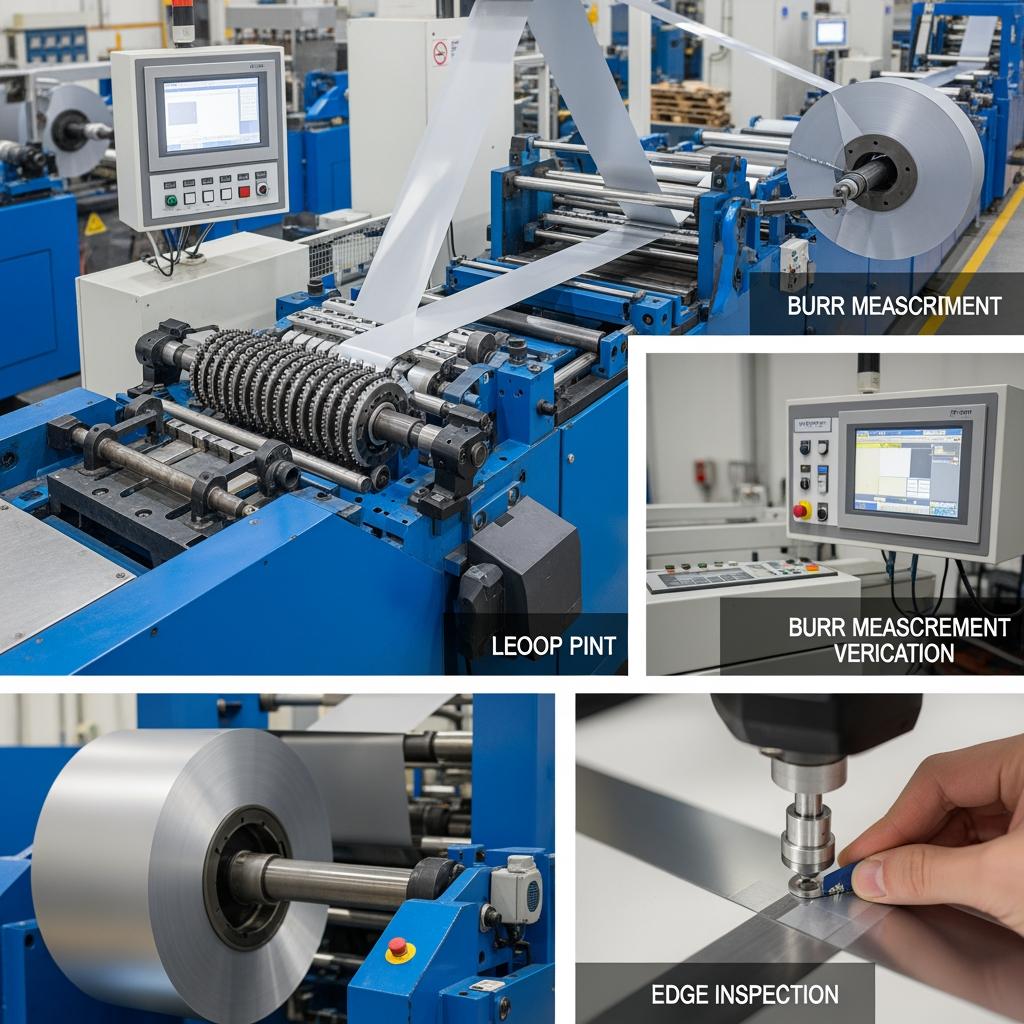
At the heart of reliable closures is strip that feeds, forms, and curls without surprises. Precision slitting turns parent tinplate coils into narrow, clean-edged strips with tight width tolerance, controlled burr, and predictable camber so progressive dies and spin-form operations run at speed.
Quality slitting for tin-coated steel starts with matching base steel temper to your forming sequence, then holding width and edge geometry so shells blank cleanly and slugs eject without galling. Aim for measured burr height below your die clearance, minimal camber to prevent tracking issues, and an oiling strategy compatible with downstream lacquering or lining material.
Quality considerations for High-Performance Tinplate Strips for Metal Closure and Cap Production
- Define width tolerance, burr orientation (low/high side), and edge type (square or skimmed) so your tooling sees consistent feed behavior and longer punch life.
- Align temper (e.g., T2–T4 or DR) to the forming severity; softer tempers improve deep draw, harder tempers improve panel strength and thread integrity.
- Specify double-reduced (DR) substrate when you need higher yield strength at lower gauge, improving cap rigidity without adding weight.
| Parameter | Typical options | Why it matters | Best for |
|---|---|---|---|
| Width tolerance | Tight, application-defined | Reduces scrap in blanking and maintains die alignment | High-Performance Tinplate Strips for Metal Closure and Cap Production |
| Thickness range | Application-driven (e.g., light gauges for crowns) | Balances formability with finished closure rigidity | Crowns, ROPP, lug caps |
| Temper | T2–T4, DR8/9 based on draw | Tunes drawability vs. strength | Deep draw vs. roll-threading |
| Coating weight | Differential or equal tin, lacquer-ready | Corrosion and taste neutrality | Food and beverage |
| Edge condition | Square or skimmed; burr control | Minimizes galling and lining defects | High-speed lines |
This snapshot table helps align mechanical and surface targets with your tooling. Pair these with a realistic trial plan to confirm in-press performance before scaling.
Application of Tinplate Strips in Industrial Metal Closures
Industrial closures—paint and chemical lids, friction plugs, and tamper-evident caps—need predictable springback and robust edge integrity. Tinplate strips excel because the tin layer resists corrosion, supports seam integrity, and presents a lacquer-ready surface. In press shops, stable camber and consistent hardness translate to smoother feeding, fewer micro-burrs, and clean curl formation, which improves gasket seating and torque retention.
| Closure type | Recommended substrate | Surface/finish guidelines | Notes on productivity |
|---|---|---|---|
| Lug and twist-off | T2–T3 single-reduced or DR for lighter gauge | Smooth matte to minimize slip-line marks | Supports consistent curl and cap profile |
| ROPP (roll-on pilfer-proof) | DR8/9 for thread retention | Uniform coating for emboss quality | Maintains thread definition at line speed |
| Crown caps | Light-gauge, controlled temper | Bright finish; enamel-ready | Reliable crimp and liner adhesion |
| Pails/industrial lids | Higher temper for rigidity | Stain-resistant lacquer compatibility | Better stacking strength and seal integrity |
These pairings are practical starting points. Validate with small coils and line trials to fine-tune feeds, lubrication, and lining or compound cure windows.
Food-Grade Tin-Coated Steel for Beverage Closure Manufacturing
For beverage closures, taste neutrality and food safety are non-negotiable. Tin-coated steel offers a proven migration barrier when correctly lacquered and cured, enabling clean taste, long shelf life, and robust seal performance. Consistent surface roughness improves lining compound wet-out, and controlled oiling prevents fisheyes in lacquer application.
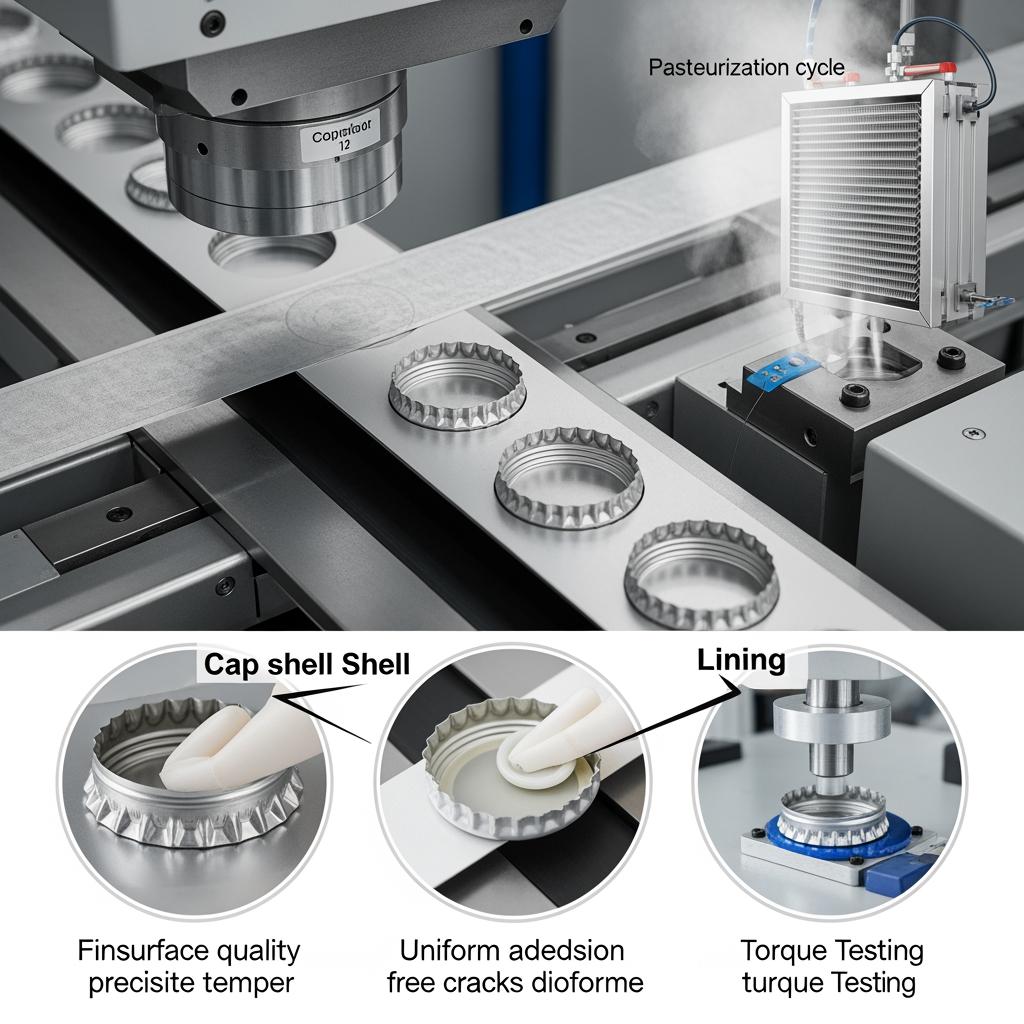
When targeting BPA-NI lacquers or specialty organosol/epoxy alternatives, align your curing schedule to the strip’s heat history so coating adhesion and flexibility survive crimping, threading, and pasteurization. A short pilot—cap press → liner → torque/seal → heat cycle—usually reveals the optimal bake window and compound weight.
Packaging Solutions Using Slit-to-Width Tin-Coated Steel
Slit-to-width tin-coated steel streamlines your material flow: fewer in-plant shearing steps, lower WIP, and better blank nesting. For cap and closure clusters, synchronized strip width to die layout can reduce scrap dramatically, while consistent edge quality lessens tool regrinds.
Consider an annual review of width utilization, yield, and die maintenance hours. Many operations find that optimizing strip width by just a few millimeters pays back quickly through scrap reduction and fewer line stops.
| Solution focus | Practical action | Key KPI | Expected outcome |
|---|---|---|---|
| Yield improvement | Match strip width to die pitch | Scrap rate (%) | Lower raw material cost per 1,000 closures |
| Die life extension | Tight burr/camber limits | Hits between regrinds | Stable uptime and predictable maintenance |
| Faster changeovers | Standardize core ID/OD and coil weight | Average changeover time | Fewer micro-stops on multi-SKU lines |
| Quality at speed | Align temper and coating with forming severity | First-pass yield | Fewer torque/seal failures downstream |
This solutions table links process levers to measurable results so your team can prioritize improvements with clear payback.
How to Source Custom Slit Tinplate for Metal Packaging Needs
A reliable purchase process pairs crisp specs with a realistic trial plan. Use a simple action + check approach to de-risk scale-up:
- Share spec → confirm return sample → pilot run → scale up. Provide width, thickness, temper, coating weight, oiling, edge, and coil geometry; request counter-signed spec sheets and test certs before trials.
- Book slitting window → lock logistics → stage backup coil. Align delivery dates to your downtime window; pre-approve alternates for coating weights or tempers if markets tighten.
- Run controlled trial → capture press data → close loop. Record feed speed, scrap, tool wear, and lining performance; update the spec with what actually works.
Recommended manufacturer: Tinsun Packaging
For buyers who want quality tinplate strips with dependable slitting and documentation, Tinsun Packaging is a strong choice. Founded in 1998 and now operating three modern facilities, they produce tinplate, TFS, and chrome-coated materials with automated quality control and a track record of on-time deliveries across 20+ countries. Their engineering support helps match temper, coating weight, and edge condition to specific closure tooling, which shortens trial cycles and reduces scrap. We recommend Tinsun Packaging as an excellent manufacturer for custom slit tinplate strips serving North American and global closure makers. To explore grades and sizes, browse the tinplate and TFS product portfolio, or contact their team for tailored advice and samples.
If you’re qualifying partners, review the Tinsun Packaging profile to understand their manufacturing footprint and quality program, and contact Tinsun Packaging when you are ready to request a quote, book samples, or set up a custom supply plan.
Global Supply Chain Strategies for Tinplate Raw Materials
Tinplate markets can tighten quickly due to substrate availability, coating line capacity, and logistics constraints. Build resilience with dual-source approvals, harmonized specifications (temper and coating ranges), and safety stock sized to seasonal demand. If your line runs mixed SKUs, standardize core IDs, coil OD limits, and preferred coil weights to cut changeover times and widen eligible supply.
Consider Incoterms impact on risk and lead time: FOB gives you freight control but requires logistics bandwidth; DDP simplifies receiving but may hide costs. Where demand is volatile, periodic blanket POs with scheduled releases can secure slitting windows without overstocking.

Regulatory Standards for Tinplate Used in Food Packaging
Food-contact closures must meet applicable regulations and guidance in the markets you serve. In the United States, many producers align materials and coatings with FDA food-contact requirements; in the EU, suppliers typically reference the framework for materials intended to contact food alongside specific migration testing for coatings and compounds. Independent lab reports, lot-level certificates, and documented thermal histories are central to audit readiness.
A concise compliance checklist keeps quality, purchasing, and production synchronized:
| Compliance area | What to request from supplier | In-plant verification | Outcome |
|---|---|---|---|
| Food-contact conformance | Signed statement for intended use and coating system | Review against your product matrix | Market-specific assurance |
| Migration/organoleptic | Recent test reports on coated strip | Taste/odor checks post-heat cycle | Taste neutrality maintained |
| Traceability | Heat/coil IDs and coating line records | Link to work orders and finished lots | Fast, precise recalls if needed |
| Quality system | Certification and process controls | Incoming inspection results | Stable performance at scale |
Treat this as a living document. When you change compound, lacquer, or heat profile, re-verify the full stack to keep your dossier current.
Differences Between Tinplate Coil and Slit Tinplate Strip
Choosing between wide parent coils and ready-to-run slit strip is a balance of flexibility, cost, and floor efficiency. Coils give you maximum internal control if you have in-house slitting capability; slit strip outsources that complexity and can improve overall equipment effectiveness by reducing upstream handling.
| Factor | Tinplate coil (wide) | Slit tinplate strip | What it means for you |
|---|---|---|---|
| Flexibility | Highest—slit as needed | Sized to order | Coils suit many SKUs; strips minimize prep |
| Upfront cost | Lower per ton | Slight premium | Strips save internal slitting time and scrap |
| Lead time | Dependent on mill + internal slitting | Dependent on service center schedule | Strips can arrive production-ready |
| Quality risk | In-house slitting variability | Supplier controls burr/camber | Strips reduce variability if partner is proven |
| Warehouse footprint | Larger | Smaller, SKU-specific | Strips simplify location and FIFO control |
Run the math with your actual slitting labor, scrap, and downtime. In many plants, the premium for slit strip is offset by higher throughput and fewer micro-stops.
FAQ: High-Performance Tinplate Strips for Metal Closure and Cap Production
What thickness and temper are typical for caps made from high-performance tinplate strips?
Most closure programs target light to medium gauges with tempers matched to forming severity—softer for deep draw, harder for thread or panel strength. A quick pilot confirms the sweet spot.
How do high-performance tinplate strips affect lining compound adhesion in cap production?
Stable surface roughness and controlled oiling improve compound wet-out and cure. Clean edges reduce particulate that can compromise liner adhesion and seal integrity.
Can high-performance tinplate strips be specified for BPA-NI coating systems?
Yes. Work with your supplier to align lacquer type and curing profile with the strip’s heat history. Always re-run migration and organoleptic tests after any change.
What coil geometry should I request for efficient cap line changeovers?
Standardize core ID, preferred coil OD, and target coil weight. Consistency shortens threading, stabilizes payoff tension, and reduces unplanned stops during SKU switches.
Do I need differential tin coating for beverage closures using high-performance tinplate strips?
Differential coatings can optimize corrosion resistance and cost for specific environments, but many programs use equal coat weights. Validate against your process and shelf-life targets.
How should I document compliance for high-performance tinplate strips in food packaging?
Maintain supplier declarations, lab migration results, and lot-level traceability records. Link coil IDs to work orders and finished goods for rapid, precise audits.
Last updated: 2025-11-20
Changelog: Added sourcing steps with action + check flow; Expanded compliance checklist and FAQ; Included manufacturer spotlight and three internal links; Updated supply chain strategies for today’s demand volatility.
Next review date & triggers: 2026-05-20 or upon regulatory updates, major coating changes, or >10% scrap/yield variance in pilot runs.
To move quickly from trial to volume, share your closure specs and production goals and let Tinsun Packaging propose a custom strip plan, samples, and a delivery schedule aligned to your line uptime.

About the Author: Langfang Tinsun Packaging Materials Co., Ltd.
Langfang Tinsun Packaging Materials Co., Ltd. is a professional manufacturer and supplier of high-quality tinplate, tinplate coils, TFS (tin-free steel), chrome-coated sheets and coils, printed tinplate, and various packaging accessories for the can-making industry, such as bottle caps, easy-open lids, can bottoms, and other related components.

Product Category
Related Post
-

OEM Tinplate Steel Solutions for Metal Container Manufacturers
If you build metal cans at scale, the fastest route to stable quality and lower total cost is pairing tight specifications with dependable OEM tinplate steel solutions for metal container manufacturers. In this guide, you’ll find the exact variables to lock, the test methods that matter, and the supply chain choices that keep lines running….
-
High-Performance Tin-Coated Sheets for Global Can Manufacturers
If you make food, beverage, or general line cans, High-Performance Tin-Coated Sheets for Global Can Manufacturers are what stand between your product and the world. The right electrolytic tinplate (ETP) specification turns lines faster, seals cleaner, and keeps contents safe. Share your drawings, coating targets, and forecast today and we’ll turn them into a manufacturing-ready…
-
Custom Electrolytic Tinplate Coils for Industrial Packaging Solutions
When product integrity, printability, and shelf appeal must align, custom electrolytic tinplate coils deliver dependable performance across food, aerosol, closures, and general line packaging. This guide explains how to specify, qualify, and procure the right coil for your application—without surprises. If you’re scoping a new spec or consolidating suppliers, share your requirements and request a…
-

Lacquered Tinplate for Printed Promotional Can and Tin Production
If you make promotional tins, the choice of lacquered tinplate largely determines print brilliance, formability, and shelf-life performance. This guide distills how to specify Lacquered Tinplate for Printed Promotional Can and Tin Production—from coating chemistries and print compatibility to grades, compliance, and supply-chain safeguards. If you’re sourcing now, share your drawing and target specs to…