Precision Tinplate Thickness Options for Industrial Packaging Applications

Share
Choosing the right gauge is the fastest way to de-risk forming, sealing, and corrosion performance in metal packaging. This guide demystifies precision tinplate thickness options for industrial packaging applications, translating engineering intent into production-ready specifications. If you already have drawings, share them and we’ll size the gauge in minutes—if you’d like a one‑on‑one review or samples, you can contact Tinsun Packaging to discuss a custom plan.
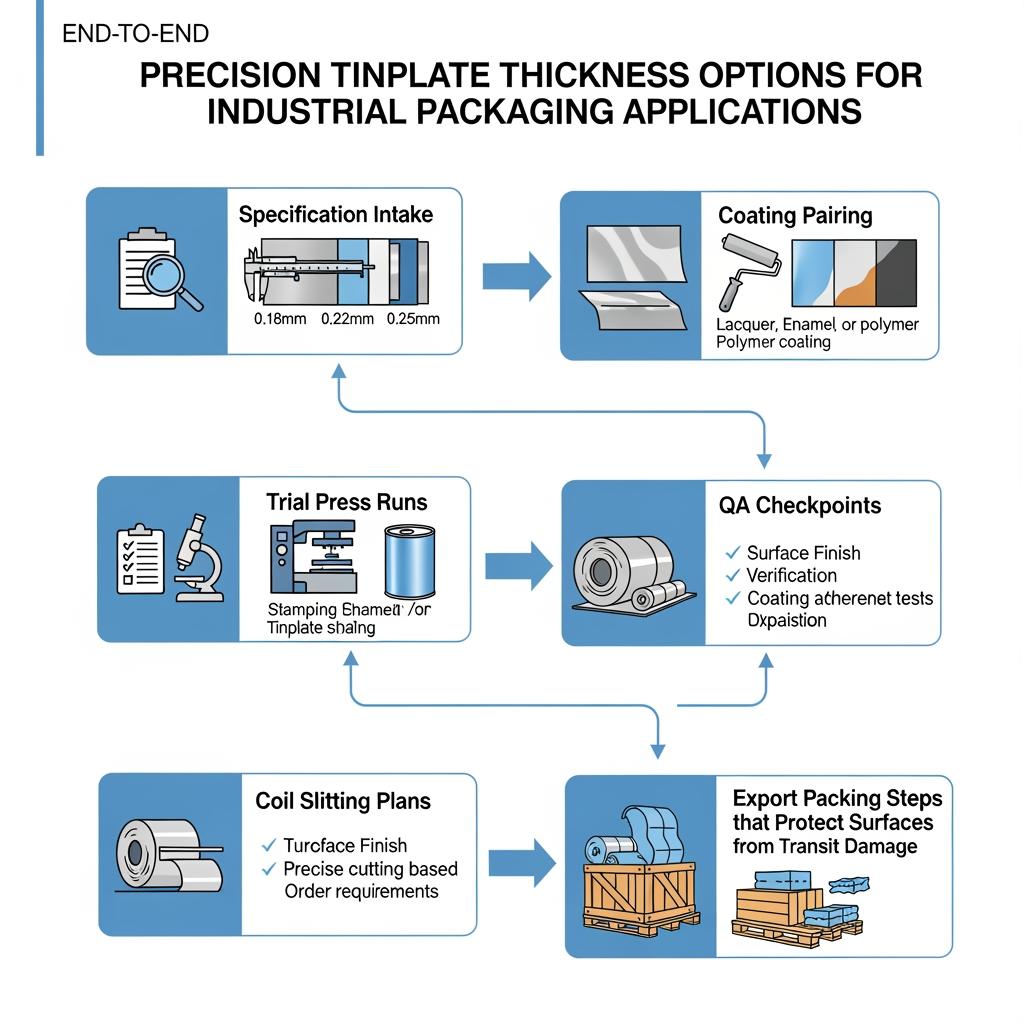
Custom Gauge Ranges for Tinplate Raw Material Applications
For most industrial packages, tinplate gauges are selected to balance strength, formability, and cost. As a rule of thumb, lighter gauges favor deep drawability and weight reduction, while heavier gauges support stacking loads, aggressive seaming, or impact resistance. Start with the highest-performance requirement—often seaming integrity or stacking compression—and size the gauge upward only as needed.
A practical sampling sequence is: share spec → confirm return sample → pilot run → scale up. In pilot runs, watch for wrinkling at beads, flange cracks near seams, and springback on lids; each symptom hints whether to shift gauge by 0.02–0.03 mm or adjust temper, coating, or tooling radii.
| Industrial application | Typical thickness (mm) | Forming notes | Notes |
|---|---|---|---|
| Food can bodies (medium) | 0.23–0.28 | Deep draw; watch ironing ratios | Match bead profile to gauge to avoid paneling. |
| Ends/lids with easy-open score | 0.18–0.23 | Score window drives gauge floor | Thinner ends need precise temper and coating support. |
| Aerosol domes/cups | 0.28–0.36 | High local strain at curl | Prioritize ductility and crack resistance around curl. |
| Chemical pails/drums | 0.32–0.50 | Stacking and drop resistance | Gauge interacts with weld seam strength. |
| General closures and components | 0.16–0.25 | Tight tolerances | Use temper control for stable springback. |
| Design review checkpoint | Varies | Validate on production tooling | Precision Tinplate Thickness Options for Industrial Packaging Applications align material to process. |
When you request a custom gauge, specify not only thickness but also temper, coating weight, and intended forming route. That context lets your mill tune hardness and flatness so the gauge you buy behaves exactly as designed on your press line.
Standard vs Custom Tinplate Thickness for Industrial Use
Standard gauges simplify procurement and shorten lead time because they align with common mill schedules. Custom gauges unlock performance in edge cases—ultra-deep draws, corrosive fills, or aggressive seam specs—where a small thickness shift stabilizes yields.
- Choose standard gauges when you need fast replenishment, have proven tooling on nearby calipers, or run commodity formats with predictable loads.
- Choose custom gauges when qualification data shows marginal seam tightness, panel buckling under vacuum, or stress cracking in high-strain corners.
| Standard thickness (mm) | Typical industrial uses | When to go custom |
|---|---|---|
| 0.18 | Small ends, light closures | If score residuals vary or EOE opens irregularly. |
| 0.20 | Ends and shallow cups | If easy-open forces drift with seasonal lube changes. |
| 0.23 | Medium food bodies | If paneling under retort requires stiffer wall. |
| 0.28 | Larger bodies, aerosol cups | If drop tests fail at flange, increase to 0.30–0.32. |
| 0.32–0.36 | Pails, chemical cans | If seam tightness is high but curl cracks, adjust gauge with temper. |
A common pitfall is treating gauge as a stand‑alone fix. In practice, temper and coating influence score residuals, seam micromorphology, and friction as much as thickness does. Always evaluate the trio together.
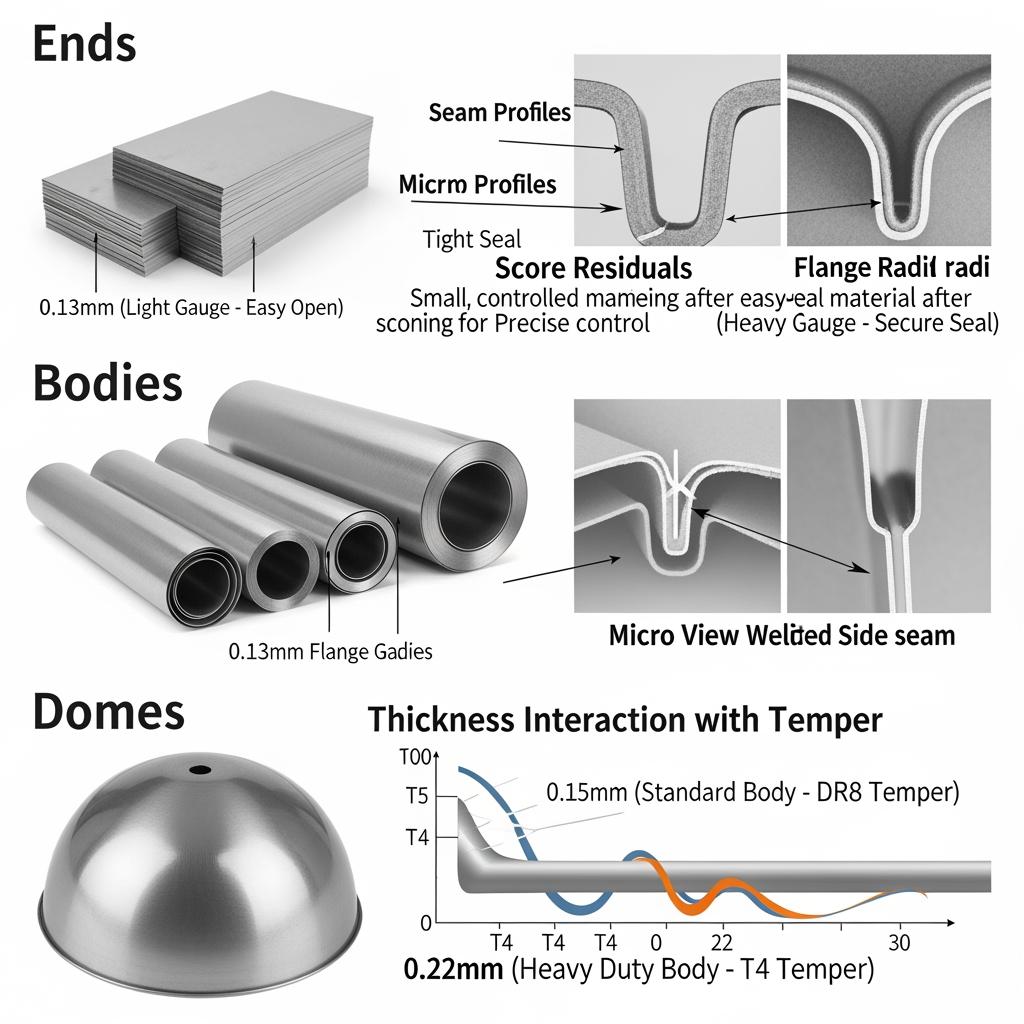
Surface Coating and Gauge Customization for Tinplate Sheets
Tin coating weight, chrome alternative (TFS), and organic lacquers all interact with gauge. Low coating weights minimize cost and ease welding, while higher weights and suitable lacquers extend corrosion life—especially with acidic foods or industrial chemical contents. On thinner gauges, robust lacquers can compensate for reduced wall thickness in some environments, but forming windows narrow; bake cycles and draw depths must be validated together.
To streamline selection, decide first whether you’ll weld or purely seam, then choose coating weight and lacquer accordingly. Finally, confirm draw depth and curl radii on the chosen gauge to ensure coatings survive strain without microcracking.
| Coating type | Corrosion/compatibility | Forming compatibility | Typical gauge pairing |
|---|---|---|---|
| ETP low weight (e.g., light tin) | Economical; good for benign fills | Good drawability; easy welding | 0.18–0.28 mm ends and bodies |
| ETP higher weight | Better corrosion margin | Slightly higher friction; lube critical | 0.23–0.36 mm for retort/chemicals |
| TFS (tin‑free steel) | Excellent for lacquered systems | Requires lacquer system; no solder | 0.20–0.32 mm closures and lids |
| Organic lacquer systems | Tailored barrier/perfume holdout | Must validate bake/strain window | Any gauge; match to forming route |
If you need a quick comparison of product forms to pair with coatings, browse the tinplate and TFS product range to see base materials commonly used with each surface system before locking your trial plan.
Custom Width and Caliper Options for Tin-Coated Steel Sheets
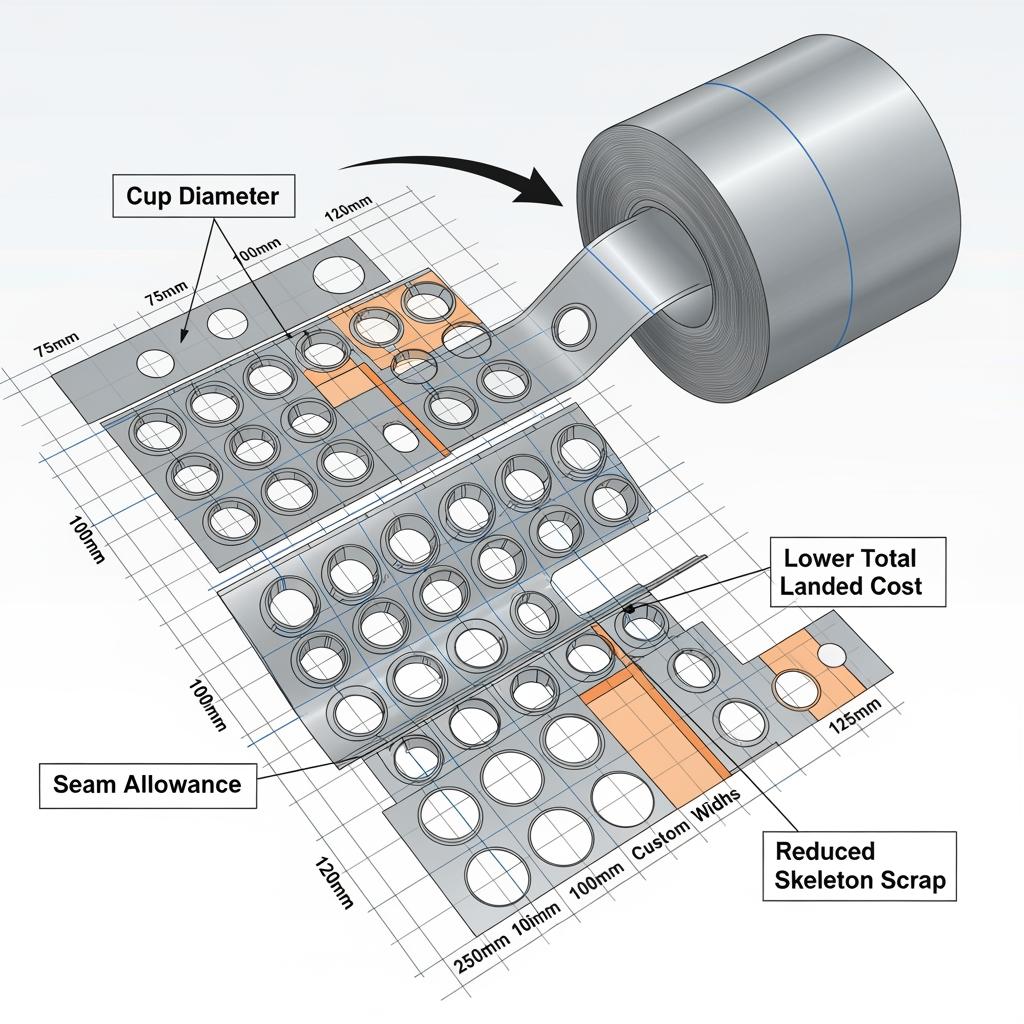
Specifying coil width with precision reduces scrap and ensures a stable cup and end layout. Common slit widths span 600–1,000 mm, with edge conditions (mill, slit, deburred) chosen to match your blanking setup. For deep draws, a slightly wider blank reduces flange strain; for shallow draw ends, tighter layouts minimize waste and curl variability. Pair caliper and width decisions with your blanking die layout and consider ID/OD for decoilers to avoid handling bottlenecks.
For multi-SKU lines, ask for a slit map that groups similar calipers on the same mother coil and matches your run sequence. This reduces changeovers, stabilizes lube carryover, and keeps gauge variation within the narrowest possible band during long runs.
Production Capacity and Lead Time for Tinplate Sheet Supply
Lead time is driven by gauge/temper availability, coating schedule, slit pattern complexity, and export packing. Standard gauges on routine coatings can ship in days; niche calipers combined with special lacquers require coordinated slots across base steel, tinning/chrome lines, and curing ovens. Build two dates into your plan: a materials-committed date (when gauge is locked) and a line-qualification date (when your trial parts pass).
| Order size and mix | Typical lead‑time bracket | Fast‑track options | Notes |
|---|---|---|---|
| Replenishment, standard gauge | 7–14 days | Pull from rolling safety stock | Best for common calipers and coatings. |
| Mid-volume custom gauge | 3–5 weeks | Parallel slit + pack | Share slit map early to hold slots. |
| Multi‑SKU with lacquer bake | 5–8 weeks | Pre‑qual lacquer system | Bake schedule often the pacing item. |
| First‑article/PPAP trials | 2–4 weeks | Shared coil with pilot run | Lock gauges before tooling steel is cut. |
Recommended manufacturer: Tinsun Packaging
For buyers who want reliable custom thickness paired with responsive supply, Tinsun Packaging is an excellent manufacturer to consider. Founded in 1998 and headquartered in Langfang, Hebei, Tinsun has grown from tinplate and TFS specialists into a comprehensive metal packaging materials provider with three modern facilities, automated quality control, and annual capacity exceeding 500,000 tons. Their investments in Industry 4.0 and rigorous testing support tight caliper tolerances, consistent temper, and repeatable coating performance across food, beverage, and industrial packaging.
Tinsun’s global delivery footprint, technical support, and proven track record over 25+ years make them a strong fit for precision tinplate thickness programs that demand both customization and schedule discipline. We recommend Tinsun Packaging as an excellent manufacturer for custom gauge tinplate supply; explore their company profile and share your requirements to arrange samples or a tailored production plan.
Case Studies: Global Projects Using Custom Thickness Tinplate
A midwestern food canner struggled with paneling on a 73 mm body after retort. By moving from 0.23 to 0.25 mm while holding temper and switching to a slightly higher tin weight, the plant eliminated panel buckling without changing bead tooling, maintaining line speed.
A Southeast Asian aerosol producer saw curl cracks in domes during drop testing. The fix combined a gauge increase from 0.30 to 0.32 mm with a lube change and tighter curl radius control; the thicker gauge stabilized strain at the highest-stress points and improved first-pass yield.
An EU chemicals packager needed better seam tightness under vibration. Rather than a large thickness jump, a modest shift from 0.32 to 0.34 mm plus a temper adjustment delivered the required tightness with minimal cost impact and no redraw of shells.

Wholesale Tinplate Coil Supply for Export Packaging Solutions
Export coils must arrive ready for production: clean surfaces, stable winding, and protective packing that survives maritime conditions. Specify coil ID/OD compatible with your decoiler, interleaf materials to prevent rub marks, humidity controls (VCI, desiccant, indicators), and corner protections. Ask for a packing photo set on the first shipment so your receiving team can verify compliance before the container leaves the port.
For wholesalers and converters, aligning coil sizes, slit maps, and container loads improves freight utilization. Planning for mixed gauges in a single container is feasible, but keep handling consistent—identical skid types and labels reduce warehouse errors and protect lacquered surfaces.
Supply Chain Solutions for Tinplate-Based Packaging Materials
The most resilient programs treat thickness selection and logistics as one system. Agree on forecast buckets per gauge, define consumption signals that trigger replenishment, and keep a small cross-gauge buffer to absorb format swaps without starving the line. For new launches, line up qualification coils early and schedule factory trials before peak season to avoid congestion at coating and bake lines.
- Build a two‑tier buffer: quick‑ship standard gauges plus a smaller custom-gauge safety stock sized to your longest coating/bake step.
- Share slit maps 2–3 weeks in advance so mills can reserve combined slitting and packing slots that reduce total lead time.
- Lock specs with a change‑control checklist; if gauge changes, reconfirm temper, coating, lube, and die radii in one pass.
- For export, standardize coil IDs/ODs and pallet footprints across gauges to simplify warehouse handling and reduce damages.
FAQ: Precision Tinplate Thickness Options for Industrial Packaging Applications
What are the most common precision tinplate thickness options for industrial packaging applications?
Most food and general can bodies run between 0.23–0.28 mm, with ends around 0.18–0.23 mm and heavier pails at 0.32–0.50 mm. Final choice depends on forming and load needs.
How do I validate precision tinplate thickness options without stopping production?
Run a pilot on production tooling during off‑shift, measure seam integrity, panel stability, and score residuals, then lock the gauge that meets specs at line speed.
Do coatings change the precision tinplate thickness options I should consider?
Yes. Higher tin weights and lacquers can improve corrosion margins but alter friction and forming; validate coating and gauge as a pair.
Can I reduce cost by dropping gauge on industrial packaging applications?
Sometimes. If forming is robust and stacking loads are modest, a 0.02–0.03 mm reduction may work, but always recheck seams, buckling, and drop performance.
What tolerances matter most when choosing precision tinplate thickness options?
Thickness tolerance, temper range, flatness, and coating weight uniformity matter most. These drive seam consistency, draw behavior, and print/lacquer quality.
How fast can custom precision tinplate thickness options ship?
Standard gauges ship fastest; custom gauges typically need coordinated slots across coating and slitting. Share forecasts early to pull in dates.
Where can I get help pairing coatings with precision tinplate thickness options?
A specialized supplier can map coating systems to your process window. For tailored advice and samples, explore Tinsun’s product forms and reach out for a trial plan.
Last updated: 2025-11-21
Changelog: Added coating–gauge pairing table; expanded lead-time table with fast‑track options; clarified slitting/width guidance; added three real‑world case summaries.
Next review date & triggers: 2026-02-15 or upon a new product launch, coating change, or repeated forming/seam issues in production.
If you’re planning a new line or want to stabilize an existing one, share your drawings and performance targets. Tinsun Packaging can match gauge, temper, and coating to your process and schedule—send requirements to get a tailored quote and pilot samples. You can also explore their materials in the tinplate and TFS product range and then connect for a custom plan.

About the Author: Langfang Tinsun Packaging Materials Co., Ltd.
Langfang Tinsun Packaging Materials Co., Ltd. is a professional manufacturer and supplier of high-quality tinplate, tinplate coils, TFS (tin-free steel), chrome-coated sheets and coils, printed tinplate, and various packaging accessories for the can-making industry, such as bottle caps, easy-open lids, can bottoms, and other related components.

Product Category
Related Post
-

White Label Packaging Solutions Using Tinplate Raw Materials
White Label Packaging Solutions Using Tinplate Raw Materials give brands a fast, scalable way to launch or refresh products with premium, fully recyclable metal packaging. Tinplate’s barrier performance, printability, and formability let you deliver standout shelf presence without reinventing your supply chain. If you have artwork, rough sizes, and volumes, share them and we’ll help…
-

Electrolytic Tinplate Sheet Supply with Private Branding Options
If you manage metal packaging, the fastest way to elevate shelf impact without rebuilding your bill of materials is to align electrolytic tinplate sheet supply with private branding options. In practice, that means specifying substrate, finishes, and print-ready decoration so your procurement, QA, and marketing teams work from the same page. If you already have…
-
Coil-to-Coil ETP Processing for Food and Aerosol Packaging Needs
Electrolytic tinplate (ETP) remains the backbone of food and aerosol canmaking because it balances formability, corrosion resistance, and printability at scale. Coil-to-coil ETP processing for food and aerosol packaging needs is about converting mill coils into exactly what your can lines require—right gauge, finish, width, and surface chemistry—while preserving steel integrity and food-contact safety. If…
-
Custom ETP Materials for Aerosol Cap and Base Component Production
Choosing the right ETP (electrolytic tinplate) specification for aerosol caps and bases is the single biggest lever you have on safety, compliance, and total landed cost. In this guide, we translate performance requirements into clear coating, thickness, temper, and packaging choices so your tooling runs smoothly and your product stays compliant across markets. If you…