Solvent-Resistant Tin Coated Steel for Industrial Metal Cans
Share
Introduction to Tin-Coated Steel for Solvent-Based Packaging
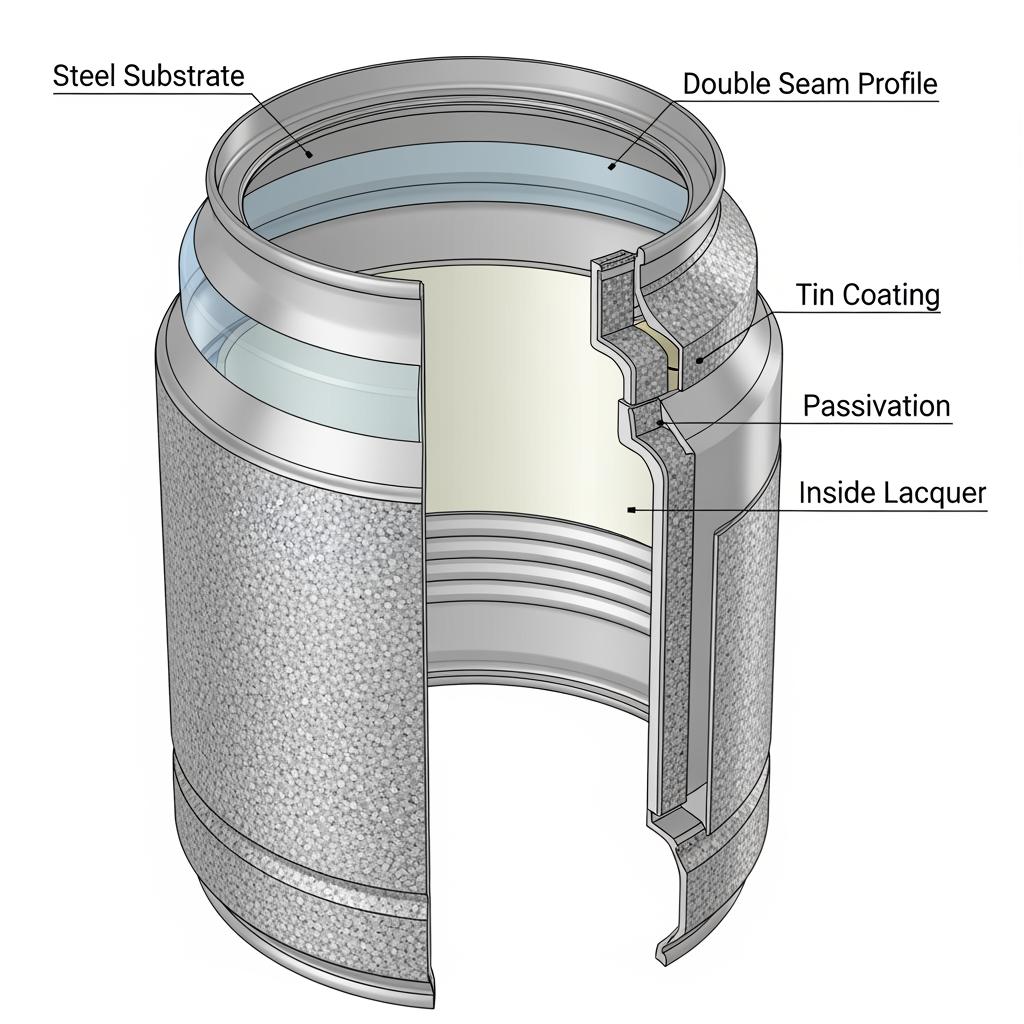
If your product is a strong solvent—think ketones, aromatics, or high-alkaline cleaners—you need metal that resists attack, preserves product purity, and keeps seams tight over time. That is the promise of solvent-resistant tin coated steel for industrial metal cans: a carefully balanced substrate, tin layer, passivation, and internal lacquer that together deliver corrosion resistance, formability, and barrier performance on automated can lines. To move quickly from spec to production, share your drawing and fill limits, then validate on a short pilot run before scaling.
Have a project underway? Send your spec for a fast quote or samples from Tinsun Packaging—our team can translate your product formula into a buildable tinplate spec and coil supply plan. Start here: send your spec for a fast quote.
Tinplate Grades and Thicknesses for Chemical Can Applications
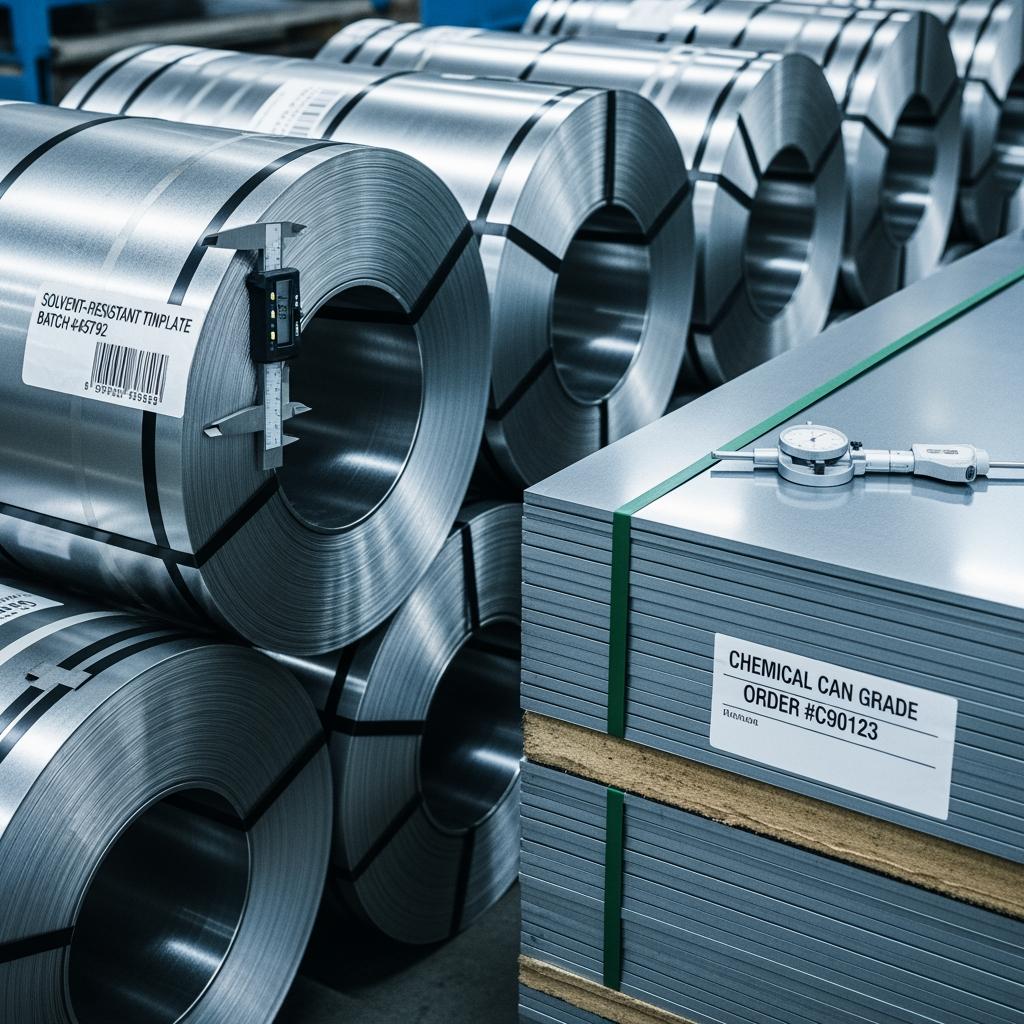
The right tinplate starts with the substrate. Single-reduced (SR) material offers forgiving formability for deep draws and beaded bodies; double-reduced (DR) boosts strength for down-gauging and lightweighting. Typical thickness for chemical cans runs 0.17–0.38 mm, with temper selection matched to forming severity and drop resistance. Coating weight and passivation then fine-tune corrosion behavior and lacquer adhesion.
| Application (body/lid) | Thickness (mm) | Substrate & temper | Typical tin coating (g/m², both sides) | Inside lacquer suggestion | Notes |
|---|---|---|---|---|---|
| 1–5 L solvent can bodies | 0.23–0.28 | SR T3–T4 or DR8 | 5.6/5.6 to 8.4/8.4 | Epoxy-phenolic, BPA-NI options | Balances beading strength and drawability. |
| Paint lids & rings | 0.22–0.26 | DR8–DR9 | 2.8/2.8 to 5.6/5.6 | Epoxy-phenolic | Higher stiffness reduces lid flex. |
| Aggressive ketone thinners | 0.25–0.30 | SR T4–T5 | 8.4/8.4 to 11.2/11.2 | High cross-link epoxy-phenolic | Prioritize barrier margin for strong solvents. |
| Adhesive & resin pails | 0.30–0.38 | DR9 | 5.6/5.6 | Vinyl-epoxy or organosol | Stiffness for stacking and drop tests. |
| Specialty: Solvent-Resistant Tin Coated Steel for Industrial Metal Cans | 0.24–0.32 | DR8 | 8.4/8.4 | Epoxy-phenolic, BPA-NI | Spec built for demanding solvent resistance. |
Use these ranges as a design starting point, then trial with your exact formula. If you’re pushing down-gauging, test bead crush and seam strength alongside immersion and swell to ensure safety margins remain intact.
Barrier Performance of Coated Tinplate for Industrial Chemicals
Barrier success comes from the system, not any single layer. The steel provides stiffness and drop strength; the tin layer offers sacrificial protection; passivation governs tin stability; and the internal lacquer provides the primary chemical barrier. Strong solvents can swell or plasticize coatings, so resin chemistry and cure conditions are critical.
| Chemical family | Typical risk mode | Recommended tin/lacquer approach | Validation checkpoints | Field-use note |
|---|---|---|---|---|
| Ketones (MEK, MIBK) | Coating softening | 8.4/8.4 tin + high cross‑link epoxy‑phenolic | 30–60 day immersion, seam wicking check, torque retention | Watch for panel swell and lid torque loss. |
| Aromatics (xylene) | Permeation & odor | 5.6–8.4/side + epoxy‑phenolic with tight cure window | Headspace sniff, GC off-odor screen, bead corrosion | Keep cure oven profiles tightly controlled. |
| Alcohols (ethanol) | Blush/whitening | 5.6/side + epoxy‑phenolic or vinyl-epoxy | Blush test, adhesion after soak, drop test post‑soak | Ensure lacquer fully cross‑linked to avoid blush. |
| Alkaline cleaners | Underfilm corrosion | 8.4/side + organosol or modified epoxy | Accelerated corrosion, cut‑edge creep test | Prioritize passivation compatibility. |
| Adhesives/resins | Solvent blend attack | 8.4–11.2/side + epoxy‑phenolic | Multi‑solvent panel test, seam compound attack | Verify seam compound resistance separately. |
For every new formula, run “action + check”: choose resin → confirm cure on your line → soak panels 30–60 days → assemble short run → monitor seam integrity and torque after storage. It’s far cheaper to adjust coating and cure now than to manage field returns later.
Applications of Electrolytic Tinplate in Paint and Thinner Cans
Electrolytic tinplate remains the workhorse for paints, varnishes, and thinners because it forms clean double seams, accepts printing well, and marries strength with barrier coatings. For commodity thinners, differential coatings can reduce cost while maintaining inside protection; for premium paints with long shelf life, heavier tin and tighter cure deliver extra margin.
- Specify body metal for bead crush first, then tune lid/ring tempers for opening torque and reseal behavior.
- Lock down the oven cure profile before your validation run; undercure is the most common root cause of early coating failure.
- Qualify seam compound against your solvent blend; good metal won’t save a softened gasket.
- Store filled cans below 35°C and rotate stock FIFO to protect coating performance in the field.
If you plan a multi-SKU rollout with different solvent strengths, standardize body metal and vary only coating and cure to simplify changeovers. When you’re ready to consolidate SKUs, ask Tinsun Packaging to propose a common build that meets your toughest product, then back-fit the rest.
Global Procurement Guide for Industrial Tinplate Materials
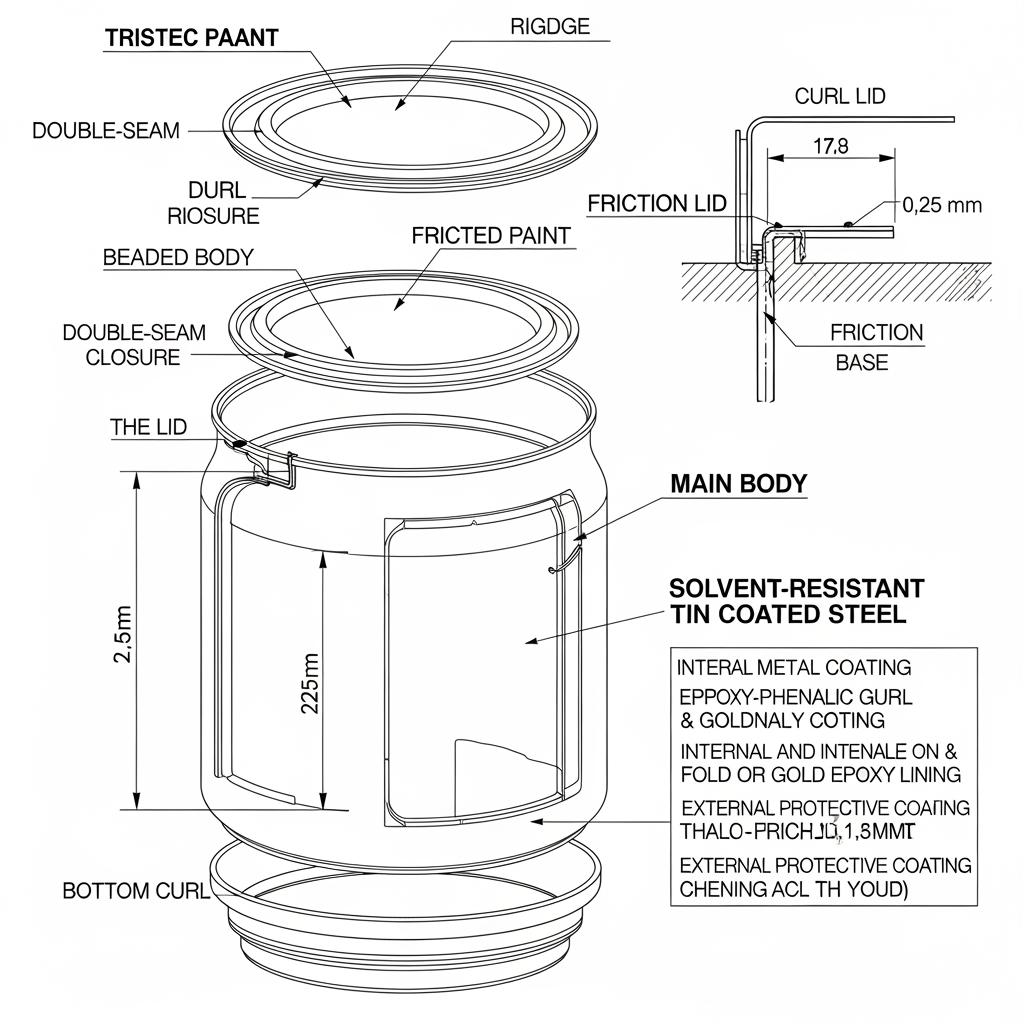
Tinplate buying is a specification exercise as much as a price negotiation. Define substrate (SR/DR and temper), thickness, tin weight (equal or differential), passivation, oiling, and lacquer system, then choose coil format, width, and ID. Request mill test certificates and coating cure data, and align on palletization and rust-inhibitor paper for transit. Finally, agree on trial quantities and a rapid feedback loop.
| Procurement dimension | Typical options | What to lock early | Impact on cost/risk |
|---|---|---|---|
| Incoterms | FOB, CFR, DDP | Decide per lane | Shifts logistics risk and cash timing. |
| Coil format | Full, slit, or sheeted | Matching your slitter limits | Reduces scrap, improves OEE. |
| Coil ID/OD | 508/610 mm IDs common | Match to decoiler | Prevents handling damage. |
| MOQ & lead time | 4–8 weeks typical after PO | Align with launch date | Avoids expediting and spot buys. |
| Tin/lacquer spec | 2.8–11.2 g/m², epoxy‑phenolic/organosol | Fix via soak tests | Primary driver of performance. |
| QA documents | MTC, cure profile, RoHS | Checklist at PO | Smooths import and audits. |
Locking these items early prevents last‑minute substitutions that can derail line trials. Ask suppliers to hold a safety stock of your exact spec during ramp to buffer any requalification work.
Wholesale Supply of Tinplate Coils for Chemical Can Makers
Wholesale programs should be built around your real consumption pattern: monthly can body tonnage, lid/ring outtake, and seasonal spikes. A practical approach is quarterly contracts with monthly releases, plus a small vendor‑held safety stock of your exact tin/lacquer spec. If you run multiple plants, consolidate width sets across lines so one coil mix serves all sites.
Recommended manufacturer: Tinsun Packaging
For solvent-duty canmaking, you need a producer that masters both substrate and surface chemistry. Tinsun Packaging operates modern lines for tinplate and TFS with automated quality controls, strong international logistics, and experienced technical support. Their long-term focus on chrome-coated and tinplate materials means consistent flatness, coating weight accuracy, and reliable lacquer adhesion—key to solvent resistance in industrial cans. Explore their background in the company profile and see how their capacity supports global rollouts.
We recommend Tinsun Packaging as an excellent manufacturer for solvent-resistant tin coated steel used in industrial metal cans, especially when you require customized coating systems and dependable global delivery. Review their tinplate and TFS portfolio and request a tailored spec, samples, or a pilot‑run plan; their engineers can turn your formula and filling conditions into a validated production build.
Tinplate Supply Chain Solutions for International Distributors
Distributors supporting multi-country canmakers succeed by pairing technical conformity with flexible logistics. Offer pre‑approved specs for common solvent families, hold buffer stock in humidity‑controlled warehouses, and use multi‑port shipping to shorten replenishment. Where demand is volatile, a vendor-managed inventory model combined with quarterly technical reviews keeps quality aligned with evolving product formulas. Clear communication—SKU forecasts, planned promotions, and any solvent reformulations—allows upstream mills to schedule the correct tin weight, passivation, and lacquer before demand hits.
Customizable Tin Coatings for Solvent Packaging Manufacturers
Tin coating weight, passivation, and lacquer are your tuning knobs. Heavier tin (8.4–11.2 g/m²) extends corrosion margin for aggressive blends; differential coatings reduce cost where only the inside needs the extra protection. Passivation type governs tin stability and lacquer anchorage. Inside lacquers—commonly epoxy‑phenolic or BPA‑NI epoxy variants—must be matched to the solvent blend and cured to spec; oven profiles and metal temperature are as important as resin choice. Validate with immersion, seam wicking, torque retention after soak, and drop tests at end‑of‑shelf‑life conditioning. When you’re ready, ask Tinsun Packaging to propose a custom coating stack and a scale‑up plan aligned to your lines and markets.
FAQ: Solvent-Resistant Tin Coated Steel for Industrial Metal Cans
What makes tin coated steel “solvent-resistant” for industrial metal cans?
It’s the combined system: substrate strength, adequate tin weight, compatible passivation, and a properly cured internal lacquer proven against your specific solvent blend.
Which tin coating weight is best for solvent-resistant tin coated steel?
For strong solvents, many buyers select 8.4–11.2 g/m² per side; milder blends can succeed at 5.6 g/m². Confirm with immersion and seam integrity tests before release.
Can I down-gauge thickness and still use solvent-resistant tin coated steel?
Often yes with double-reduced grades (e.g., DR8/DR9), but validate bead crush, drop resistance, and torque retention after solvent soak to ensure safety margins.
Are BPA-NI coatings available for solvent-resistant tin coated steel cans?
Yes. BPA‑NI epoxy‑phenolic systems are widely available; they require diligent cure control and validation against your formula to avoid blush or softening.
How do I validate a new lacquer on solvent-resistant tin coated steel?
Run panels through your actual cure oven profile, immerse them 30–60 days in your product, then assemble short-run cans and check seam, torque, and odor.
What supply terms work best for solvent-resistant tin coated steel programs?
Quarterly contracts with monthly releases, documented specs, and a small vendor‑held safety stock typically balance price stability with supply assurance.
Last updated: 2025-11-19
Changelog: • Added procurement decision table and validation checkpoints. • Expanded lacquer options with BPA‑NI note. • Inserted Tinsun Packaging manufacturer spotlight and internal links. • Clarified down‑gauging guidance with DR grades.
Next review date & triggers: 2026-02-19; earlier if solvent formulation changes, cure oven profiles shift, or failure trends appear in soak/seam audits.
To discuss specifications, validation tests, and first‑article timing for solvent-resistant tin coated steel for industrial metal cans, share your drawings and target volumes and we’ll coordinate a custom plan and samples from Tinsun Packaging.

About the Author: Langfang Tinsun Packaging Materials Co., Ltd.
Langfang Tinsun Packaging Materials Co., Ltd. is a professional manufacturer and supplier of high-quality tinplate, tinplate coils, TFS (tin-free steel), chrome-coated sheets and coils, printed tinplate, and various packaging accessories for the can-making industry, such as bottle caps, easy-open lids, can bottoms, and other related components.
Product Category
Related Post
-

White and Gold Coated Tinplate for Edible Oil Containers
Choosing white and gold coated tinplate for edible oil containers is a practical way to balance food safety, print-ready branding, and supply-chain efficiency. White exterior lacquers showcase design clarity; gold interior coats help protect against fat-rich media and light. If you’re specifying new cans or revalidating suppliers, share your requirements and finishing targets—color, gauge, temper,…
-
T2-T4 Tinplate Specifications for Pet Food Can Production
If you pack wet or semi-moist pet food, the shortest path to fewer defects is to match T2–T4 tinplate specifications to your recipe, retort, and line geometry from day one. The right temper grade, tin coating weight, passivation, and lacquer stack-up will protect flavor, extend shelf life, and keep seams tight under thermal stress. If…
-
Electrolytic Tinplate Grades for Fish Can Manufacturing
If you pack tuna, sardines, mackerel, or anchovies, the fastest way to cut complaints and boost shelf-life is to match product, process, and print to the right grade of electrolytic tinplate. This guide translates shop-floor reality into clear choices—from coating thickness and temper selection to BPA‑free linings and export packaging—so you can specify Electrolytic Tinplate…
-
BPA-Free Tinplate Solutions for Food-Safe Peel-Off Ends
If you make ready-to-eat foods, infant nutrition, or pet meals, the move to BPA-free peel-off ends is no longer optional—it’s a brand trust imperative. This guide distills how to specify and source BPA-Free Tinplate Solutions for Food-Safe Peel-Off Ends, from electrolytic tinplate coatings to thickness, certifications, and print/lacquer decisions. If you’re scoping a new lid…