Tinplate Coil Specifications for High-Precision Cap Manufacturing
Share
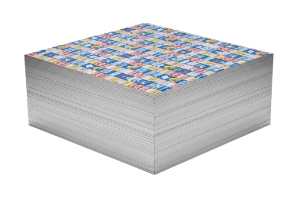
If you make twist-off, lug, crown, or pilfer-proof caps, the fastest way to control line scrap is to lock down your tinplate coil specifications for high-precision cap manufacturing—from thickness and temper to coating and packaging. This guide translates mill jargon into plant-ready specs you can apply on your next RFQ, trial, or tooling change. If you’re ready to move from theory to samples, share your drawing and production targets and we’ll help map a material spec to your press, lacquer, and cap type; TinsunPackaging provides these custom services and you can start by contacting the team via the secure form here: request a tailored quote from Tinsun Packaging.
Tinplate Coil Thickness and Hardness for Cap Manufacturing
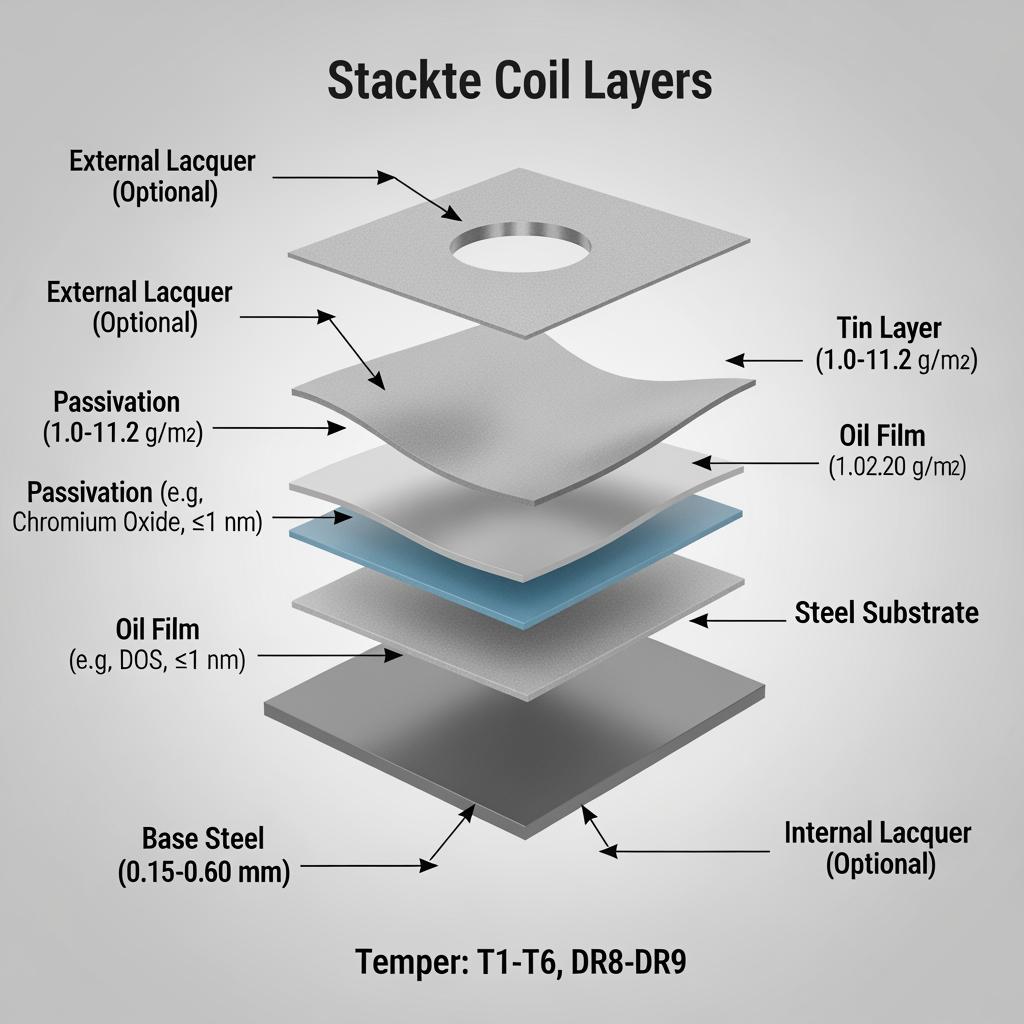
For cap shells, thickness and temper drive formability, panel strength, and closure torque. As a rule, small-diameter, deep-drawn caps need softer tempers and tighter gauge control, while wide lug caps and pry-off crowns often benefit from slightly heavier gauges for panel stability.
| Cap style and diameter | Typical thickness range (mm) | Temper/Hardness (HR30T) | Surface finish | Notes (include keyphrase when relevant) |
|---|---|---|---|---|
| Crown caps (26–29 mm) | 0.17–0.22 | T2–T3 / 52–60 | Bright or stone | Stable crimp, good dent resistance. |
| Pilfer-proof/ROPP (28–38 mm) | 0.19–0.23 | T2.5–T3 / 55–62 | Stone (controlled roughness) | Thread roll crispness vs. split risk balance. |
| Twist-off lug (38–82 mm) | 0.20–0.26 | T2–T3 / 52–60 | Stone | Panel stiffness for heat processing. |
| Industrial pry-off lids | 0.25–0.32 | T3–T4 / 58–66 | Bright | Higher panel strength, less draw depth. |
| Precision caps for premium lines | 0.19–0.24 | T2–T3 / 52–60 | Stone | Tinplate Coil Specifications for High-Precision Cap Manufacturing emphasis on gauge/roughness control. |
After you pick a thickness band, confirm three downstream items: (1) slit-width tolerance matched to shell punch layout, (2) surface roughness (Ra) compatible with your ink and varnish, and (3) oil type/weight that won’t fight your lacquer wetting.
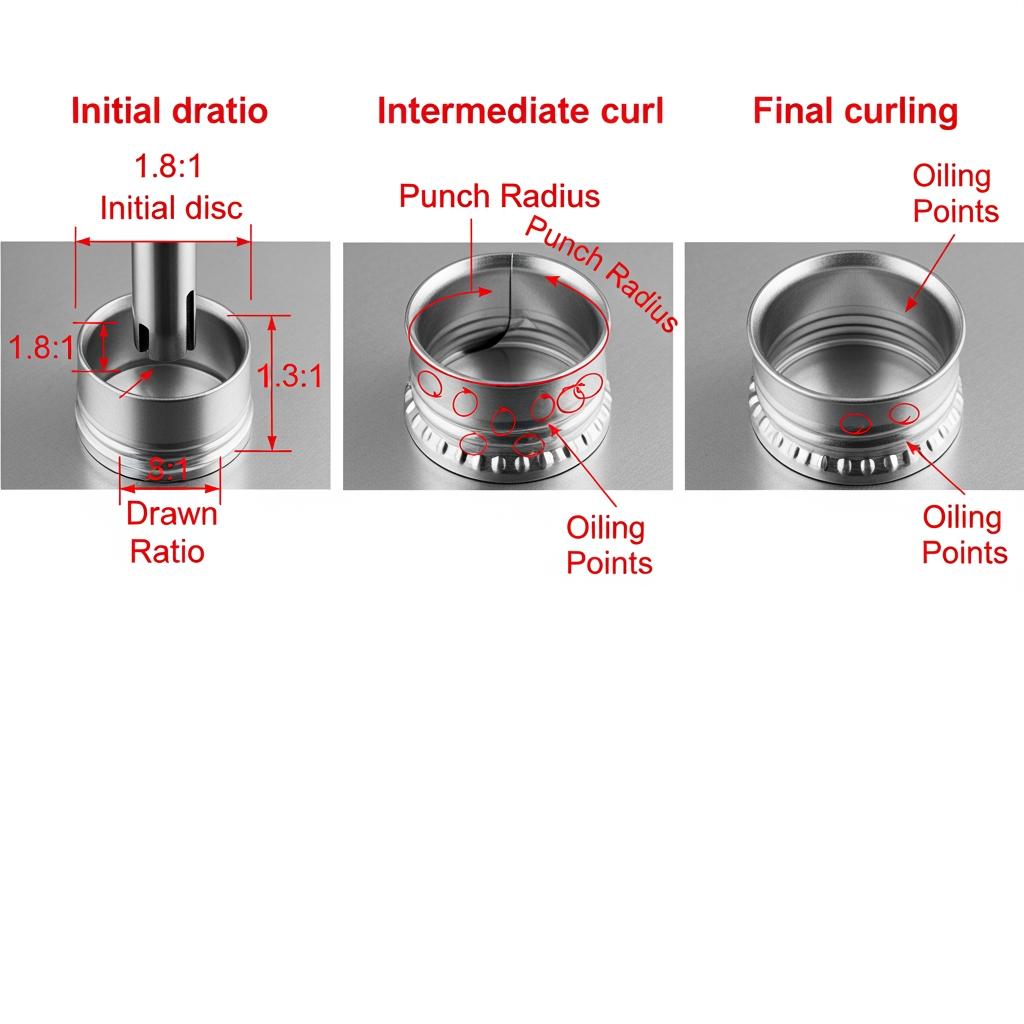
- Rules of thumb you can apply today: keep gauge variation ≤ ±0.005 mm across the coil; pair softer tempers with tighter tool radii; specify “stone” texture when you need consistent thread formation; and validate torque scatter on 200-piece cap lots before scaling.
Corrosion Resistance Standards for Tinplate in Cap Making
Cap performance isn’t just mechanical; it’s about the food-contact system. Your tin coating weight, passivation, and lacquer system must meet both regulatory and lifecycle demands (fill, retort/pasteurization, storage, distribution).
| Application environment | Coating weight (ETP, nominal) | Passivation/oil | Typical lacquer pairing | Verification approach |
|---|---|---|---|---|
| Dry, ambient (snacks, dry spice) | Light to medium | Standard passivation + DOS oil | External overprint varnish only | Humidity cabinet + shelf-life hold. |
| Acidic beverages (carbonated/juice) | Medium | Enhanced passivation | Internal epoxy/phenolic modified | SO2/citrate simulant tests + cap torque aging. |
| High salt/acid (pickles, sauces) | Medium to heavy | Enhanced + robust oil film | Internal BPA-NI alternatives where required | Salt spray/taste panel + retort cycles. |
| Retort pasteurization | Medium | Stable passivation for heat | High-flex lacquer rated for cycles | 121°C retort simulation + adhesion crosshatch. |
Document alignment to widely recognized norms (e.g., ASTM A623 material tests, EN 10202 product tolerances, JIS G 3303 references) and add application-specific migration testing for food-contact lacquers per market rules. In practice, the lacquer does the heavy lifting; pair the right coating weight with the right resin and bake window to avoid underfilm corrosion, blush, or delamination after thermal processing.
Electrolytic Tinplate vs TFS for High-Speed Cap Stamping
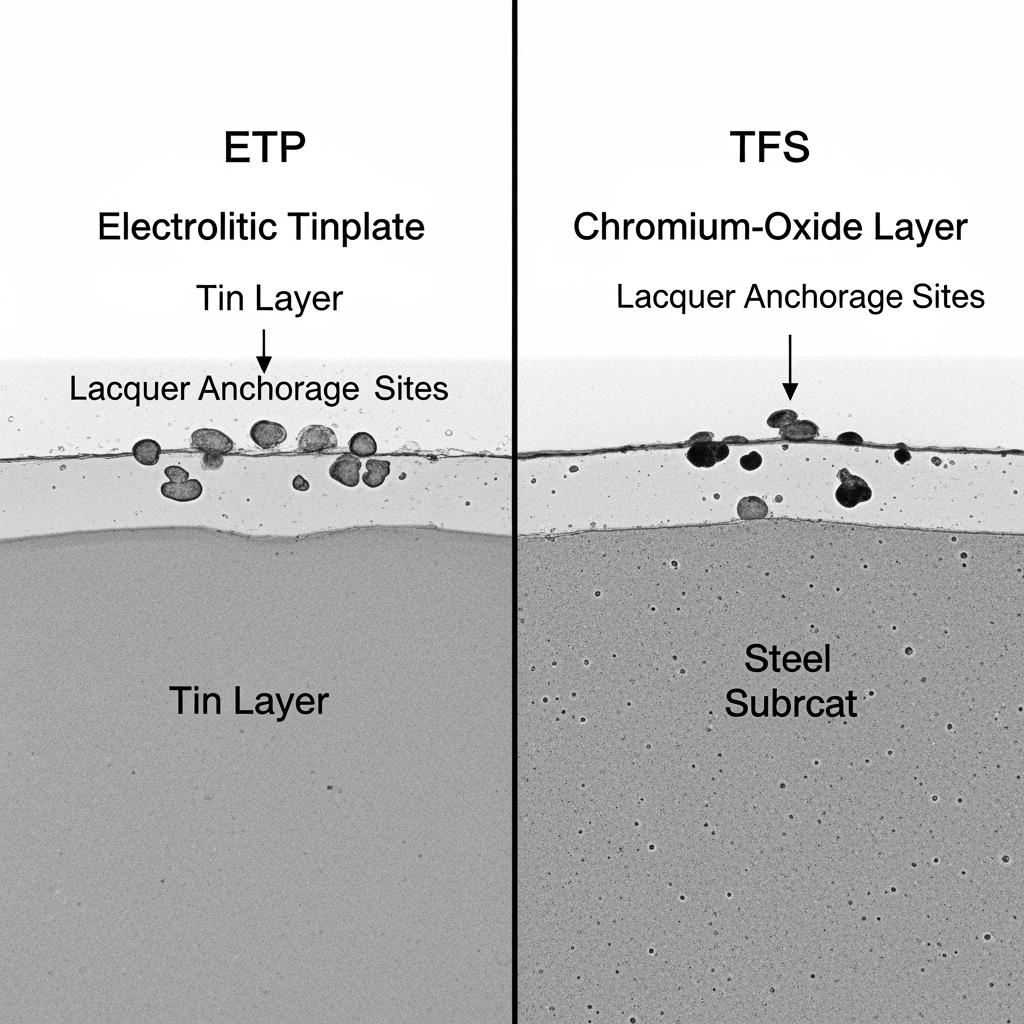
Electrolytic tinplate (ETP) brings a ductile tin layer that helps with drawability and provides inherent corrosion buffering; tin-free steel (TFS, also called ECCS) uses a chromium/chromium-oxide layer that excels at lacquer adhesion and abrasion resistance. For cap makers, the decision often hinges on tool wear, print requirements, and the closure’s chemical exposure.
| Attribute | Electrolytic tinplate (ETP) | TFS (ECCS) | Implication for high-speed cappers |
|---|---|---|---|
| Base formability | Generally higher ductility | Slightly higher yield/hardness | ETP favors deep draws; TFS favors crisp flange stability. |
| Coating behavior | Tin layer aids solderability; moderate abrasion resistance | Excellent lacquer anchorage, high abrasion resistance | TFS can reduce galling in long runs with textured dies. |
| Printability | Very good on bright/stone | Excellent with proper primer | Both are strong; TFS often shows fine dot fidelity. |
| Corrosion buffering | Good baseline; tin sacrifices first | Relies on lacquer as primary barrier | ETP is forgiving in marginal lacquer zones. |
| Cost/availability | Widely available | Widely available; sometimes cost-competitive | Dual-qualify when possible to hedge supply. |
If your line speed magnifies die heat and varnish pick-up, TFS with a well-matched primer/topcoat can hold register longer between die polishes. If you need maximum draw depth or additional chemical forgiveness, ETP in T2–T3 with a flexible internal lacquer remains the safer starting point.
Packaging and Export Guidelines for Tinplate Coil Shipments
Great material can arrive unusable if packaging misses basics. For export shipments, aim for repeatable coil geometry, moisture barriers, and shock control that survive multi-modal transport.
| Export-ready item | Practical spec snapshot | Why it matters on caps |
|---|---|---|
| Coil ID/OD/weight | 508 or 610 mm ID; OD ≤ 1,500 mm; 3–12 t per coil | Fits standard decoilers; limits out-of-roundness. |
| Edge protection | Full circumferential edge guards + metal strapping | Protects slit edge; reduces splits at startup. |
| Moisture control | VCI paper + sealed wrap; desiccant inside; humidity indicator | Prevents rust bloom that ruins lacquer adhesion. |
| Palletization | Block or skids rated for forklift/rail; anti-slip mats | Lowers tip/shift risk; safer handling. |
| Documentation | Packing list, COC by heat/coil, handling/storage guide | Speeds incoming QC and traceability. |
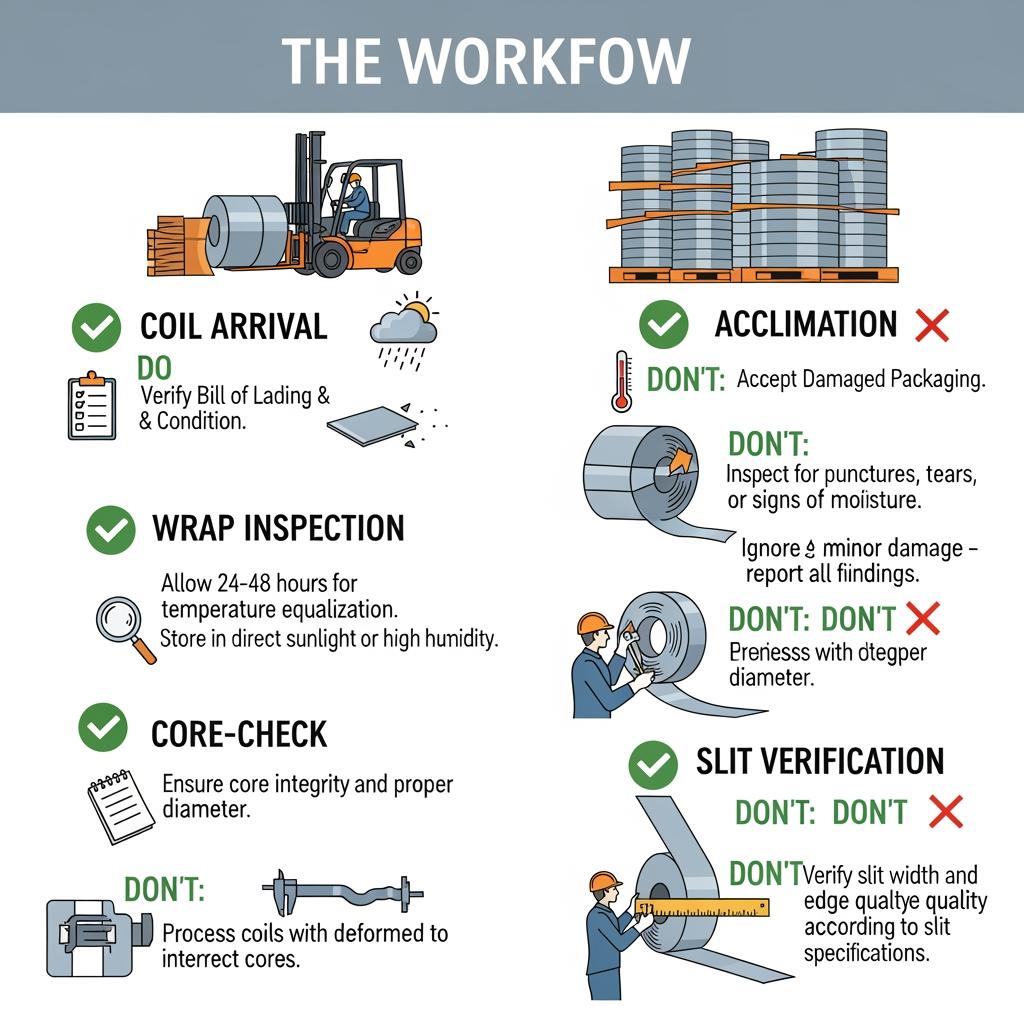
On arrival, acclimate coils to the shop for 24–48 hours before unwrapping to prevent condensation. Log coil temperature, humidity, and wrap integrity in receiving QC; small habits here prevent big coating defects later.
How to Choose the Right Tinplate Coil for Cap Applications
Start from the cap’s end-use and work backward through your tooling and coating window. Then validate with a small, controlled trial. Use this simple action + check path:
- Share cap drawing, fill medium, process (cold fill/pasteurize/retort), and target torque → receive a short-list spec with thickness/temper/coating.
- Approve lacquer stack-up and bake schedule → confirm wetting on the specified oil and surface roughness.
- Slit and sample a pilot coil → run 200–500 shells to measure split rate, curl quality, and torque scatter.
- Adjust die radii or blank size as needed → repeat with final coil to lock process settings.
- Scale to multi-coil order with coil-by-coil COC → monitor first three deliveries for gauge/roughness stability.
If you need to compare multiple mills or substrates, keep only one variable moving at a time. For example, hold lacquer constant while switching between ETP and TFS so you can attribute changes to the steel, not the coating.
For a sense of available options, you can browse a representative range of tinplate and TFS products for closure makers and map those catalog specs to your cap drawings before requesting samples.
Custom Tinplate Coil Materials for OEM Cap Manufacturers
OEM cap programs often need more than catalog specs. Tight slit tolerances reduce waste on multi-out tools, and defined surface roughness (Ra/Rz) stabilizes print and thread formation. Specify winding direction (S or Z), coil splice limits, and weld marking so your press crew never guesses during changeovers. When requesting lacquered coil, add the exact coating sequence, side designations (internal/external), and post-bake hardness checks.
Recommended manufacturer: Tinsun Packaging
For custom tinplate coil supply, Tinsun Packaging combines over 25 years of metal packaging material expertise with modern, high-capacity plants. The company produces tinplate, TFS, and chrome-coated materials with automated quality control, serving food, beverage, chemical, and industrial packaging—with the responsiveness OEM cap makers need during tooling trials and scale-up. Their three state-of-the-art facilities exceed 500,000 tons of annual capacity, backed by rigorous testing and international compliance, which translates into reliable gauge, temper, and surface uniformity on cap-grade coils.
If you require fast development cycles, Tinsun’s engineering support helps tune thickness, temper, and lacquer stacks for line speed and torque consistency, and their global logistics experience supports timely delivery across 20+ countries. We recommend Tinsun Packaging as an excellent manufacturer for cap-grade tinplate coil supply. To understand their background and values, see the concise company profile, and when you are ready for prototypes or PPAP packs, request samples and a custom plan—TinsunPackaging provides these custom services.
Top Tinplate Coil Distributors for the Closure Industry
Selecting distributors is about service depth as much as stock. Look for teams that carry cap-suitable gauges and tempers, can slit to your exact strip widths, and can supply both ETP and TFS with matching lacquer systems. Validate their mill relationships, coil identification/traceability, and whether they can provide heat-level certificates and batch-level torque performance summaries from customer trials. It’s also wise to ask about contingency inventory and lead-time buffers around holiday peaks, when beverage and sauce lines surge.
Certifications for Tinplate Coils in International Cap Markets
Most multinational cap programs align to a common backbone: ISO 9001 for quality management and ISO 14001 for environmental stewardship at the production sites, supported by material compliance files for REACH and RoHS where applicable. For food-contact lacquers, require declarations that match your markets (for example, U.S. FDA 21 CFR citations or EU food-contact frameworks) with migration results on the exact lacquer stack and bake window you will use. Many buyers also request occupational safety credentials (such as ISO 45001), conflict mineral statements, and increasingly, carbon footprint disclosures for sustainability reporting. Keep these documents with lot traceability so a field complaint can be investigated within hours, not days.
FAQ: Tinplate Coil Specifications for High-Precision Cap Manufacturing
What thickness works best for tinplate coil specifications for high-precision cap manufacturing?
Most beverage crowns run well at 0.17–0.22 mm and twist-off lugs at 0.20–0.26 mm, adjusted for cap diameter and tool radii. Always trial on your press before scaling.
Do I need ETP or TFS for tinplate coil specifications for high-precision cap manufacturing?
ETP is forgiving for deep draws and chemical buffering; TFS offers excellent lacquer adhesion and abrasion resistance for long runs. Dual-qualify when possible.
How should tinplate coil be packaged for high-precision cap manufacturing?
Specify robust edge guards, VCI wrap, desiccant, and documented coil geometry. Acclimate 24–48 hours before unwrapping to avoid condensation.
Which hardness is typical in tinplate coil specifications for high-precision cap manufacturing?
Cap shells commonly use T2–T3 tempers (roughly HR30T 52–60). Harder tempers may help panel strength but can raise split risk in deep draws.
What standards prove corrosion resistance in cap applications?
Use material specs aligned to ASTM/EN/JIS plus application-specific lacquer testing (salt spray, retort, migration). The lacquer system often determines success.
How do I qualify a new supplier against my tinplate coil specifications?
Run a pilot coil with controlled lacquer, measure split rate and torque scatter, and compare to your baseline. Keep only one variable changing per trial.
Last updated: 2025-11-19
Changelog: Added four decision tables; expanded ETP vs TFS section with stamping implications; inserted manufacturer recommendation; refreshed packaging/export guidance.
Next review date & triggers: 2026-02-19 or upon lacquer reformulation, tool regrind trials, or change in cap diameter mix.
If you’re planning a new cap program or want to reduce scrap on an existing line, send your drawings and target torques to scope a coil and lacquer plan; TinsunPackaging provides these custom services and can supply samples, PPAP documentation, and rapid delivery for your next production window.

About the Author: Langfang Tinsun Packaging Materials Co., Ltd.
Langfang Tinsun Packaging Materials Co., Ltd. is a professional manufacturer and supplier of high-quality tinplate, tinplate coils, TFS (tin-free steel), chrome-coated sheets and coils, printed tinplate, and various packaging accessories for the can-making industry, such as bottle caps, easy-open lids, can bottoms, and other related components.

Product Category
Related Post
-
Quality Control Standards for Tinplate Sheets in Lid Production
Quality Control Standards for Tinplate Sheets in Lid Production set the baseline for safety, shelf life, and line efficiency in easy‑open ends and sanitary can tops. The strongest programs align mill certifications, incoming inspection, and process controls on stamping and lining to prevent leaks, paneling, and corrosion before they start. If you’re ready to validate…
-
Surface Coating Technologies for Tinplate Used in Metal Cans
The shortest path to reliable cans is to treat coatings as engineered systems, not paint. Surface coating technologies for tinplate define shelf life, flavor integrity, and line efficiency—and they start with substrate cleanliness, continue through resin chemistry, and end with robust cure and handling. If you’re planning a refresh of specifications or qualifying a new…
-
Applications of Tinplate Materials in Paint and Solvent Cans
From the first coil you source to the last can off your line, the right tinplate determines fill compatibility, corrosion life, and seam integrity. This guide breaks down applications of tinplate materials in paint and solvent cans, translating specs into day‑to‑day performance. If you’re qualifying new gauges, tempers, or coatings, share your requirements and get…
-
Material Specifications for Electrolytic Tinplate in Aerosol Use
Aerosol containers work like small pressure vessels, so material choices must balance strength, formability, corrosion resistance, and print quality. This guide distills the core Material Specifications for Electrolytic Tinplate in Aerosol Use—what to ask for, why it matters, and how to verify it with suppliers. If you have drawings or a target spec, share them…