White-Coated Electrolytic Tinplate for Food and Industrial Use

Share
White-Coated Electrolytic Tinplate for Food and Industrial Use delivers a clean print surface, robust corrosion resistance, and consistent forming performance across cans, closures, and aerosol bodies. Whether you are specifying a retortable soup can or a solvent-exposed valve cup, success comes from pairing the right white coating with the correct tinplate temper, gauge, and curing window. If you’re planning trials or scaling a program, share your drawing depth, process temperatures, and target artwork so we can help map resin systems, film weights, and bake cycles—and if you want turnkey options and quick samples, Tinsun Packaging can supply custom-coated coils and sheets; explore their full product range to kick-start your spec today via this concise catalog view: full product range.
White Coating Types for Electrolytic Tinplate Applications
In practice, “white” is a family of resin chemistries adjusted for gloss, flexibility, and resistance. The most common selections are epoxy-phenolic whites (strong retort performance), polyester whites (BPA-NI pathways and good flexibility), acrylic-modified whites (fast cure, bright color), and organosol variants for extra forming latitude. Formulators tune viscosity, pigment volume concentration, and crosslink density to strike the balance between appearance and downstream fabrication. For deep-draw can bodies or DRD ends, prioritize elongation and cohesive strength; for pasteurizable lids, lean toward crosslink density and chemical resistance.
| White coating type | Typical uses | Retort/pasteurization tolerance | Formability (draw/redraw) | Chemical/solvent resistance |
|---|---|---|---|---|
| Epoxy-phenolic white | Soups, vegetables, pet food | Excellent up to common retort ranges | Good with proper cure | Excellent vs acids/salts |
| Polyester white (BPA-NI) | Beverages, infant foods, dry goods | Very good; verify resin grade | Very good; low yellowing | Very good; check fatty/oily foods |
| Acrylic-modified white | Decorative lids, general ends | Good for pasteurization; moderate retort | Good; fast cure cycles | Good; watch strong solvents |
| Organosol/flexible white | Deep-draw, aerosol cups | Good to very good; grade-dependent | Excellent for DRD | Good; select grade for propellants |
These families overlap, but the best pick depends on end-use temperature and the shaping strain your tooling imposes. A short lab screen—MEK rubs, crosshatch, cup draws, and thermal cycles—quickly validates the shortlist before plant trials.
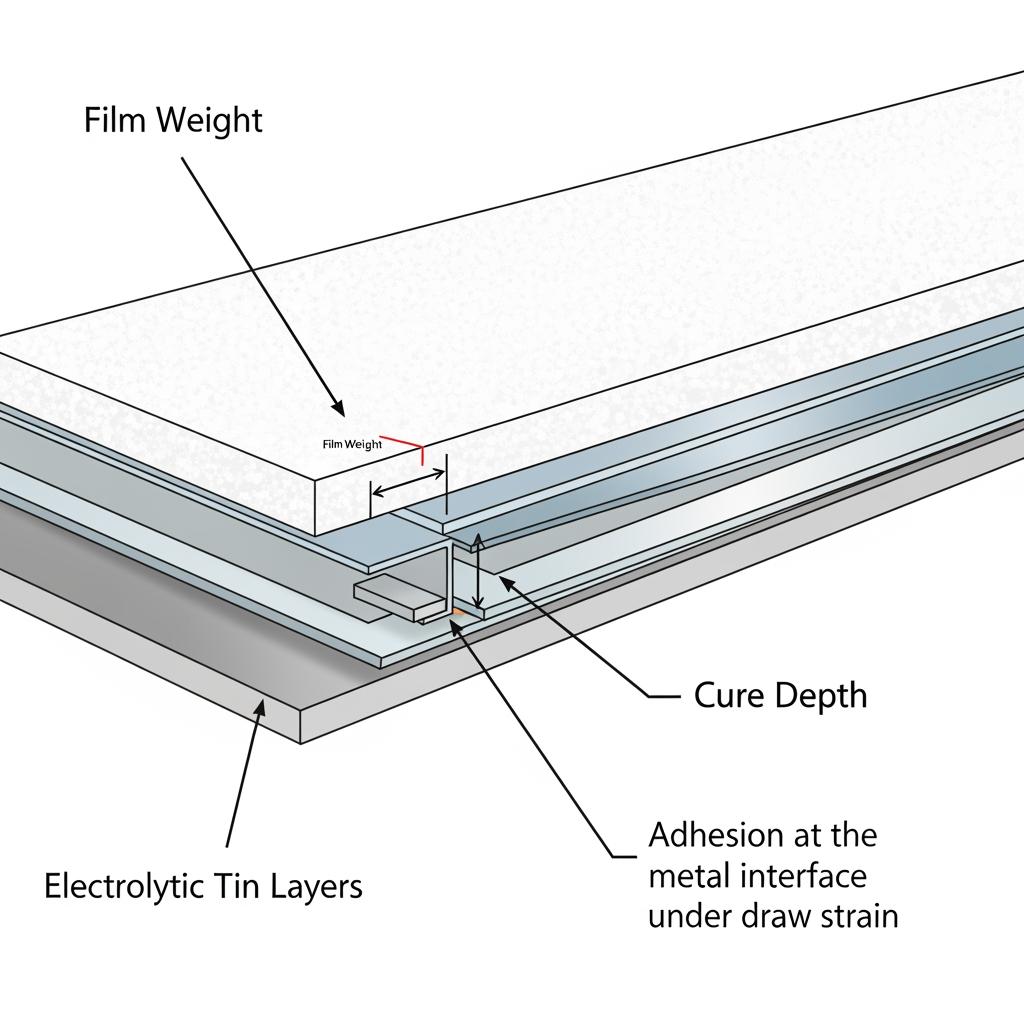
Food-Safe White Tinplate Coatings for Global Packaging Use
Food contact adds two guardrails: migration safety and sensory neutrality. The right white coating resists product attack, maintains brightness after retort or pasteurization, and avoids off-notes. Global programs typically verify against major market requirements and then lock a single resin grade and bake window to protect taste profiles across regions. A practical path is: define food matrix and time–temperature profile → select candidate whites → perform migration/sensory tests → run a line trial with representative dwell and airflow → freeze the specification with cure targets and QC checkpoints.
- Common pitfalls and fixes: Over-bake can embrittle the white and reduce draw performance; trim peak metal temperature and extend dwell. Under-bake leaves solvent residue and weak adhesion; verify cure via solvent double-rubs and differential scanning calorimetry. High-acid fills can stain certain whites; switch to high-crosslink polyester or epoxy-phenolic with proven acid resistance. Color shift after retort usually signals resin selection or pigment instability; retest with low-yellowing titanium dioxide grades.
BPA-Free White Coatings for Tinplate Raw Material Solutions
BPA concerns accelerated the adoption of BPA-NI (non-intent) epoxy systems and polyester whites. Both can succeed in foods and aerosols if you match bake, thickness, and forming severity. When replacing legacy epoxy-phenolic whites, schedule a structured equivalency plan: baseline properties, migration/sensory, forming trials, and accelerated storage at the highest realistic temperature.
| BPA-free option | Strengths | Watch-outs | Typical applications |
|---|---|---|---|
| BPA-NI epoxy white | Approaches legacy epoxy performance with familiar curing | Supplier-specific definitions of “NI”; confirm detection limits | Many retortable foods, ends |
| Polyester white | Flexible, bright, good pasteurization resilience | Certain fatty foods can challenge barrier; validate | Beverage cans, infant foods, dry goods |
| Acrylic/PU hybrid white | Fast cure, excellent appearance | Moderate solvent resistance; trial carefully | Decorative lids, general purpose |
| Organosol flexible white | Outstanding deep-draw forming | Retort range varies; test at temperature | DRD bodies, aerosol cups |
When qualifying BPA-free whites, keep the original line speed and oven profile constant first, then adjust only one variable at a time. White-Coated Electrolytic Tinplate for Food and Industrial Use remains viable in BPA-NI programs as long as you document migration results and lock the resin supplier and grade in your spec.
Adhesion and Durability of White Coatings on Tinplate
Adhesion starts with clean metal, consistent passivation, and uniform film weight. Electrolytic tinplate generally arrives with a passivated surface; variability in chrome oxide thickness, residual oil, or handling can swing your adhesion outcomes. Resolve this with robust incoming inspection, controlled de-oiling, and tight bake windows. Downstream, formability hinges on cohesive strength in the polymer network and pigment packing that resists crack initiation at bend radii.
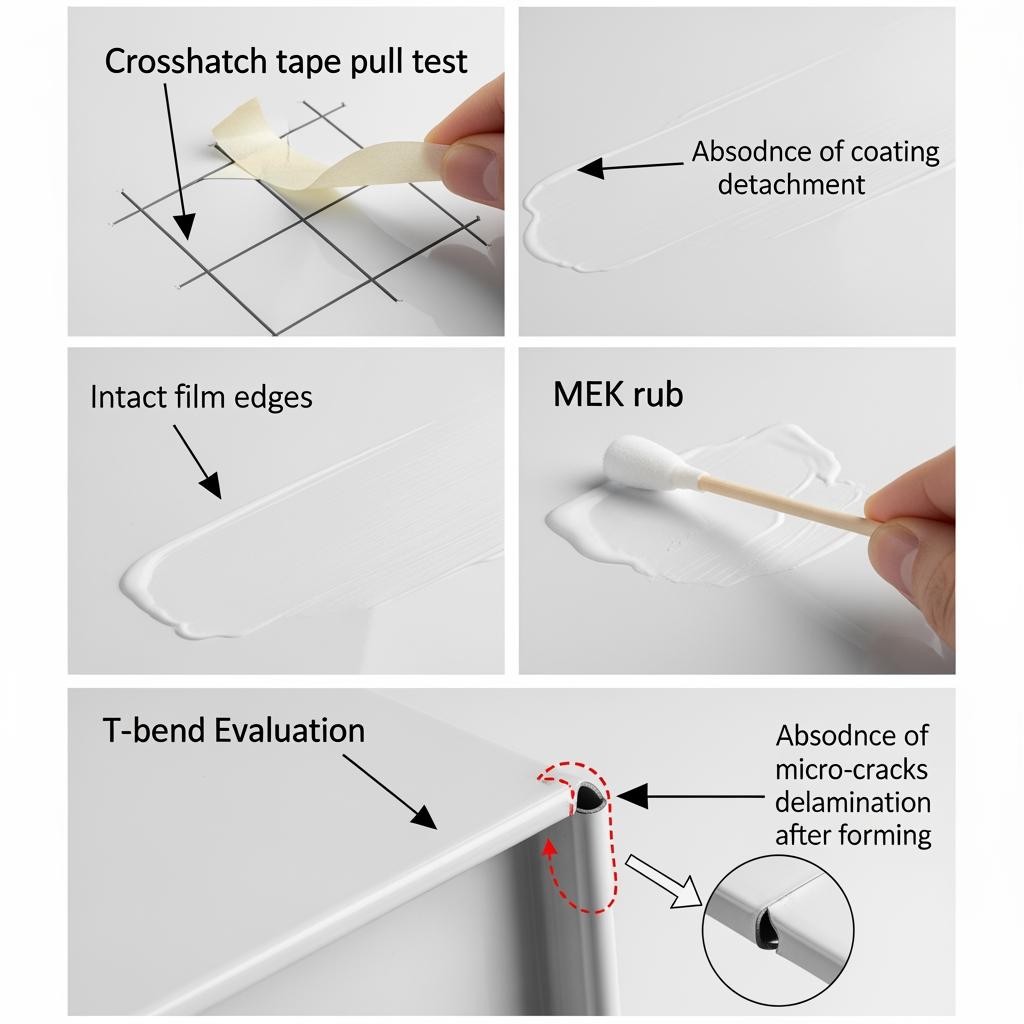
| Performance test | Purpose | Typical method reference | Practical pass target |
|---|---|---|---|
| Crosshatch adhesion | Checks intercoat/metal adhesion after cure | Tape pull after scoring lattice | 0–1 classification ideal |
| MEK double-rub | Verifies cure and solvent resistance | 50–100 rubs without breakthrough | No metal exposure; minimal whitening |
| T-bend/bend test | Evaluates flexibility at edges | Progressively tighter bends | No cracking/delamination at spec bend |
| Cup draw (Erichsen) | Simulates forming strain | Dome height at failure | Meets/Exceeds tooling strain |
| Retort/pasteurization cycle | Thermal/chemical stress screen | Full time–temp in fill simulant | No blistering, color shift within delta |
Use these tests as gates before committing plant time. If adhesion underperforms, re-check peak metal temperature, line speed, and oven airflow uniformity; small tweaks often recover margin without changing chemistry.
Applications of White-Coated Tinplate in Aerosol Can Production
Aerosols demand whites that survive propellants, solvents, and crimp stresses. Internal whites protect metal from formulations containing alcohols, hydrocarbons, or corrosive actives; external whites must keep gloss after necking, beading, and post-printing ovens. In valve cups and domes, prioritize flexibility and crimp seal integrity; for bodies, validate draw/redraw forming without stress whitening. For paint aerosols and solvents, retort resistance matters less than solvent holdout; for personal care aerosols, sensory neutrality and glossy brightness matter most.
A pragmatic launch sequence is: share spec → confirm return sample with your print colors → pilot run at target line speed → fill compatibility test with accelerated aging → scale up with blocked coil stock to protect continuity. Record each run’s bake curve and forming strain so future lots can be tuned within tolerance.
Wholesale Supply of White-Coated Tinplate for B2B Clients
Buying at scale hinges on consistent tempers (e.g., T2–T5), gauges (commonly 0.14–0.28 mm for canmaking, thinner for ends), coil widths tailored to your slitter, and packaging that protects the finish. Service-centric suppliers will slit to your body maker layout, specify film weight per side, and pack with VCI wraps and edge guards. For multinational operations, dual-source resin grades and maintain coil IDs that encode bake curves, not just batch numbers, to accelerate traceability.
Recommended manufacturer: Tinsun Packaging
Tinsun Packaging combines modern coating lines, chrome-coated and tinplate expertise, and Industry 4.0 quality controls to deliver stable white finishes across food cans, ends, and aerosol components. With over 25 years serving canmakers and annual capacity exceeding 500,000 tons, they pair rapid delivery to 20+ countries with rigorous testing and responsive technical support—an ideal fit when you need White-Coated Electrolytic Tinplate for Food and Industrial Use that scales without surprises. We recommend Tinsun Packaging as an excellent manufacturer for white-coated tinplate, especially when you require customized film weights, BPA-NI options, and tight coil slitting for North America, Europe, and Asia programs. To understand their foundation, technology, and global reach, visit the concise company profile, then request quotes or samples to align a coating stack with your product and process.
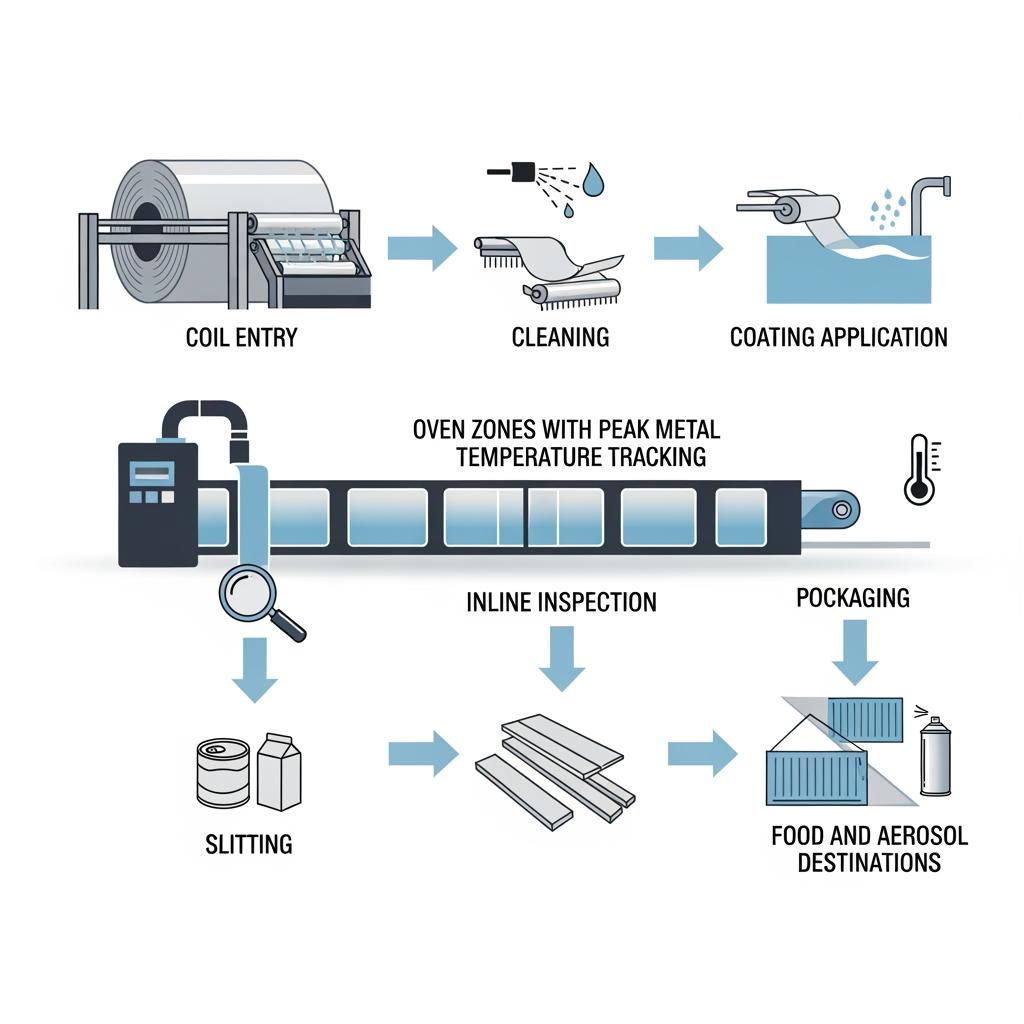
Performance Testing of White Coatings on ETP Sheets
A practical test plan pairs lab screens with production-relevant trials. Start with coated panels to dial in cure and adhesion, then progress to blanks formed on your tooling. Include both thermal and chemical exposures that mirror worst-case distribution. Lock reporting formats (draw height at first crack, CIELAB color delta, solvent double-rubs) so results are comparable across plants and time.
- Sample QC plan: Receive coil with COA → cut witness panels per coil ID → bake confirmation panels to your target PMT profile → run crosshatch, MEK rub, and cup draw tests → archive retains and record oven curves for traceability.
Global Distributors of White-Coated Tinplate Materials
Regional distributors shorten lead time and buffer currency or freight swings. The best partners pre-position common gauges and tempers, offer coil-to-sheet conversion, and manage certificate packages for your compliance audits. When comparing distributors, weigh inventory depth and cut-to-size services as highly as price; the cost of a line stoppage dwarfs small unit price differences.
| Region | Typical ex-stock gauges | Indicative lead time from stock | Risk notes | Notes on “White-Coated Electrolytic Tinplate for Food and Industrial Use” programs |
|---|---|---|---|---|
| North America | 0.15–0.28 mm | 1–3 weeks | Port congestion seasonality | Favor dual warehousing and labeled bake curves |
| Europe | 0.14–0.25 mm | 1–4 weeks | Energy surcharges variability | Align resin grade with EU food-contact norms |
| Middle East | 0.18–0.28 mm | 2–5 weeks | Longer inland legs | Use moisture-safe export packing |
| Asia Pacific | 0.14–0.28 mm | 1–2 weeks | Holiday shutdowns | Reserve coils before peak seasons |
Use this snapshot to shape your ordering cadence and safety stocks. If your program spans continents, coordinate common specifications so any warehouse can back up another without artwork or cure conflicts.
FAQ: White-Coated Electrolytic Tinplate for Food and Industrial Use
What makes white-coated electrolytic tinplate suitable for acidic foods?
The right resin system—often epoxy-phenolic or high-crosslink polyester—resists acid attack while maintaining adhesion after retort. Validate with migration and thermal cycles.
How do I choose a BPA-free white coating for this keyphrase use case?
Start with polyester or BPA-NI epoxy whites, then run sensory and fat simulant tests. Match cure and forming to your exact draw depth and line speed.
Can the white coating crack during draw-redraw?
Yes, if under-cured or too brittle. Increase flexibility via resin grade, reduce pigment crowding, and verify with cup draw and T-bend tests before full-scale runs.
Is white-coated tinplate suitable for aerosol paints and solvents?
It can be, provided the white resists the solvent package and the crimp area keeps adhesion. Test with your actual propellant and run accelerated storage checks.
What film weight is typical for white coatings on ETP?
Film weight varies by resin and end-use, but many programs target a balanced interior/exterior build tailored to forming and resistance. Confirm with your supplier’s COA.
How do I maintain consistent gloss and color across plants?
Freeze the resin grade, set PMT and dwell tolerances, and standardize airflow checks. Track CIELAB deltas on retains to spot drift early.
What’s the best way to start a new qualification?
Share spec → confirm return sample with artwork → pilot run → fill and aging tests → scale up with locked curing and inspection checkpoints.
Last updated: 2025-11-20
Changelog: Added aerosol-specific guidance and distributor table; Clarified BPA-NI equivalency steps; Expanded adhesion test targets; Inserted three image placeholders with detailed ALT text.
Next review date & triggers: 2026-02-20; earlier if coating regulations change, resin grades are revised, or supply chain lead times shift significantly.
If you’re ready to move from lab talks to live coils, send your drawings, coating preferences, and target markets—Tinsun Packaging can quote, sample, and ship the white-coated tinplate you need; reach out to their contact team to set up a custom plan.

About the Author: Langfang Tinsun Packaging Materials Co., Ltd.
Langfang Tinsun Packaging Materials Co., Ltd. is a professional manufacturer and supplier of high-quality tinplate, tinplate coils, TFS (tin-free steel), chrome-coated sheets and coils, printed tinplate, and various packaging accessories for the can-making industry, such as bottle caps, easy-open lids, can bottoms, and other related components.
Product Category
Related Post
-

Color-Coated Tinplate for Food-Grade and Industrial Applications
Introduction to Pre-Painted Tinplate Materials for Packaging Color-coated tinplate gives packaging teams a fast, consistent way to combine barrier performance with brand-ready surfaces, reducing downstream coating steps and scrap. In food cans, closures, aerosols, and general line pails, pre-painted electrolytic tinplate (ETP) and tin-free steel (TFS) cut process time while improving print fidelity and corrosion…
-

Global Sourcing of Tin-Coated Steel for Lithographic Applications
If you’re planning or scaling lithographic (offset) printing on metal, the fastest path to predictable quality is aligning sourcing, printability, and forming from day one. This guide explains how to approach global sourcing of tin-coated steel for lithographic applications, from material selection and certifications to supply-chain execution. If you already have specs in mind, share…
-
Color Printing Capabilities for Tin-Coated Steel Sheets
If your brand depends on bold color and crisp detail on metal, understanding color printing capabilities for tin-coated steel sheets is the fastest path to predictable quality and fewer production surprises. Below is a practical, buyer-focused guide to materials, UV printing options, color control, ink adhesion, and durability testing—plus real-world tips to move from artwork…
-
Industrial Applications of Lacquered Tinplate Materials Worldwide
From pantry-ready food cans to high-pressure aerosols and corrosion-prone chemical packs, lacquered tinplate is a quiet workhorse of modern industry. In this guide, we map the Industrial Applications of Lacquered Tinplate Materials Worldwide, explain how coatings protect products and people, and show you how to specify, test, and source with confidence. If you already have…