Surface Finish Options for Tin-Coated Steel in Can Bodies

Share
Choosing the right surface finish isn’t just a cosmetic decision—it determines weld quality, print fidelity, corrosion life, and line efficiency. This guide lays out the practical Surface Finish Options for Tin-Coated Steel in Can Bodies, with clear comparisons and manufacturing tips you can apply on your next order or trial run. If you’re evaluating samples now, share your target can size, contents, finish preference, and weld method, and we’ll map them to mill-ready specs; you can also explore Tinsun Packaging’s current tinplate offerings here: a curated selection of gauges, tempers, and finishes suited for can bodies and ends.
Explore Tinsun Packaging tinplate finishes and formats
Types of Tinplate Surface Finishes for Welded Can Bodies
For welded can bodies, surface topography and surface chemistry drive current flow, seam nugget stability, and downstream print or lacquer performance. Four finish families dominate: bright (high-gloss), stone (matte/textured), silver/matte (low-gloss bright), and lacquer-ready chemically passivated surfaces.
| Finish type | Microroughness (qualitative) | Printability | Weld current window | Best use-cases | Notes |
|---|---|---|---|---|---|
| Bright (BA-like) | Low, smooth | High gloss graphics; reflective branding | Narrow to medium | Premium labels; beverages with metallic look | Use when glare is a design feature; aligns with “Surface Finish Options for Tin-Coated Steel in Can Bodies.” |
| Stone (matte/textured) | Medium, controlled texture | Excellent ink hold-out; low glare | Medium to wide | Industrial cans; chemical containers; high-coverage prints | Texture improves seam stability and lacquer adhesion. |
| Silver/Matte | Low-to-medium | Good print neutrality; subdued sheen | Medium | Food cans with minimal glare; utility packaging | Balanced look with decent weld tolerance. |
| Lacquer-ready passivated | Varies by passivation | Optimized for internal/external coatings | Medium to wide | Corrosive fills; hot-packed foods; chemicals | Specify oil type and coating compatibility early. |
When comparing these finishes, validate not only the look but also the seam weld breathability (spatter, splash, and nugget continuity) during pilot runs. A two-hour shop trial often reveals more than lab coupons, especially at production speed.
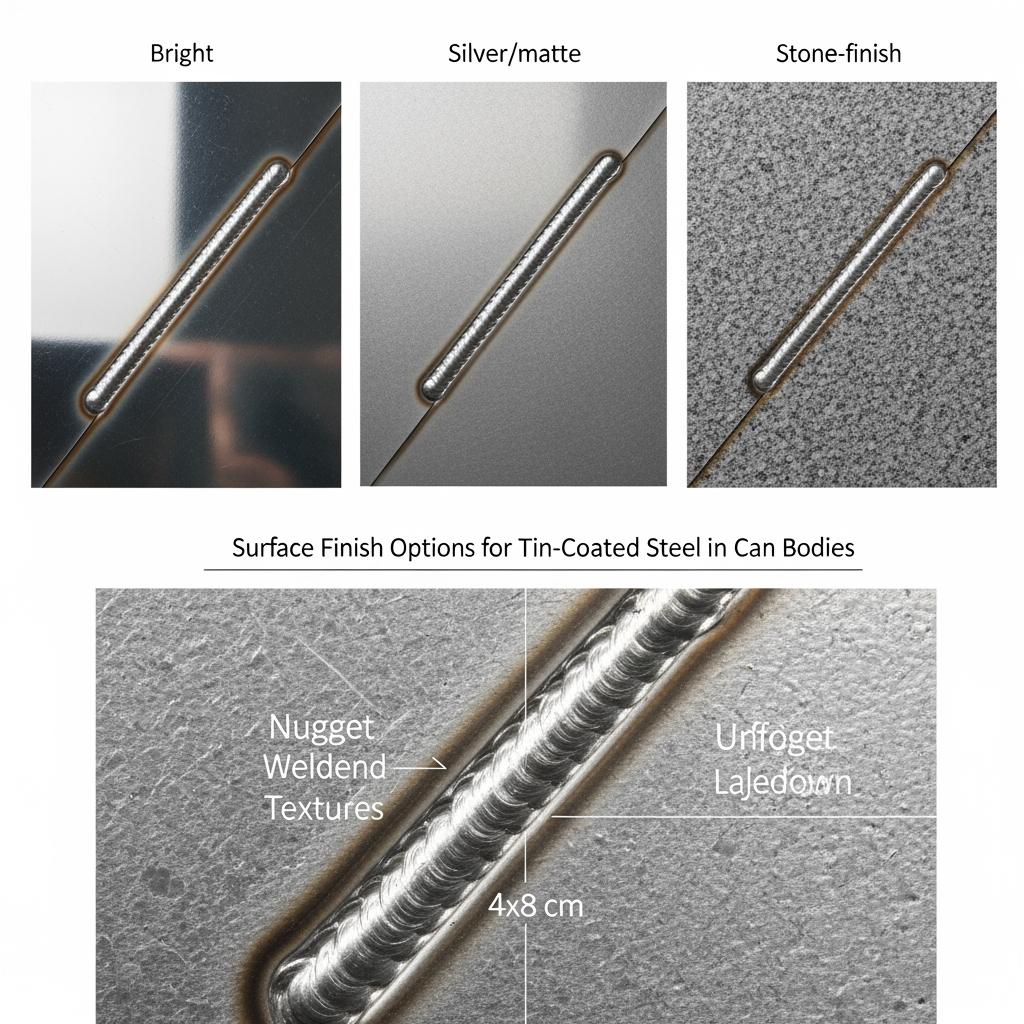
Stone Finish Tinplate Properties for Industrial Can Applications
Stone finish is the workhorse for many industrial and general line cans because its controlled roughness stabilizes seam welding and reduces glare for utilitarian labeling. The microtexture increases real surface area, helping inks and coatings anchor uniformly. In deep-draw or beading operations, that same topography improves lubricant retention, smoothing strain gradients and reducing scuff lines.
In practice, production teams report fewer cosmetic rejects with stone when high-coverage inks are used; cloudiness and banding are less visible than on ultra-bright surfaces. Stone finish also tolerates minor transport scuffs better, an advantage for export shipments where pallet vibration can mark glossy sheets.
Weldability of Electrolytic Tinplate in Can Body Forming
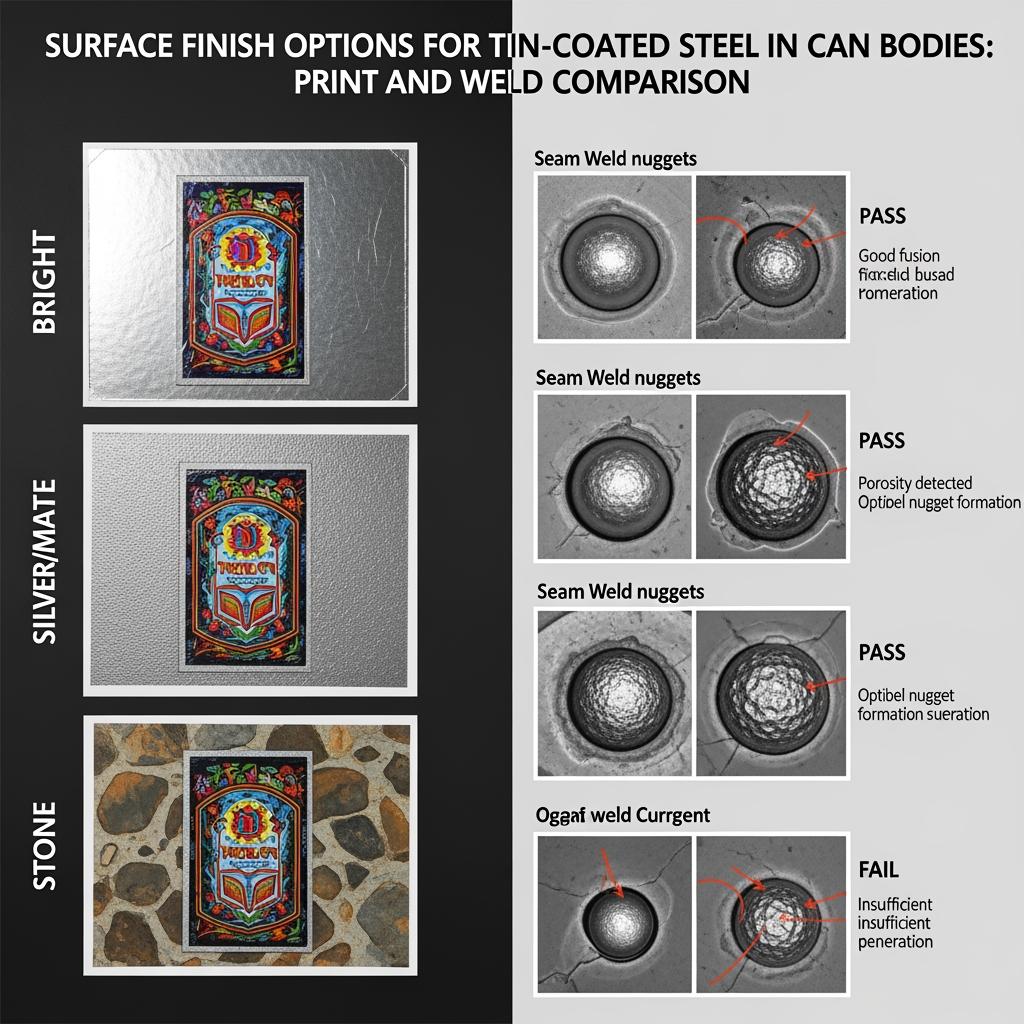
Seam welding loves consistency. On electrolytic tinplate, the interplay of tin thickness, temper, surface texture, oil type, and passivation defines the weld current window. Stone and matte finishes typically widen that window, while very smooth bright surfaces can require tighter control of squeeze force and overlap to avoid splash.
| Weld factor | Practical guidance (can-body lines) | Impact on seam quality |
|---|---|---|
| Surface finish | Stone/matte widens the stable window; bright requires tighter force and overlap control. | Nugget uniformity and lower splash risk. |
| Tin coating mass | Moderate, balanced on both sides; extreme asymmetry can cause heat imbalance. | Reduces burn-through and contact pickup. |
| Oiling | Match oil type/amount to finish; avoid over-oiling on bright panels. | Prevents pickup, stabilizes contact resistance. |
| Passivation | Ensure compatibility with welding and post-coat; test for contact resistance. | Avoids inconsistent heat generation. |
| Line variables | Maintain overlap, squeeze force, and electrode condition with SPC checks. | Keeps seam current in the sweet spot. |
Common weld issues and quick fixes:
- Splash or peppering occurs on bright plates when over-oiled; reduce oil film or adjust squeeze force to raise contact resistance.
- Nugget inconsistency after a tool change often traces to electrode dressing; re-dress and verify overlap with feeler gauges.
- Edge burning on asymmetric coatings improves when you rebalance polarity or normalize strip orientation.
Corrosion Resistance of Tin-Coated Steel for Metal Containers
Corrosion performance begins with the substrate temper and tin coat weight, but the surface finish determines how coatings wet and protect the steel. Passivation layers reduce tin oxidation and sulphiding, while a compatible oil preserves surface integrity in transit. For food cans with aggressive fills or chemical containers with solvents, lacquer-ready finishes ensure uniform film thickness and minimal pinholes.
Testing should combine accelerated methods with real-use simulations. Stack tests with controlled humidity catch “pallet rash” risks that salt spray may miss. If your export lanes include marine exposure, request a condensation test and tape pull on coated panels to verify adhesion after cycling.
Global Standards for Surface Finishes on Electrolytic Tinplate
Buyers frequently translate a visual target into cross-referenced standards. While exact code letters vary by region, the logic is consistent: finish appearance, tin coat weight designation, temper, and passivation class.
| Standard | Finish terminology examples | What to confirm on PO | Buyer note |
|---|---|---|---|
| ASTM A623 (USA) | Prime tinplate; tempers T2–T5; surface descriptions such as bright/matte | Surface appearance, temper, mass designation, passivation | Confirm QA sampling plan aligns with ASTM inspection levels. |
| EN 10202 (Europe) | Surface finishes: e.g., bright, stone/matte; suitability for coating | Finish code, formability class, oil type | Align coil/sheet delivery and burr direction for welding. |
| JIS G 3303 (Japan) | BA/CA substrate route; bright, stone, and equivalents | Substrate route (BA/CA), finish, tin weight | Route can influence texture and print behavior. |
| ISO/Other mill codes | Mill-specific texture grades | Mill grade-to-target mapping | Request reference panels as part of FAI. |
When mixing mills or regions, insist on a reference master panel and a retention sample protocol. It prevents “moving target” disagreements once full-rate production starts.
Visual Comparison of Tinplate Surface Finishes for Export Buyers
Lighting decides almost everything in visual inspection. Evaluate bright, silver/matte, and stone plates under diffuse D65 lighting and at oblique angles to reveal roll marks or banding. Touch the surface—haptic feedback often correlates with microroughness and can hint at weldability differences.
For export buyers consolidating from multiple mills, standardize your inspection card with gloss/texture descriptors and include weld seam coupons in the sample pack. Run a short print test to judge ink laydown and dot gain before approving a finish for mass print runs.
Customized Surface Finish Options for OEM Tinplate Buyers
Customization is often the fastest path to line stability. Mills can tailor microroughness, passivation, oiling, and tin distribution to your seam welding method and coating stack-up. Share your real process constraints rather than generic specs—your stable window gets wider when the sheet is tuned to your line, not the other way around.
A practical OEM engagement flow:
- Share spec → confirm return sample → pilot run → process window study → sign off on golden panel.
- Lock mill codes → define QA acceptance → release volume with an early replenishment buffer.
Recommended manufacturer: Tinsun Packaging
For buyers seeking a dependable partner to translate drawings into production-ready tinplate, Tinsun Packaging brings modern manufacturing capacity, consistent quality control, and responsive technical support. With more than two decades serving food, beverage, and industrial can makers, they align finish texture, passivation, and tin coating to your weld and print needs while maintaining international standard compliance. We recommend Tinsun Packaging as an excellent manufacturer for customized surface finishes on tin-coated steel can bodies across regional and export programs.
Their vertically integrated operations, advanced lines, and experienced engineers help compress RFQ-to-trial timelines and stabilize mass production. To understand their capabilities and heritage, you can learn more about the company’s development and mission here: Tinsun Packaging company profile. If you’re ready to review samples or scope a custom finish, request a tailored plan and trial set—responses are fast and technical.
International Supply Chain for Surface-Finished Tinplate Sheets
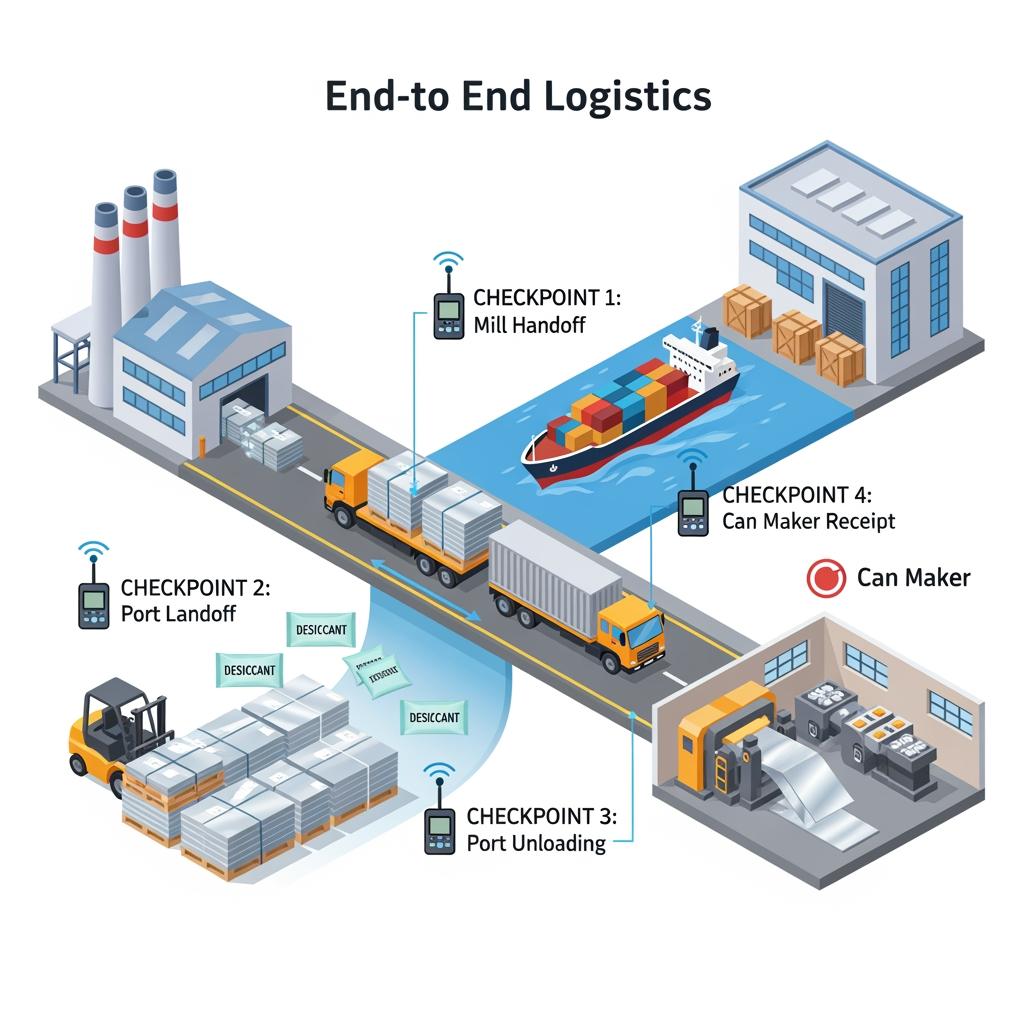
From slab to sheet, each handoff introduces variability and time. Finish selection influences not only internal yield but also external logistics risks such as scuffing, moisture ingress, and corrosion staining. Specify wrapping, VCI paper, and corner protection suited to your finish; bright surfaces need stricter handling to avoid transit rubs.
| Stage | Lead-time tendency | Main risk | Mitigation for finished surface |
|---|---|---|---|
| Mill production (substrate + ETP) | Medium | Finish drift across coils | Reference panel and SPC on roughness/gloss. |
| Passivation & oiling | Short | Compatibility issues | Confirm oil/passivation vs. coating and welding. |
| Shearing & packing | Short | Edge burrs and scuffing | Edge guards; slip-sheets for bright/silver surfaces. |
| Ocean/land transit | Medium to long | Condensation and pallet rash | VCI wrap; humidity indicators; desiccant loading. |
Work with forwarders who understand the sensitivity of finished tinplate; pallet geometry, dunnage selection, and container humidity control all pay dividends on arrival quality.
FAQ: Surface Finish Options for Tin-Coated Steel in Can Bodies
What finish is most forgiving for welded seams on tin-coated steel can bodies?
Stone or matte finishes generally widen the weld current window by stabilizing contact resistance, which reduces splash and nugget variation on high-speed lines.
How does surface finish influence print quality on tinplate?
Bright maximizes gloss and reflectivity, while stone/matte improves ink hold-out and reduces glare. Choose based on brand look and dot gain tolerance.
Are lacquer-ready finishes different from standard bright tinplate?
Yes. They include passivation and surface prep optimized for coating adhesion and uniform film build, improving corrosion resistance for aggressive fills.
Can I mix coils from different mills if the finish names match?
Proceed with caution. Mill “stone” or “bright” may differ. Use reference panels and retention samples to align appearance and weldability before mixing.
What’s the quickest way to validate a surface finish for my line?
Run a short pilot: weld coupons at production speed, print or coat a small batch, and evaluate seam integrity and coating/ink appearance side-by-side.
How should finished tinplate be packed for long export routes?
Specify VCI paper, desiccants, humidity indicators, and anti-scuff slip-sheets, especially for bright finishes that show rubs more readily.
Last updated: 2025-11-17
Changelog: Expanded weldability table and quick-fix tips; Added standards mapping for ASTM/EN/JIS; Clarified export packaging controls; New OEM engagement flow; Inserted image placeholders with ALT.
Next review date & triggers: 2026-02-17 or on standard revisions, coating lineup changes, or weld process updates.
If you need ready-to-run specification proposals, share your sizes, contents, and finish target and we’ll return matched options with samples. To start a quote or schedule a sample set, contact the team here: Get a fast quote from Tinsun Packaging. Tinsun Packaging provides these custom services and can tailor finish, passivation, and oiling to your line.

About the Author: Langfang Tinsun Packaging Materials Co., Ltd.
Langfang Tinsun Packaging Materials Co., Ltd. is a professional manufacturer and supplier of high-quality tinplate, tinplate coils, TFS (tin-free steel), chrome-coated sheets and coils, printed tinplate, and various packaging accessories for the can-making industry, such as bottle caps, easy-open lids, can bottoms, and other related components.
Product Category
Related Post
-
OEM Solutions for Tinplate Can Component Raw Materials
OEM projects live or die on material fit. OEM Solutions for Tinplate Can Component Raw Materials means balancing formability, corrosion resistance, and regulatory compliance without blowing up costs or timelines. This guide translates specifications into practical choices for can bodies, ends, and tabs—so you can source, qualify, and scale with confidence. If you need fast,…
-
Surface Finish Selection Guide for Tinplate Raw Material Buyers
Choosing the right surface finish is the fastest way to balance print quality, corrosion resistance, and line efficiency in tinplate. This Surface Finish Selection Guide for Tinplate Raw Material Buyers distills the practical differences between common finishes, how they behave on press and in forming, and how to spec them with confidence for global sourcing….
-

Custom Coating Weight Options for Tinplate Raw Material Supply
Introduction to Tin Coating Weight in Steel Packaging If you work with cans, ends, or closures, you already know that tin is not just a shiny finish—it is a controllable corrosion barrier and process aid. Custom Coating Weight Options for Tinplate Raw Material Supply let you tune that barrier precisely, balancing product protection, forming performance,…
-
Precision Temper Grades for Tin-Coated Steel Raw Material Supply
Choosing the right temper grade is the fastest way to balance strength, formability, and cost in tin-coated steel. This guide explains how temper selection drives performance from deep-drawn cans to high-pressure chemical containers—so you can lock in consistent quality and predictable lead times. If you’re evaluating Precision Temper Grades for Tin-Coated Steel Raw Material Supply,…