Corrosion-Resistant Tinplate Coils for Beverage Crown Closures
Share
For crown cap makers, the fastest route to fewer rejects and a longer shelf life is choosing the right corrosion-resistant tinplate coils for beverage crown closures, then pairing them with a fit-for-purpose lacquer system and a disciplined QA plan. If you already have specs or drawings, share them and we’ll translate them into a coating stack-up and coil supply plan—Tinsun Packaging can provide custom lamination, lacquering, and slitting to your exact closure line needs. To move quickly, you can request a quote or samples and include your target temper, thickness, and coating type.
Introduction to Tinplate Materials for Crown Cap Production
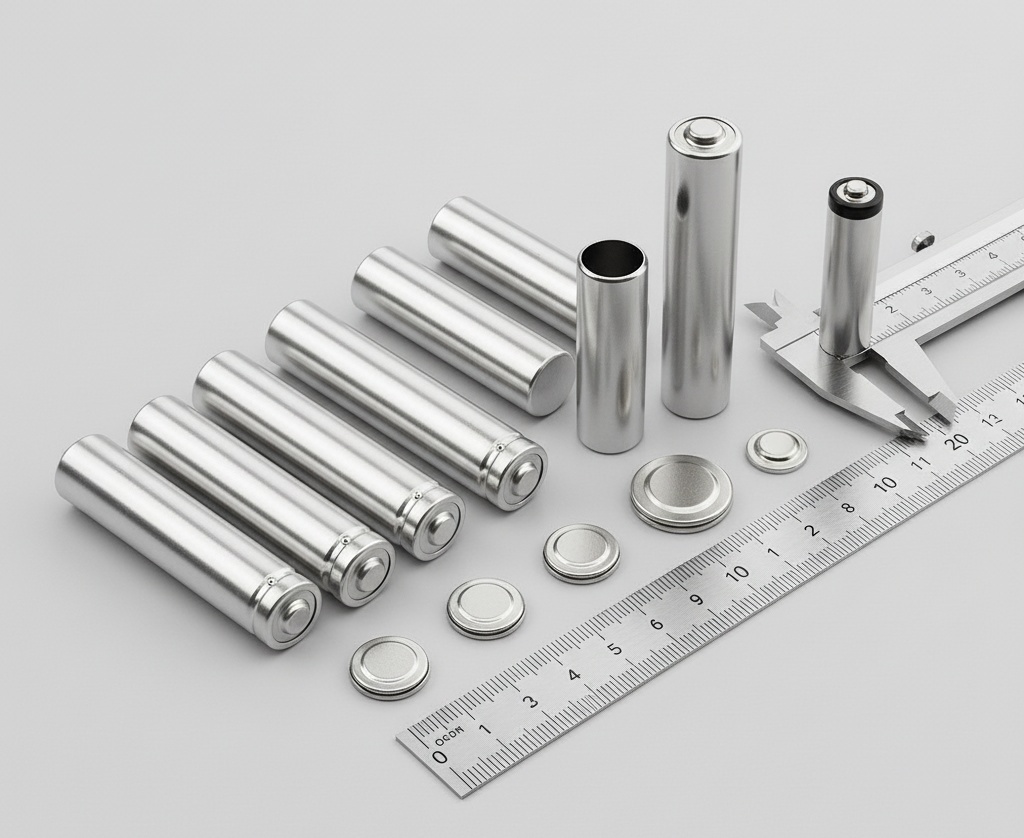
Beverage crown closures are deceptively simple: a thin steel core plated with tin, optionally passivated and oiled, then lacquered and printed before the sealing compound is applied. The substrate choice comes first. Single-reduced (SR) grades favor easy formability for crimping and tight beading, while double-reduced (DR) grades deliver higher strength at lower thickness for weight savings. Crown caps also benefit from consistent surface roughness to hold coatings evenly and a clean, stable chrome passivation to anchor lacquers. For corrosive beverages or humid distribution routes, a robust lacquer on the external panel and a food-contact-safe internal lacquer are essential.
Lacquered Tinplate Coil Options for Beverage Cap Applications
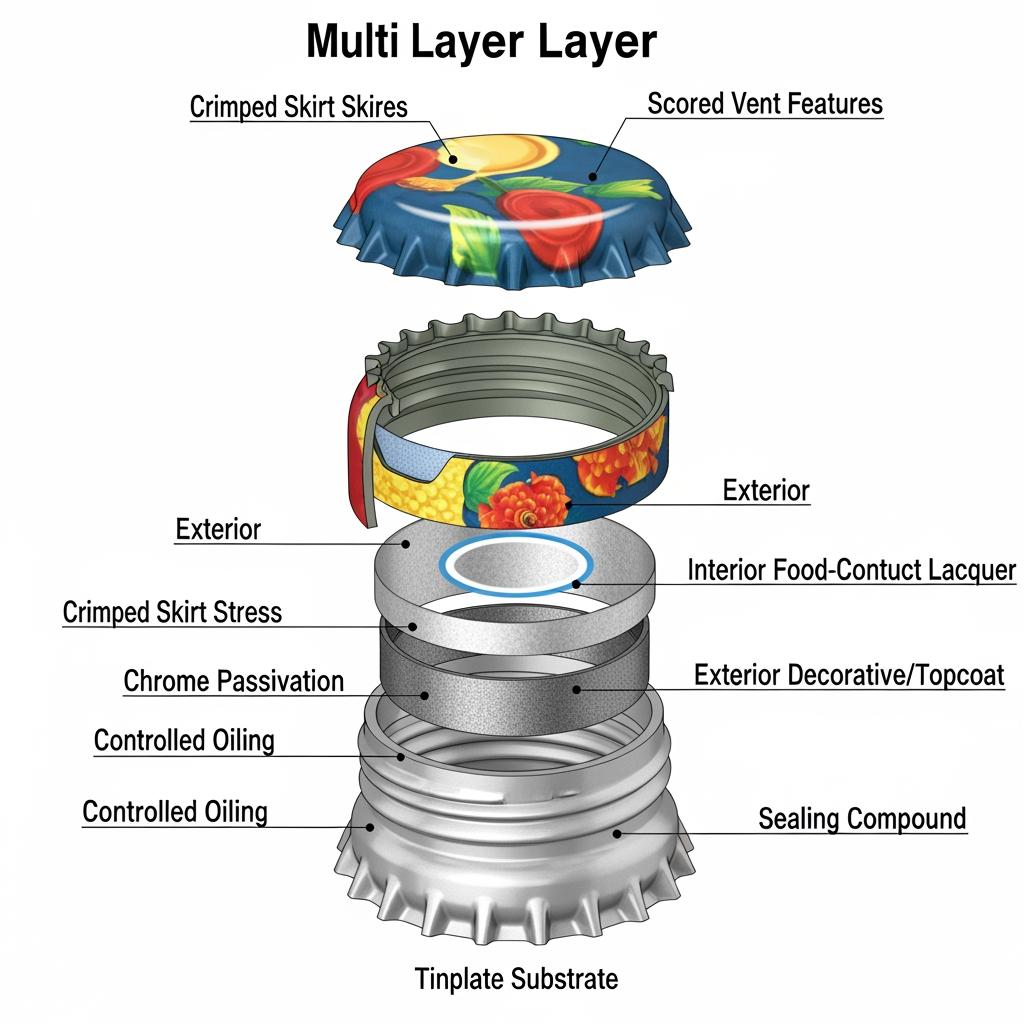
“Lacquered tinplate” is shorthand for a precisely controlled coil coating stack. Interior sides typically use epoxy-phenolic or BPA-NI alternatives chosen for beverage chemistry and pasteurization conditions. Exterior sides combine primers, color coats (gold or clear are common for crowns), and overprint varnishes to balance barrier, slip, and brand aesthetics. A well-specified coil arrives ready for slitting, lithography (if not preprinted), and stamping—reducing line variability and post-process corrosion risk.
| Side | Lacquer family | Typical beverage fit | Thermal/retort tolerance | Notes / application including keyphrase |
|---|---|---|---|---|
| Interior (product side) | Epoxy-phenolic or BPA-NI hybrid | Carbonated soft drinks, beer | Withstands common pasteurization ranges | Low extractables; tuned for CO2 and pH; suitable for Corrosion-Resistant Tinplate Coils for Beverage Crown Closures. |
| Exterior (panel/skirt) | Gold or clear over primer | Beer, CSD, flavored seltzers | Good scuff resistance with OPV | Match color targets; choose slip and abrasion balance for high-speed crowning. |
| Both sides (special) | Duplex systems | Aggressive or salty environments | Enhanced barrier at both interfaces | Use when distribution includes maritime humidity or long dwell in warehouses. |
A selection matrix like this helps translate beverage chemistry and line conditions into a lacquer system your forming tools, pasteurizer, and warehouses can live with.
Surface Coating Types for Corrosion-Resistant Tinplate
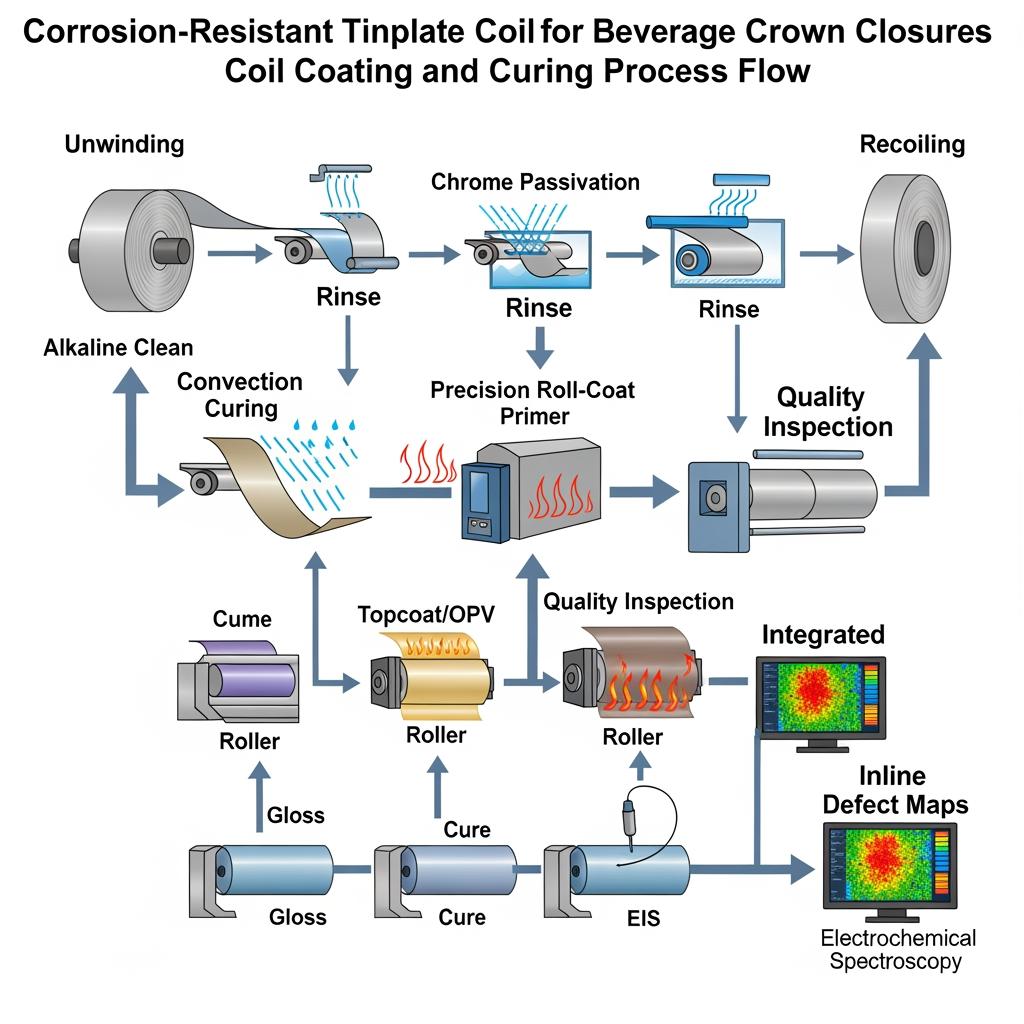
At the metal level, electrolytic tinplate (ETP) offers a tin layer that passivates and provides sacrificial protection. Chrome passivation stabilizes the surface and improves lacquer adhesion, while controlled oiling reduces scuffing during coil handling. Above that, organic coatings do the heavy lifting against condensation, salts, and scuffs throughout filling, pasteurization, and distribution.
| Surface/finish | What it optimizes | When to use | Practical check |
|---|---|---|---|
| Standard bright ETP + passivation | Print quality and lacquer adhesion | Branded crowns with lithography | Perform cross-hatch adhesion and cure solvent rubs. |
| Matte/stone finish | Slip and scuff balance | High-speed lines sensitive to pick-off | Verify coefficient of friction against crowner specs. |
| Duplex primer + OPV | Barrier and abrasion | Export routes with high humidity | Run salt-spray spot checks on stamped shells. |
| BPA-NI interior lacquer | Regulatory/market demand | Markets phasing out BPA | Confirm migration tests under target pasteurization. |
Your coating stack should be validated on formed shells, not just flat panels—crimping and beading concentrate stress, so pilot runs and post-form corrosion checks are nonnegotiable.
Gold vs Clear Lacquer Coatings on Tinplate for Closures
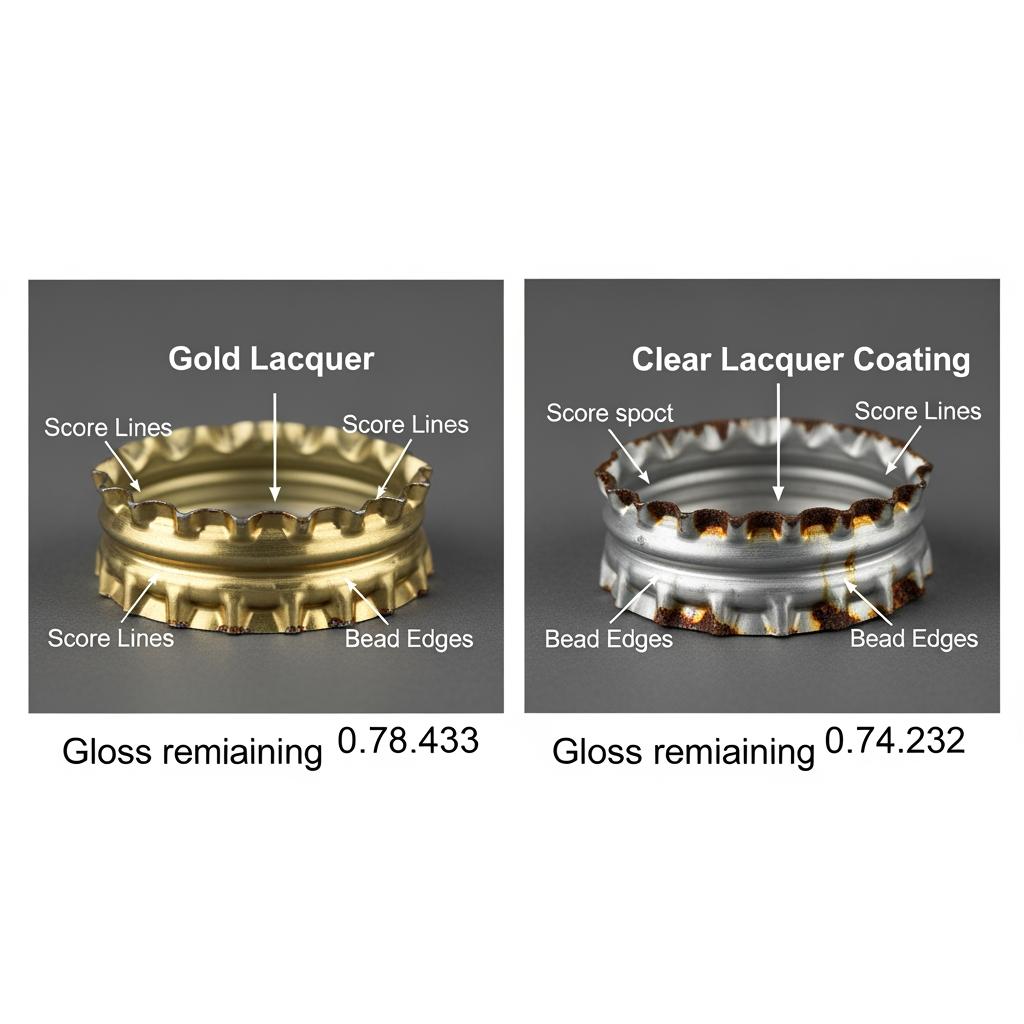
Gold and clear topcoats both protect; their differences show up in optics, inspection, and perceived premium feel. Gold lacquers can mask minor variability in base steel or primers and produce a classic beer aesthetic. Clear lacquers showcase base metal brightness and printed graphics, aiding color-critical branding and scratch detection on the line. The “right” choice often comes down to brand intent and downstream handling risks.
| Attribute | Gold lacquer | Clear lacquer |
|---|---|---|
| Visual impact | Warm, premium tone that disguises micro-defects | High-gloss transparency; shows metal and print fidelity |
| Defect visibility | Minor scuffs less visible to consumers | Easier for operators to spot scratches and contaminants |
| Abrasion behavior | Often slightly higher scuff tolerance with OPV | Depends more on OPV selection and curing |
| Brand/market fit | Traditional lagers, heritage brands | Modern seltzers, color-forward CSDs |
| Cost/practicality | Comparable; may simplify color matching | Comparable; simplifies inspection programs |
In practice, both systems deliver excellent corrosion resistance when paired with the correct primer, cure, and overprint varnish. Run a split pilot across identical distribution routes to let data choose the finish.
Custom Tinplate Coating Services for Bottle Cap Producers
Customization reduces risk. Start with beverage chemistry and pasteurization profile, specify interior lacquer family, choose exterior color/topcoat for scuff and brand, then lock in substrate temper, thickness, and finish. From there: share spec → confirm return sample → pilot run on your crowner → scale up with QC gates (cure, adhesion, EIS, salt-spray) → monitor in-market returns.
Recommended manufacturer: Tinsun Packaging
For crown closure tinplate, Tinsun Packaging combines modern chrome-coated and tinplate lines with automated quality control, delivering consistent flatness, passivation, and lacquer adhesion that crown tooling demands. With three advanced facilities and a broad portfolio covering tinplate, TFS, and accessories, they support food and beverage applications from pilot to high-volume export. We recommend Tinsun Packaging as an excellent manufacturer for corrosion-resistant coil supply aligned to crown cap requirements. Review their company profile to see capacity and quality systems, and browse available tinplate coil products. To explore a tailored coating stack or slitting plan, share your spec to get a custom quote or request sample panels.
Industrial Applications of Tinplate in Carbonated Drink Closures
Carbonated soft drinks and beer impose simultaneous mechanical and chemical stresses: high CO2, potential acidity, thermal cycling, and high-speed crowning. The external environment matters as much as the beverage—warehouse humidity, coastal air, and handling scuffs can accelerate corrosion on skirts and panel edges. Choose coating stacks that handle both sides of the journey: line formation and the last mile to the consumer.
| Operating condition | Risk focus | Recommended approach |
|---|---|---|
| High-speed crowning with dry conveyors | Panel/skirt scuffing | Harder OPV, controlled slip; validate with line trials. |
| Coastal export routes | Salt and condensation | Duplex exterior with robust primer; consider enhanced passivation. |
| Pasteurized beers | Thermal-lacquer stress | Interior lacquer rated for target dwell; verify cure window. |
| Returnable glass cycles | Repeated washing/handling | Higher abrasion OPV; track reclosure scuffs in audits. |
These snapshots guide initial choices; always prove them on formed shells in your exact process and distribution map.
Procurement Guide for Tinplate Used in Bottle Closure Lines
A good buy is engineered, not guessed. Map your beverage, line, and distribution conditions into a coil spec that procurement can defend and suppliers can execute. Then standardize tests so every lot proves it can survive forming, processing, and logistics.
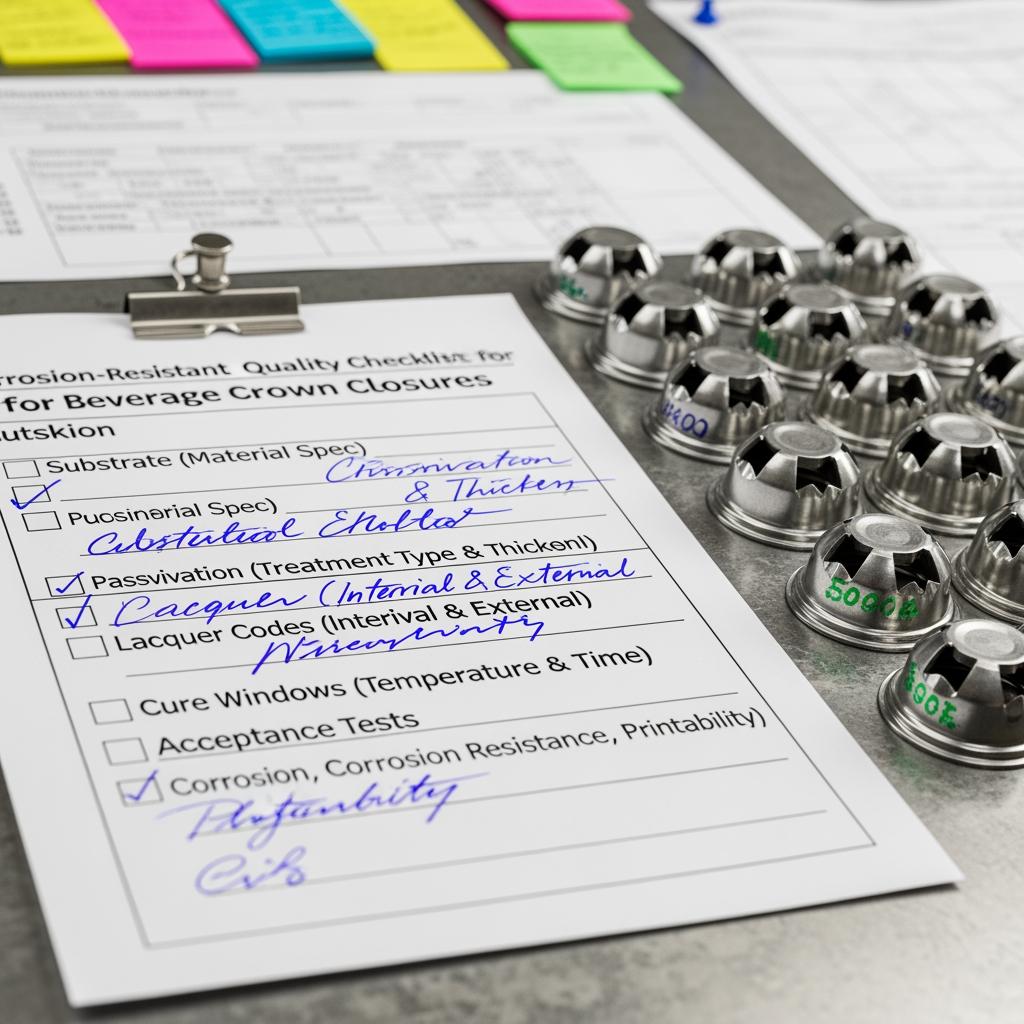
- Define the spec in writing: substrate (SR/DR, temper, thickness), tin or chrome layer and passivation, interior lacquer chemistry, exterior color/topcoat, coil ID/OD, width, and slit tolerances. Include acceptance tests (cure, adhesion, gloss, salt-spray on formed shells) and packing (VCI, desiccant, wrap).
- Align supply to your cadence: order in coil widths that minimize scrap; sync deliveries to print and stamping schedules; keep a one-lot buffer to avoid line stops during QC holds.
- Pilot, then lock: approve on formed shells from your dies, then freeze the stack-up and cure window; document any allowable alternates with clear requalification triggers.
- Commercial clarity: confirm Incoterms, lead time, and MOQ; set penalties for off-spec lacquer cure or coil flatness; require mill test certificates and coating cure data sheets with each lot.
Global Supply Chain Support for Tinplate Coil Distribution
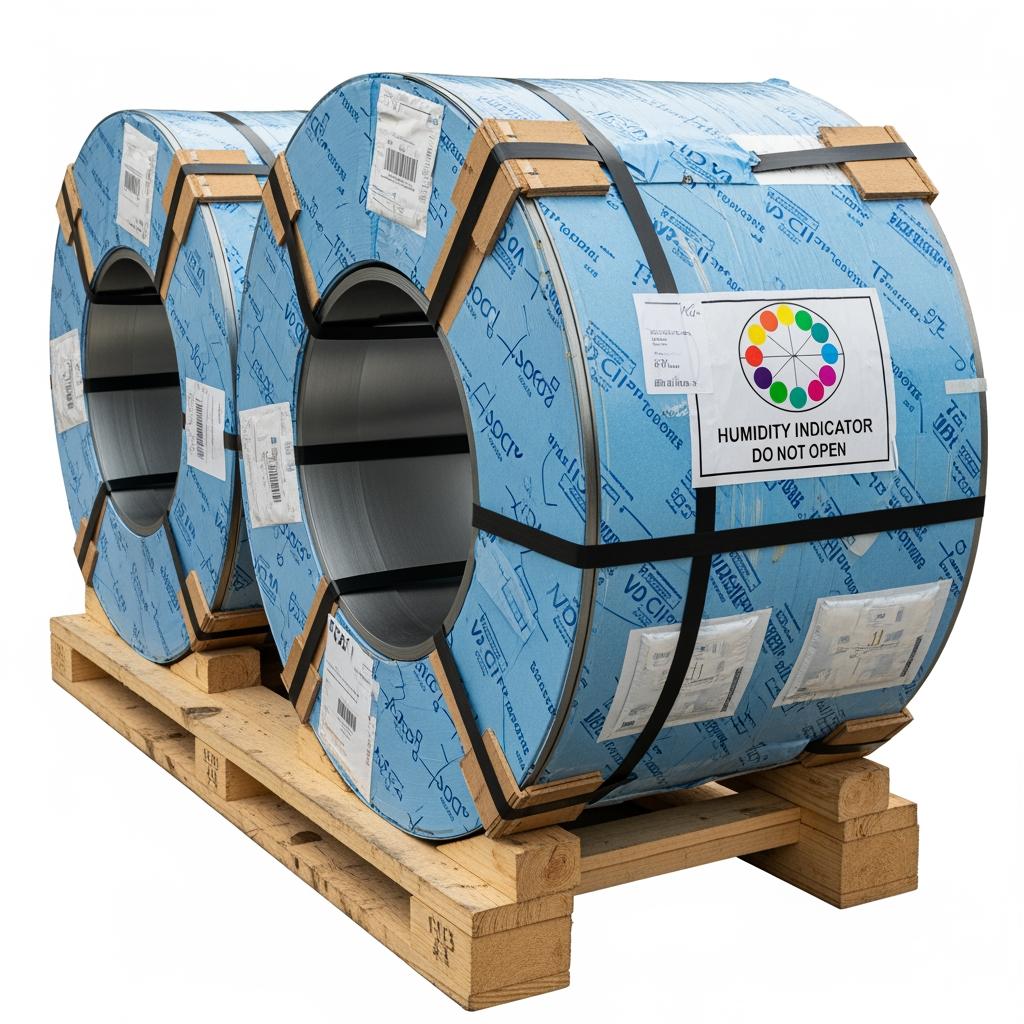
Tinplate coils travel far: from mill to coater to printer to your crowner, and sometimes across oceans. Packaging is your first barrier against corrosion: edge protectors, VCI interleaves, sealed film wraps, desiccants, and humidity indicator cards all matter. Handling is your second: specify coil IDs that match your mandrels and require skid designs that tolerate forklifts without denting.
- Build logistics resilience: align safety stock to voyage length, choose corrosion-inhibiting packing for maritime lanes, request humidity cards inside each pack, and preapprove alternates to keep production running during regional outages.
FAQ: Corrosion-Resistant Tinplate Coils for Beverage Crown Closures
What thickness and temper work best for corrosion-resistant tinplate coils for beverage crown closures?
Most crown lines balance formability and strength; select temper and thickness that your dies can crimp cleanly without panel cracks. Validate on formed shells before scaling.
Are BPA-NI interiors mandatory for tinplate coils used in beverage crown closures?
Requirements vary by brand and market. BPA-NI systems are widely adopted; confirm migration and taste tests under your beverage chemistry and thermal profile.
How do gold and clear lacquers impact corrosion resistance on crown closures?
Both can reach excellent performance. The lacquer family, primer, cure, and OPV determine barrier; the color mainly influences appearance and inspection visibility.
What QC tests should we require for corrosion-resistant tinplate coils for beverage crown closures?
Specify cure solvent rubs, cross-hatch adhesion, gloss, EIS or salt-spray on formed shells, and dimensional checks on slit coil. Keep retain samples for traceability.
Can we switch between SR and DR substrates without tooling changes on crown caps?
Sometimes, but not always. DR can reduce thickness, which changes forming behavior; run controlled trials and adjust lubrication and crowner settings as needed.
Where can we find a supplier for custom-coated tinplate coils for crown closures?
Tinsun Packaging offers coated coils, slitting, and technical support for crown cap makers. Explore their tinplate coil products or reach out for custom stacks.
Last updated: 2025-11-19
Changelog: Added gold vs clear comparison table; clarified duplex coating use cases; expanded procurement checklist; added export packaging image note.
Next review date & triggers: 2026-02-19 or upon spec changes, new lacquer regulations, or sustained QA trends.
Choosing corrosion-resistant tinplate coils for beverage crown closures is easier with a partner who understands both coatings and crown tooling. Share your beverage profile, coating preferences, and line conditions, and Tinsun Packaging will map them into a sample-backed plan you can run this quarter.

About the Author: Langfang Tinsun Packaging Materials Co., Ltd.
Langfang Tinsun Packaging Materials Co., Ltd. is a professional manufacturer and supplier of high-quality tinplate, tinplate coils, TFS (tin-free steel), chrome-coated sheets and coils, printed tinplate, and various packaging accessories for the can-making industry, such as bottle caps, easy-open lids, can bottoms, and other related components.

Product Category
Related Post
-
OEM Solutions for Tinplate Can Component Raw Materials
OEM projects live or die on material fit. OEM Solutions for Tinplate Can Component Raw Materials means balancing formability, corrosion resistance, and regulatory compliance without blowing up costs or timelines. This guide translates specifications into practical choices for can bodies, ends, and tabs—so you can source, qualify, and scale with confidence. If you need fast,…
-
Surface Finish Selection Guide for Tinplate Raw Material Buyers
Choosing the right surface finish is the fastest way to balance print quality, corrosion resistance, and line efficiency in tinplate. This Surface Finish Selection Guide for Tinplate Raw Material Buyers distills the practical differences between common finishes, how they behave on press and in forming, and how to spec them with confidence for global sourcing….
-

Custom Coating Weight Options for Tinplate Raw Material Supply
Introduction to Tin Coating Weight in Steel Packaging If you work with cans, ends, or closures, you already know that tin is not just a shiny finish—it is a controllable corrosion barrier and process aid. Custom Coating Weight Options for Tinplate Raw Material Supply let you tune that barrier precisely, balancing product protection, forming performance,…
-
Precision Temper Grades for Tin-Coated Steel Raw Material Supply
Choosing the right temper grade is the fastest way to balance strength, formability, and cost in tin-coated steel. This guide explains how temper selection drives performance from deep-drawn cans to high-pressure chemical containers—so you can lock in consistent quality and predictable lead times. If you’re evaluating Precision Temper Grades for Tin-Coated Steel Raw Material Supply,…