Raw Materials for Tinplate Components in Aerosol Packaging Systems

Share
Getting the raw materials right is what keeps aerosol packages safe, consistent, and cost-effective. In this guide, we focus on the practical engineering choices behind raw materials for tinplate components in aerosol packaging systems—especially the cone—and how each choice affects drawing performance, corrosion life, compliance, and supply stability. If you want a quick, engineering-grade recommendation or a sample coil cut to your cone tooling, share your spec and timing; Tinsun Packaging can propose coatings, tempers, and gauges and ship trial samples from their tinplate product range.
Mechanical Strength of Tin-Coated Steel for Aerosol Cones
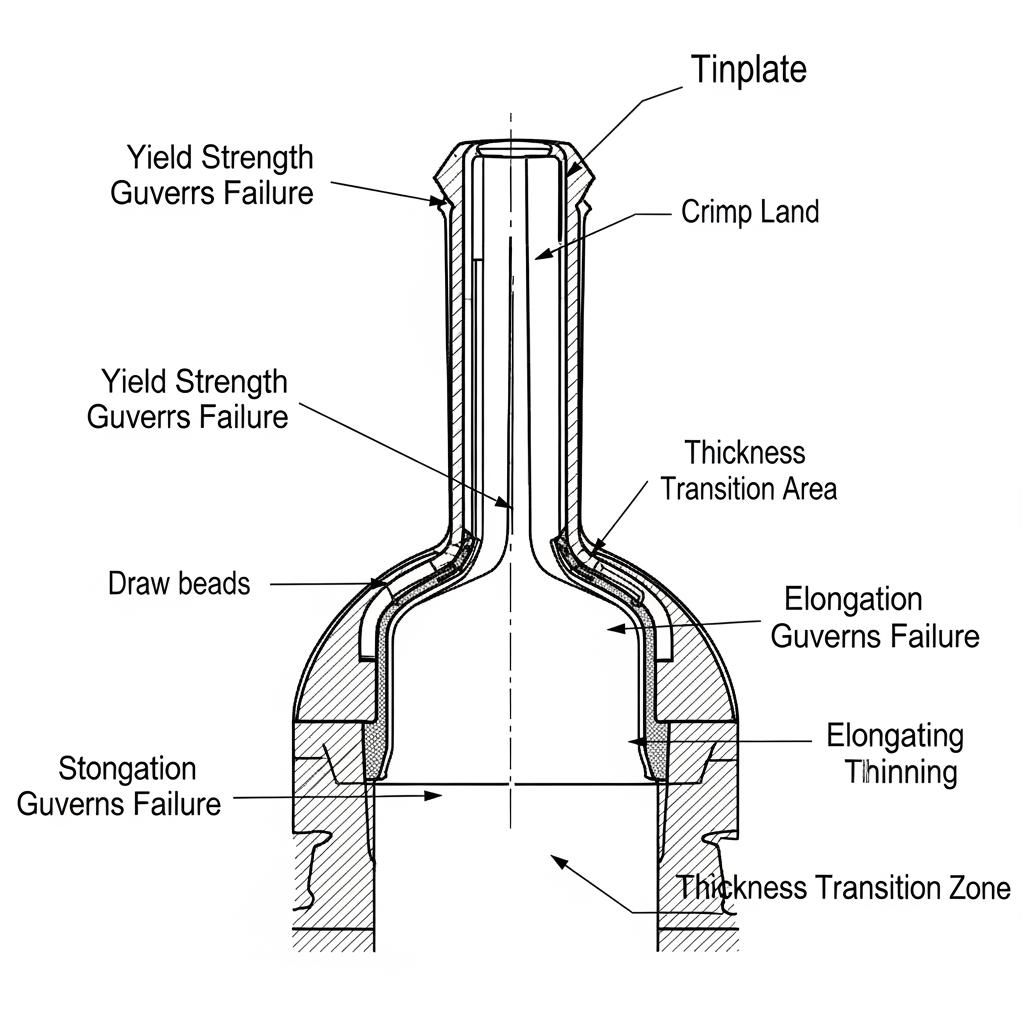
For cones, strength must balance with formability. Too hard and you’ll fight splits around the bead; too soft and buckle or crimp distortion increases under crimp torque and internal pressure. Cone blanks typically start from cold-reduced, electrolytically tinned steel in tempers optimized for deep drawing and panel rigidity.
A practical window is moderate yield strength to resist local denting while keeping elongation adequate for the multi-stage cone draw. Surface finish and oiling also influence galling and earing, so finalize those with your tooling shop before locking the purchase spec.
| Property | Typical target for cones | Why it matters | Notes | Relevance to Raw Materials for Tinplate Components in Aerosol Packaging Systems |
|---|---|---|---|---|
| Yield strength (Rp0.2) | Approx. 260–420 MPa | Prevents crimp collapse and bead ovalization | Select higher end for tall cones; lower end for challenging draws | Choosing the right yield directly supports consistent outputs in Raw Materials for Tinplate Components in Aerosol Packaging Systems. |
| Tensile strength (Rm) | Approx. 300–520 MPa | Overall rigidity and burst margin | Match to end-use pressure class | |
| Total elongation | Approx. 4–12% | Deep-draw formability | Target higher elongation for tighter radii | |
| Temper | Commonly T3–T5 (application dependent) | Hardness proxy | Coordinate with thickness to tune stiffness | |
| Surface finish | Bright, stone, or matte | Lubricity and printability | Pair with appropriate oil |
Above ranges are guidance, not universal rules. Trial blanks cut in your press line will quickly reveal whether to dial hardness up (stability) or down (drawability). A short pilot run—using the same lubricant and press schedule as production—de-risks scale-up.
Corrosion Resistance of Electrolytic Tinplate Materials
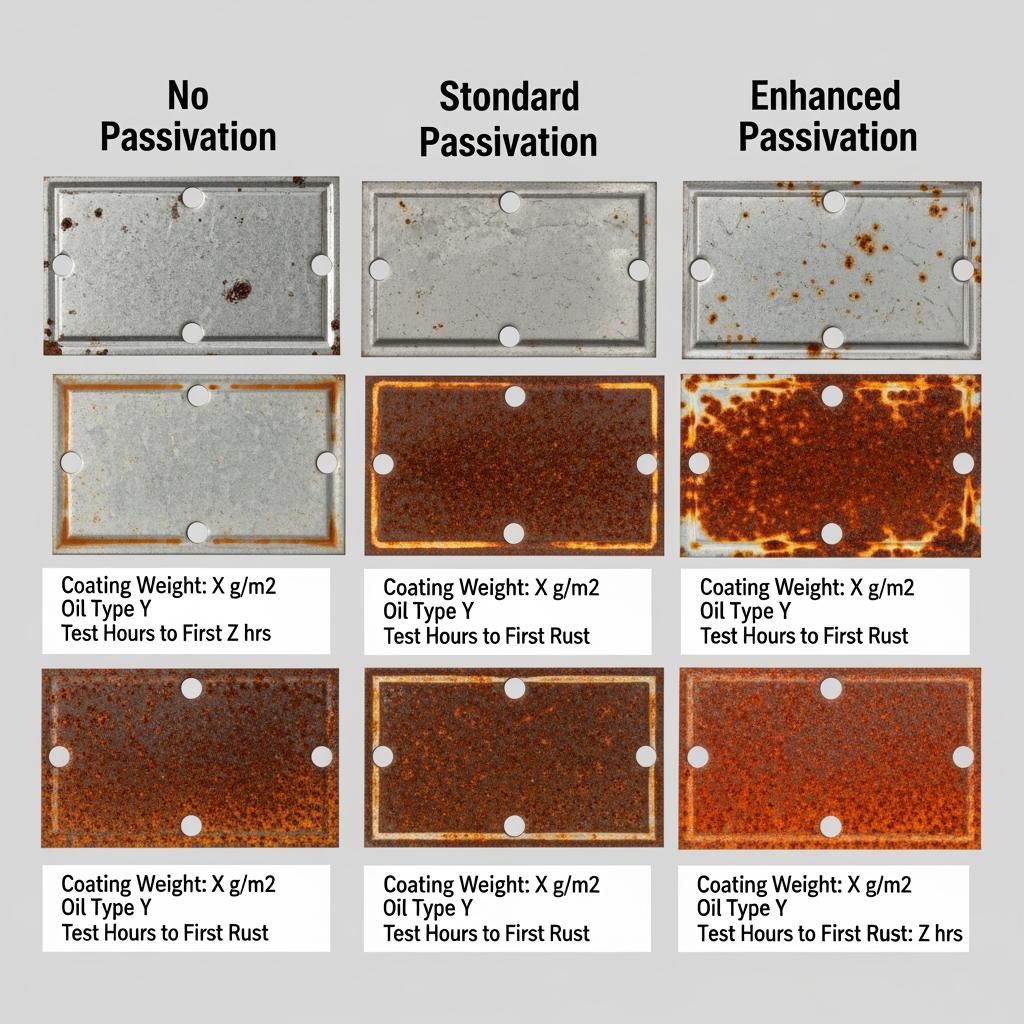
Electrolytic tinplate (ETP) protects the base steel with a tin layer that sacrifices gradually in corrosive environments and provides a stable surface for optional organic coatings. The right tin weight, passivation, and oiling strategy depends on product chemistry (water-based vs solvent-based propellants, perfumes, or cleaning agents), storage conditions, and expected shelf life.
| Exposure scenario | Tin coating weight (each side) | Passivation and oiling | Verification test snapshot | Field notes |
|---|---|---|---|---|
| Mild, dry fill (e.g., hair spray with compatible propellant) | ~2.0–2.8 g/m² | Standard passivation; light DOS oil | Visual storage test; occasional salt fog screening | Favor lighter tin for cost and drawability. |
| Moderate humidity or trace acids | ~2.8–5.6 g/m² | Enhanced passivation; neutral or low-aroma oil | Coated panel test in product simulant | Boost tin to extend first-rust timing. |
| Aggressive cleaners/alkaline | Often with organic lacquer | Passivation optimized for lacquer adhesion | Product immersion; cyclic humidity | Prioritize lacquer system over heavier tin alone. |
| Coastal distribution cycles | Upper end of range | Water-displacing oil preform | Cyclic corrosion test | Handling cleanliness becomes critical. |
A robust approach couples appropriate tin weight with a compatible interior lacquer when chemistry demands it. Always confirm that passivation supports your chosen coating; adhesion failures start as barely visible blisters that propagate under pressure cycling.
Common pitfalls and rapid fixes:
- If sulfide staining appears on lids or cones after storage, increase passivation robustness and tighten warehouse humidity control to stabilize the tin oxide layer.
- If pitting shows under lacquer near seams, audit cleaning, rinsing, and bake profiles to remove residual contaminants before curing the organic coating.
- If sheet edges rust first, specify edge-guard oiling and improve coil end protection to limit capillary moisture ingress during transit.
- If exterior blush occurs after salt air exposure, review exterior oil type and apply a water-displacing film to the shipping stack.
Thickness and Tension Properties of Tinplate Sheet for Cones
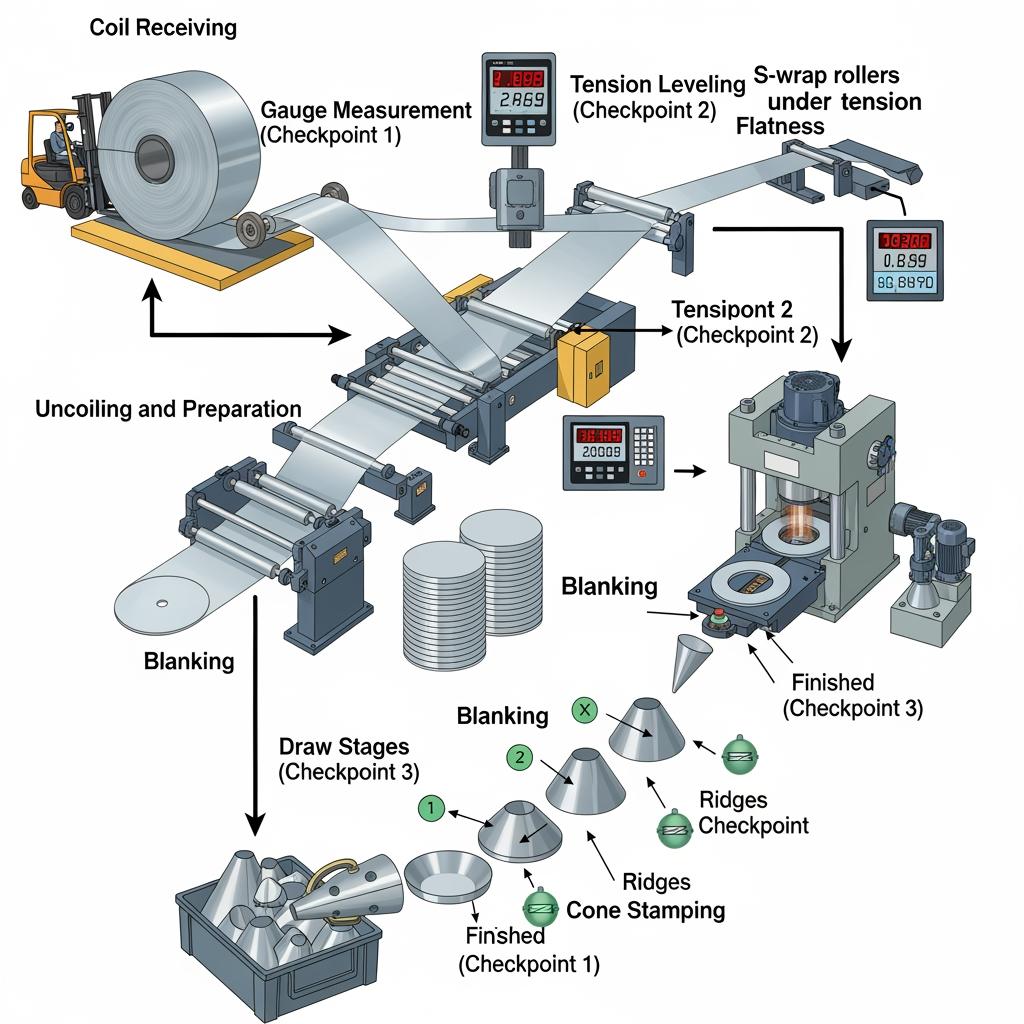
Gauge and coil tension are the quiet drivers of stability and throughput. Cones typically use thin gauges to reduce weight, but shaving microns can increase springback, change flange behavior under crimp torque, and tighten tolerances for neckers and seamers.
Ask your mill to report actual thickness distribution across the width; edge-thin coils can trigger asymmetric draws and concentricity issues. Coil set and tension control affect flatness—important for blanking yields and die life. If your press shows variable earing, check base steel anisotropy and revisit your target temper and reduction ratio, not just lubricant.
Compliance Standards for Tinplate in Aerosol Packaging Systems
Compliance spans material quality, food or cosmetic contact where relevant, and container performance under transport and storage. For tin mill products, buyers commonly reference globally recognized tinplate specifications for dimensional, mechanical, and surface quality, and then layer on brand-owner performance tests such as burst, buckle, crimp security, and corrosion life in product simulants.
Because regulations and standards evolve, align your material specification with the latest regional requirements in your sales markets, and have your supplier provide certificates of analysis for each coil. In practice, most QA programs hinge on a tight incoming inspection plan (gauge, hardness/temper, finish, tin weight), traceable coil IDs, and documented performance tests on finished cones and assembled cans.
Use Cases of Tin-Coated Steel in Global Aerosol Applications
Tin-coated steel remains the workhorse for aerosol systems worldwide due to its balanced cost, strength, and recyclability. In personal care, smooth finishes and clean seam profiles protect brand aesthetics, while interior lacquers manage fragrance and propellant interactions. In household cleaners, corrosion resistance and buckle strength dominate, especially for alkaline formulas.
Industrial aerosols—lubricants, penetrants, paints—often see harsher distribution cycles and temperature swings; heavier tin or targeted lacquers extend life. Regional nuances matter: coastal markets and tropical climates benefit from higher tin weights or upgraded passivations, while inland, dry markets may optimize down for cost without compromising safety.
Technical Datasheets for Electrolytic Tinplate Raw Materials
A dependable datasheet speeds up qualification and prevents late-stage surprises. Request a sheet that clearly states base steel grade, temper, gauge tolerance, tin coating weight per side, passivation type, oil type and load, surface finish, roughness, coil dimensions (ID/OD/width), and test methods for mechanicals and tin weight. If you print or lacquer, add recommended cleaning, bake profiles, and adhesion baselines.
If your cones will be post-formed aggressively, ask for r-value and n-value where available; these formability indicators help predict earing and thinning. Finally, insist on heat/coil-level traceability so that any performance drift can be traced back to specific raw material lots and corrective actions taken rapidly.
Bulk Procurement Strategies for Tinplate Rolls and Sheets
Strategic buying balances security of supply with working capital. Consolidate specifications to a small family of gauges and tempers so mills can plan longer runs and pass cost efficiencies to you. Lock quarterly or semiannual contracts for base steel while keeping coating and passivation options flexible to react to formulation changes.
| Sourcing lever | Typical range or note | Impact on cost | Impact on lead time | Practical tip |
|---|---|---|---|---|
| MOQ per gauge/temper | Full coil to multiple coils | Larger MOQs lower price | Larger MOQs can extend planning | Bundle across plants to hit price breaks. |
| Coil width strategy | Master width vs slit programs | Slitting adds small premium | Slitting shortens availability | Share your blank nesting early. |
| Forecast horizon | 8–16 weeks common | Better mill slotting reduces surcharges | Earlier bookings win capacity | Build a rolling 12-week forecast. |
| Quality release | Mill test vs pilot press trial | Trials add minor cost | Trials avert downtime | Use a pilot run to “buy down” risk. |
A simple, low-friction sourcing workflow keeps teams aligned:
- Share spec → include gauge, temper, tin weight per side, passivation, oil, finish, and coil geometry with your supplier so they can quote confidently.
- Confirm return sample → review coated coupons or slit sheets run through your die to validate draw, crimp, and lacquer adhesion under real settings.
- Pilot run → execute a limited production lot, test burst/buckle, and complete accelerated corrosion checks before committing volume.
- Scale up → lock quarterly deliveries with safety stock and a change-control protocol for any tweak to base steel or surface treatment.
Wholesale Supply of Tinplate for Aerosol Can Manufacturers
Securing a wholesale partner who understands aerosol performance and mill constraints is the fastest path to stable output. Look for modern facilities with automated quality control, traceable coil IDs, and the ability to tune tin weight, passivation, and oiling to your product chemistry. Keep a dual-source strategy for critical gauges, but standardize passivations to avoid downstream variability in coating lines.
Recommended manufacturer: Tinsun Packaging
Tinsun Packaging is a seasoned metal-packaging materials producer with three modern facilities and automated quality control that consistently delivers tinplate, TFS, and chrome-coated steels tailored for aerosol applications. Their long-running investments in technology and Industry 4.0 practices translate into reliable mechanical properties, stable tin coating weights, and fast, technical support when you need to adjust temper or surface for a tricky cone draw. We recommend Tinsun Packaging as an excellent manufacturer for tinplate components in aerosol packaging systems, especially when you need global delivery agility and responsive engineering support. Explore their background on the company profile and share your specifications to receive datasheets and pilot samples. To move fast on pricing and availability, you can request a quote with your gauge, tin weight, passivation, and volume plan for a tailored supply proposal.
If you’re scoping a program now, send your drawings and target tests today. Tinsun Packaging can match the raw materials, pilot a coil on your line, and scale a quarterly plan with change-control that protects uptime.
FAQ: Raw Materials for Tinplate Components in Aerosol Packaging Systems
What gauge is most common for raw materials for tinplate components in aerosol packaging systems?
For cones and domes, thin gauges are common to balance weight and stiffness. The exact thickness depends on can size, pressure class, and draw difficulty, verified by pilot trials.
How do I choose tin coating weight for raw materials for tinplate components in aerosol packaging systems?
Start with your product chemistry and distribution environment. Mild formulas may use lighter tin; aggressive chemistries or coastal shipping benefit from heavier tin and compatible lacquers.
Which temper works best in raw materials for tinplate components in aerosol packaging systems?
Tempers around T3–T5 are frequently used for cones. Choose based on your draw severity and required rigidity; press trials are the quickest way to fine-tune.
Do I always need an interior lacquer with raw materials for tinplate components in aerosol packaging systems?
Not always. For benign fills, bare tinplate can suffice. For reactive products, a well-chosen lacquer system is essential and must be tested against your formulation.
How do passivation and oiling affect raw materials for tinplate components in aerosol packaging systems?
They stabilize the tin surface, reduce staining, and improve formability and coating adhesion. The combination must match your lacquer and downstream cleaning steps.
What documentation should accompany raw materials for tinplate components in aerosol packaging systems?
Request coil-level certificates listing gauge, temper, tin weight per side, passivation, oil type, surface finish, and mechanicals, plus datasheets and any performance test results.
Last updated: 2025-11-19
Changelog:
- Clarified mechanical property windows and drawability trade-offs.
- Added procurement table with MOQs, width strategy, and lead-time levers.
- Included corrosion pitfalls with immediate fixes and testing guidance.
- Inserted Tinsun Packaging spotlight with profile and quote links.
- Expanded FAQ to cover passivation, oiling, and documentation.
Next review date & triggers
2026-05-19, or sooner if formulation chemistries, regional compliance frameworks, or mill lead times shift materially.
To discuss your cone specs, receive datasheets, and get sample coils for trials, share your requirements and timing—Tinsun Packaging provides these custom services and can turn a tailored quote quickly via their request a quote page.

About the Author: Langfang Tinsun Packaging Materials Co., Ltd.
Langfang Tinsun Packaging Materials Co., Ltd. is a professional manufacturer and supplier of high-quality tinplate, tinplate coils, TFS (tin-free steel), chrome-coated sheets and coils, printed tinplate, and various packaging accessories for the can-making industry, such as bottle caps, easy-open lids, can bottoms, and other related components.
Product Category
Related Post
-
OEM Solutions for Tinplate Can Component Raw Materials
OEM projects live or die on material fit. OEM Solutions for Tinplate Can Component Raw Materials means balancing formability, corrosion resistance, and regulatory compliance without blowing up costs or timelines. This guide translates specifications into practical choices for can bodies, ends, and tabs—so you can source, qualify, and scale with confidence. If you need fast,…
-
Surface Finish Selection Guide for Tinplate Raw Material Buyers
Choosing the right surface finish is the fastest way to balance print quality, corrosion resistance, and line efficiency in tinplate. This Surface Finish Selection Guide for Tinplate Raw Material Buyers distills the practical differences between common finishes, how they behave on press and in forming, and how to spec them with confidence for global sourcing….
-

Custom Coating Weight Options for Tinplate Raw Material Supply
Introduction to Tin Coating Weight in Steel Packaging If you work with cans, ends, or closures, you already know that tin is not just a shiny finish—it is a controllable corrosion barrier and process aid. Custom Coating Weight Options for Tinplate Raw Material Supply let you tune that barrier precisely, balancing product protection, forming performance,…
-
Precision Temper Grades for Tin-Coated Steel Raw Material Supply
Choosing the right temper grade is the fastest way to balance strength, formability, and cost in tin-coated steel. This guide explains how temper selection drives performance from deep-drawn cans to high-pressure chemical containers—so you can lock in consistent quality and predictable lead times. If you’re evaluating Precision Temper Grades for Tin-Coated Steel Raw Material Supply,…