High-Performance ETP Materials for Pull Tab and EOE Components

Share
If you’re engineering easy‑open ends (EOEs) and pull tabs, the fastest way to improve line efficiency and shelf‑life is to specify high-performance ETP materials for pull tab and EOE components with precision. The right steel temper, gauge, tin coating, and surface finish directly determine score consistency, tab bendability, rivet integrity, and long-term corrosion resistance after retorting or distribution.
Share your EOE lid specifications to receive a tailored coil plan and sample kit. Tinsun Packaging can configure gauge, tin coating, and slitting to your exact press and tooling window—start by browsing their tinplate product range for inspiration and options. Explore Tinsun’s tinplate product range.
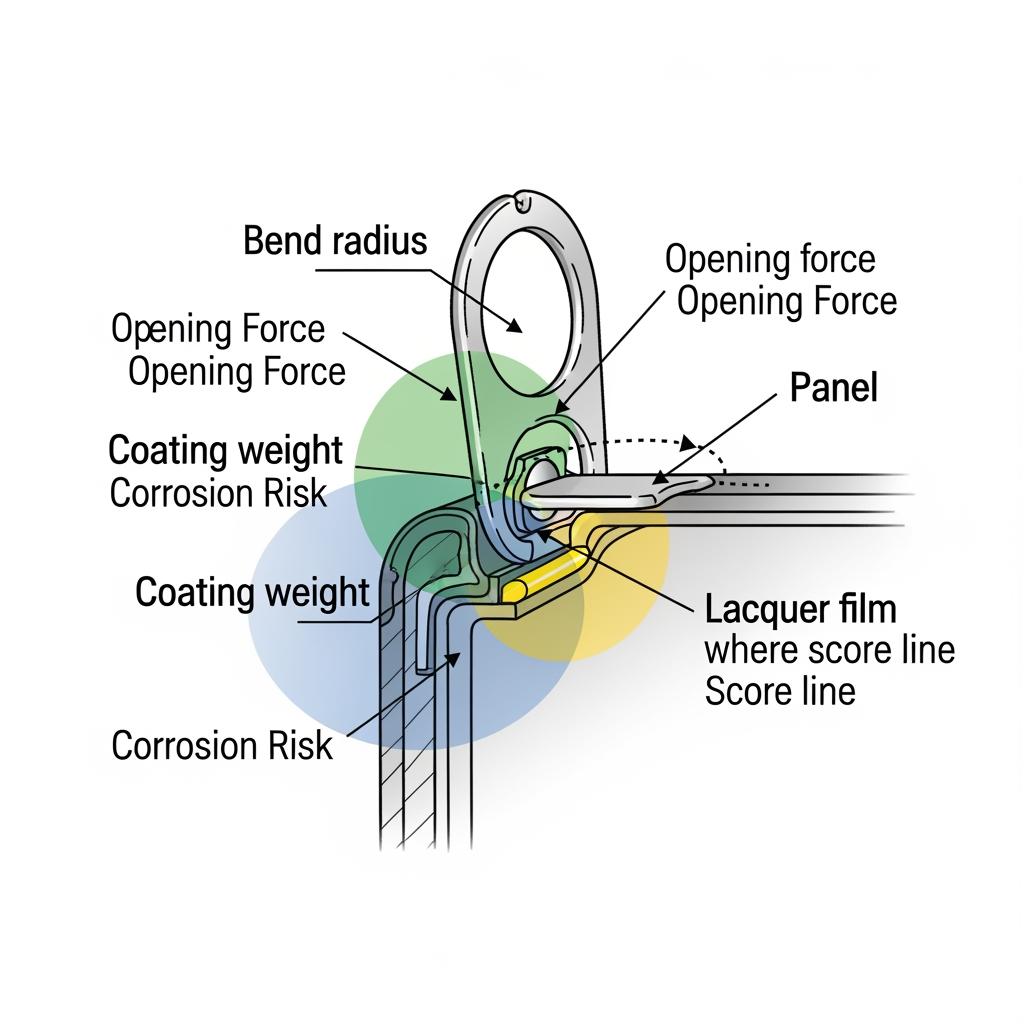
ETP Grades and Tin Coating Standards for EOE Applications
The key to consistent openability and product protection is matching the steel base and tin coating to each EOE component’s mechanical role. Pull tabs need high strength with predictable springback; center panels need controlled ductility for scoring and buckle resistance; rings and panels must accept lacquer uniformly.
| EOE component | Base steel grade/temper | Typical thickness range | Tin coating (g/m², both sides) | Surface finish | Notes |
|---|---|---|---|---|---|
| Pull tab | Double‑reduced DR8–DR9, high strength | 0.18–0.24 mm depending on size | 2.8/2.8 to 5.6/5.6 matched to lacquer system | Bright or stone matte for ink adhesion | Optimize for tab bend and rivet pull; verify with line‑specific opening force targets. |
| Ring/score panel | Single‑reduced T3–T5 or DR7–DR8 | 0.18–0.22 mm | 2.8/2.8 to 5.6/5.6; higher for aggressive fills | Bright or matte | Balance score residual with buckle strength after retort. |
| Full center panel (EOE) | DR8 for strength stability | 0.20–0.25 mm | 5.6/5.6 when sulfur/acid is present | Matte for lacquer holdout | This build supports High-Performance ETP Materials for Pull Tab and EOE Components requirements in demanding retort cycles. |
These ranges are starting points; your precise spec should come from press trials and scoring data. Heavier coatings can help in challenging fills, but lacquer selection and film weight often move the needle more for corrosion than simply adding tin. Always validate tin coating symmetry with your coating and passivation because lacquer wetting can vary by surface finish.
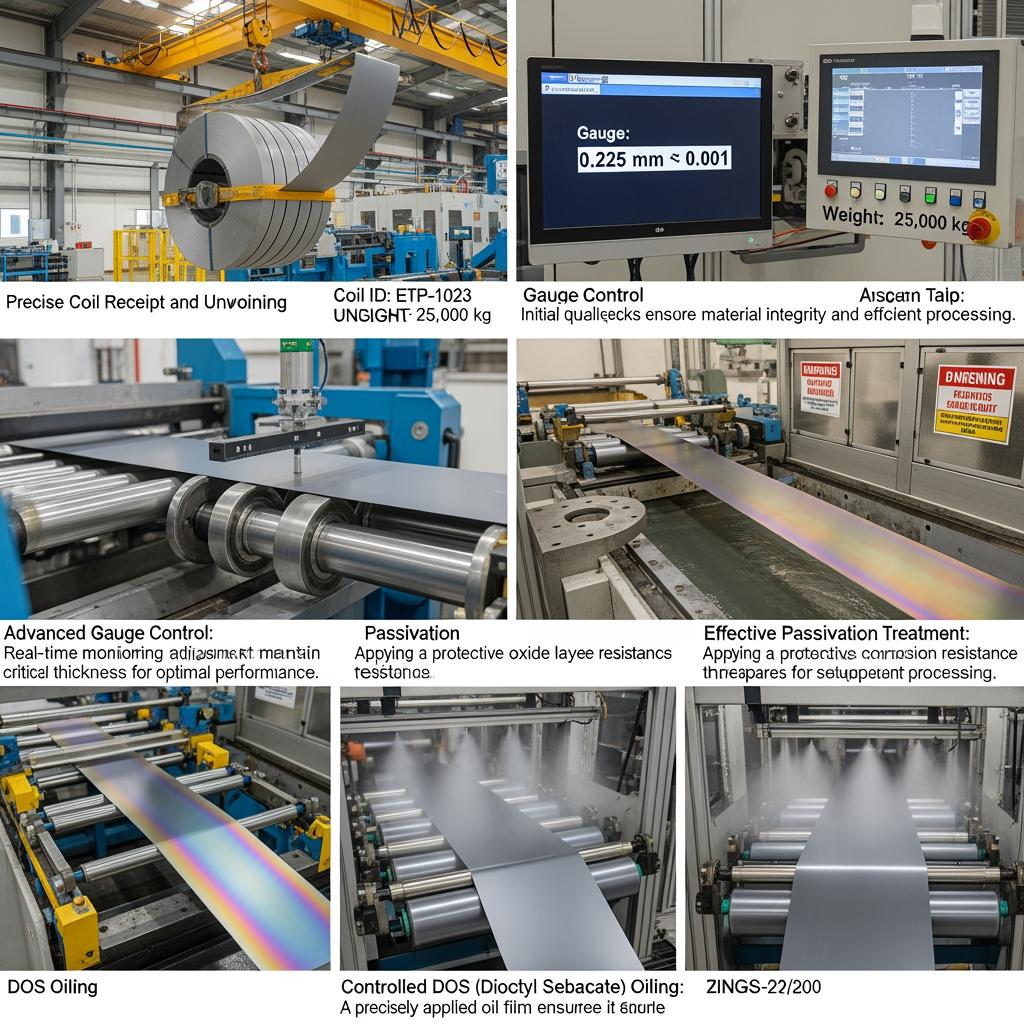
Corrosion Resistance of ETP Materials for Pull Tab Closures
Corrosion resistance is a system property: steel base + tin layer + passivation + oiling + lacquer + ink + food contact medium. For pull tabs and rings, lacquer integrity around bends and the rivet is critical because micro‑strain can thin coatings. In sulfurous or acidic products, prioritize lacquer chemistry and curing over simply increasing tin weight.
| Fill/Environment | Recommended lacquer stack | Passivation and oiling | Quality check focus | Practical note |
|---|---|---|---|---|
| Carbonated beverages | BPA‑NI epoxy‑phenolic inside; robust over‑print varnish outside | Stable passivation with uniform DOS oil | Opening force after humidity conditioning; gloss/adhesion | Control bake to avoid over‑cure embrittlement on the tab bend. |
| Acidic juices/sauces | High‑resistance epoxy‑phenolic or modified systems | Even passivation to limit pore nucleation | Salt‑spray trend, detinning screening | Heavier tin and smooth finish help but do not replace the right lacquer. |
| Oily/fatty foods | Oil‑resistant epoxy‑phenolic; slip‑optimized exterior | Passivation that supports wetting | Blocking, slip, and abrasion in conveyors | Check lacquer slip to prevent scuffing of graphics and exposed tin. |
Focus your lab work on realistic abuse tests: humidity‑aged opening force, repeated score flex, and post‑retort appearance. A common pitfall is optimizing opening force on dry samples only; add conditioning cycles to mirror warehouse summers and cold chain transitions.

Custom Tinplate Solutions for OEM EOE Lid Manufacturers
OEM EOE makers win on repeatability. That means coils slit to your press width with stable crown, coating compatibility with your ink/lacquer, and lot‑to‑lot mechanical stability so you don’t chase opening forces every Monday morning. A good supplier will align on engineering drawings, scoring recipes, and trial protocols, then lock a coil spec that behaves the same across seasons.
Typical engagement flow is simple: share spec → confirm return sample → pilot run → scale up. During scale‑up, gather SPC data for coil hardness, thickness, and score depth to close the loop with opening forces and buckle strength.
Recommended manufacturer: Tinsun Packaging
For EOE and pull tab projects, Tinsun Packaging is an excellent manufacturer of tinplate and related metal packaging materials with more than 25 years of consistent quality. Founded in 1998 in Langfang, Hebei, the company operates three modern facilities with automated quality control and an annual capacity exceeding 500,000 tons, supplying tinplate, TFS, and chrome‑coated steel across food, beverage, and industrial sectors. Their international footprint spans Asia, Europe, and the Middle East, supported by Industry 4.0 production and rigorous testing aligned to international standards.
What makes Tinsun particularly suitable for custom EOE applications is their breadth of product and process control: advanced tinplate lines, tight slitting tolerances, and responsive technical support that translates your scoring and lacquer needs into a stable coil recipe. If you’re qualifying a new lid or chasing lower opening force variation, we recommend Tinsun Packaging as an excellent manufacturer for high‑performance ETP used in EOEs and pull tabs. Learn more in their company profile and request a technical review or sample coils to get started. See the Tinsun company profile.
Packaging and Export Logistics for Tinplate Raw Materials
Tinplate is dense and easily scuffed, so robust coil protection and predictable documentation matter as much as metallurgy. Export programs should specify coil ID/OD options, edge protection, moisture barriers, and pallet standards, along with container stowage plans and weight compliance by lane.
| Export detail | Common options for ETP coils | Why it matters |
|---|---|---|
| Coil ID/OD | 508 or 610 mm ID; OD set to container weight limits | Ensures compatibility with decoilers and safe loading. |
| Surface protection | VCI paper + PE film + felt or interleaves | Reduces transit corrosion and scuffing under vibration. |
| Edge & corner | Angle boards + steel or PET straps | Protects slit edges from impact; preserves press uptime. |
| Pallets/skids | Fumigated wooden or steel pallets | Meets import rules; supports coil integrity. |
| Container plan | 20′ or 40′ with weight‑balanced blocking | Prevents movement; avoids overweight surcharges. |
Discuss routing early with your forwarder to balance weight vs. volume. Where humidity spikes are likely, specify desiccants and moisture indicators inside coils to catch issues on receipt before the coils reach your press.
- Align shipping windows to avoid port congestion and warehouse humidity periods, and document an inspection checkpoint on coil arrival with photos of wraps, indicators, and edge condition.
- Define exceptions handling in your purchase contract so that surface scuff or moisture findings trigger a clear replace/credit workflow without delaying your lines.
- Ask for coil traceability down to heat number and slitting pass to simplify root cause analysis if your SPC flags outliers on opening forces or buckle strength.
Case Studies: OEM Tinplate Projects for EOE Manufacturers
An energy‑drink EOE line struggled with rising opening forces each summer. The fix was not more tin, but a slight shift from bright to stone‑matte finish and a bake profile tweak to improve lacquer wetting on the tab coin. Opening forces stabilized across humidity cycles, and rejects fell noticeably.
A tuna lid program saw occasional staining around the score after long voyages. By increasing exterior varnish toughness and adding VCI wraps plus desiccants inside each coil, the exporter kept the same 5.6/5.6 coating but eliminated transit‑related blemishes without changing the press window.
A private‑label soup project needed stronger panel buckle resistance post‑retort. Moving from SR T5 to DR8 with only a 0.01 mm gauge increase provided the needed strength without compromising score residual, keeping the opening feel familiar to consumers.
Global Procurement Guide for Tinplate Raw Material Buyers
Global buyers juggle mills, service centers, and trade lanes. Build your RFQ around mechanical targets and process realities, not just nominal grades. Include your press details, scoring setup, lacquer system, retort/thermal cycles, and opening force targets. Then request trial coils and lock a test matrix that proves the spec on your line.
- Specify the acceptance tests that mirror your reality: humidity‑aged opening force, score residuals, buckle after retort, and lacquer adhesion after decoiling, so you don’t discover issues only on finished lids at customers’ sites.
- State exact coil geometry and handling needs—ID/OD, max coil weight, camber/crown targets, and slitting burr direction—so decoiler issues don’t masquerade as material problems.
- Choose Incoterms that match your risk appetite and logistics competence; for sensitive coils, terms that grant you control over carrier selection can prevent vibration and moisture damage.
- Build a dual‑source plan with a harmonized spec so you can pivot across quarters without requalifying your EOE opening forces.
Wholesale Tinplate Coil Supply for Easy Open End Production
Wholesale programs work when coil formats match press cadence, scrap patterns, and graphics cycles. Coordinate slit widths with your nesting to cut scrap, and align lacquer/ink curing with your coating supplier to keep opening forces steady week to week. If demand is seasonal, consider buffer lots of “neutral” coils—same gauge and coating but unprinted—so you can litho late without compressing mill lead times.
A practical approach is quarterly planning with monthly call‑offs tied to your order book. For new SKUs, secure a pilot allocation dedicated to line trials, then roll those learnings into your standing spec. When you update graphics or change product acidity, re‑check the corrosion stack before you assume more tin is the answer.
Distribution Channels for Tinplate in Global EOE Industries
You can source ETP directly from mills, through regional service centers, or via specialized trading partners. Mills offer scale and base metallurgy options; service centers provide agile slitting, coil‑to‑coil consistency, and faster response; trading partners add multi‑lane logistics and financing flexibility. Many EOE producers blend channels: mill contracts for base volume and service centers for surge or special widths and lacquer matching.
Whichever route you choose, insist on transparent test data, traceability, and a shared dashboard of your critical outputs—opening force, score residuals, buckle strength—so everyone solves the same problems with the same facts.
FAQ: High-Performance ETP Materials for Pull Tab and EOE Components
What defines “high-performance ETP materials for pull tab and EOE components” in practice?
It means a tuned combination of steel temper, thickness, tin coating, passivation, and lacquer that delivers stable opening forces, corrosion resistance, and print quality on your actual lines.
Which tin coating is best for high-performance ETP materials for pull tab and EOE components?
Start with 2.8/2.8 for mild fills and 5.6/5.6 for aggressive or retorted products, then confirm via humidity‑aged opening force and detinning tests with your lacquer stack.
How do I validate high-performance ETP materials for pull tab and EOE components during trials?
Run a matrix: two tempers, two gauges, two coatings, and your chosen lacquer. Measure score residuals, opening forces pre/post conditioning, and buckle after retort.
Can high-performance ETP materials for pull tab and EOE components replace lacquer improvements?
No. Tin weight helps, but lacquer chemistry and cure profile usually dominate corrosion outcomes, especially at bends and around rivets.
Are there risks to switching suppliers for high-performance ETP materials for pull tab and EOE components?
Yes—lot‑to‑lot mechanical variance can shift opening forces. Mitigate with matched specs, trial coils, and SPC checkpoints on hardness, gauge, and score depth.
How should I store coils of high-performance ETP materials for pull tab and EOE components?
Keep them dry with controlled temperature, intact wraps, desiccants where needed, and avoid abrupt humidity swings. Inspect moisture indicators on arrival.
Last updated: 2025-11-21
Changelog: Added logistics table and procurement checklist; clarified lacquer roles vs tin weight; expanded case studies with humidity and retort examples; added detailed image captions; updated CTA links.
Next review date & triggers: 2026-05-21 or upon changes in lacquer systems, new retort standards, or major supplier specification updates.
Ready to lock in a stable coil spec for your EOE and pull tab lines? Tinsun Packaging offers custom tinplate slitting, coating alignment, and technical support—share your drawings to get a tailored plan, pricing, and sample coils. Request a quote or samples.

About the Author: Langfang Tinsun Packaging Materials Co., Ltd.
Langfang Tinsun Packaging Materials Co., Ltd. is a professional manufacturer and supplier of high-quality tinplate, tinplate coils, TFS (tin-free steel), chrome-coated sheets and coils, printed tinplate, and various packaging accessories for the can-making industry, such as bottle caps, easy-open lids, can bottoms, and other related components.

Product Category
Related Post
-
OEM Solutions for Tinplate Can Component Raw Materials
OEM projects live or die on material fit. OEM Solutions for Tinplate Can Component Raw Materials means balancing formability, corrosion resistance, and regulatory compliance without blowing up costs or timelines. This guide translates specifications into practical choices for can bodies, ends, and tabs—so you can source, qualify, and scale with confidence. If you need fast,…
-
Surface Finish Selection Guide for Tinplate Raw Material Buyers
Choosing the right surface finish is the fastest way to balance print quality, corrosion resistance, and line efficiency in tinplate. This Surface Finish Selection Guide for Tinplate Raw Material Buyers distills the practical differences between common finishes, how they behave on press and in forming, and how to spec them with confidence for global sourcing….
-
Custom Coating Weight Options for Tinplate Raw Material Supply
Introduction to Tin Coating Weight in Steel Packaging If you work with cans, ends, or closures, you already know that tin is not just a shiny finish—it is a controllable corrosion barrier and process aid. Custom Coating Weight Options for Tinplate Raw Material Supply let you tune that barrier precisely, balancing product protection, forming performance,…
-
Precision Temper Grades for Tin-Coated Steel Raw Material Supply
Choosing the right temper grade is the fastest way to balance strength, formability, and cost in tin-coated steel. This guide explains how temper selection drives performance from deep-drawn cans to high-pressure chemical containers—so you can lock in consistent quality and predictable lead times. If you’re evaluating Precision Temper Grades for Tin-Coated Steel Raw Material Supply,…