Corrosion-Resistant Tin-Coated Steel for Food and Chemical Containers

Share
Corrosion-resistant tin-coated steel—commonly called electrolytic tinplate (ETP)—remains the most trusted, scalable substrate for safe food and chemical container production. When correctly specified, coated, and handled, it balances product protection, printability, and cost efficiency for both retort and ambient applications. If you’re evaluating substrates for cans, closures, or pails, share your coil specs and printing needs for a fast quote or samples from Tinsun Packaging’s tinplate product portfolio.
Food-Grade Tinplate Coatings for Metal Packaging Safety
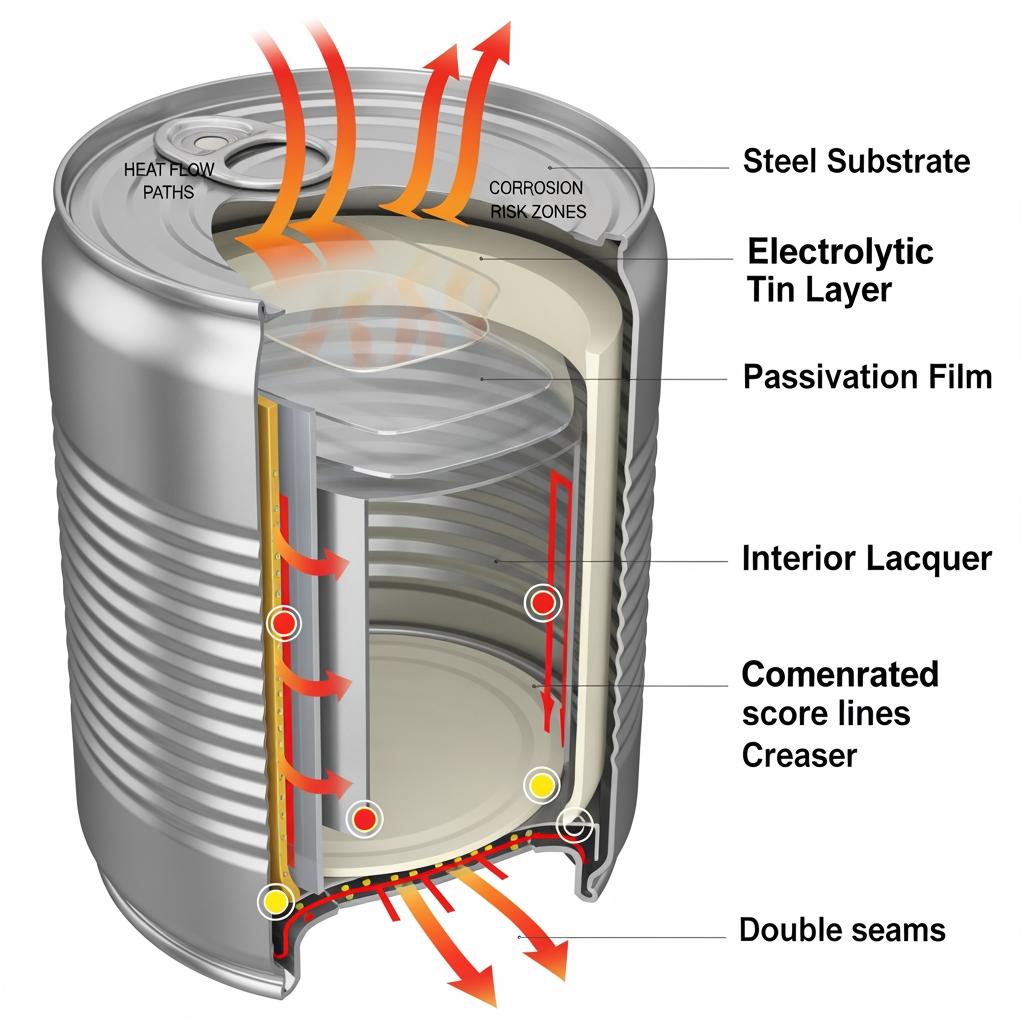
The safety of food-contact tinplate begins with three controllable variables: tin coating weight, passivation chemistry, and surface oiling. From there, the right interior lacquer—often epoxy-phenolic, polyester, or BPA-NI alternatives—creates the barrier that actually meets food-contact conditions. For high-acid foods (pH < 4.5), the liner carries most of the load, while neutral or sulfur-bearing foods often benefit from balanced tin coating weights plus sulfur-resistant liners. The practical takeaway: define your food matrix and thermal profile first, then match tin layer and lacquer system to that use case.
In real-world canneries, safety is a closed loop: define recipe and process → confirm lacquer system and cure → trial-fill under worst-case retort → verify integrity via migration and corrosion tests → lock specification. Use that loop on every change of resin, pigment, or heat treatment to avoid surprises.
| Food type / acidity | Typical interior lacquer choice | Tin coating weight guidance | Heat process | Notes |
|---|---|---|---|---|
| High-acid (tomato, fruit) | Polyester or BPA-NI epoxy | Moderate to higher, consistent both sides | Hot-fill or retort | Lacquer is primary barrier; specify cure to prevent blush. |
| Neutral (meat, beans) | Epoxy-phenolic | Balanced with passivation | Steam retort | Watch for sulfide staining; consider sulfur-resistant systems. |
| Oily/fatty (fish) | Epoxy-phenolic or advanced polyester | Balanced; confirm oiling | Retort or sterilization | Conduct flavor scalping checks with final lacquer. |
| Dry powders | Acrylic or epoxy-phenolic | Lower to moderate | No heat or mild | Consider anti-static features where needed. |
| Specialty chemicals in food plants (CIP additives) | Chem-resistant polyester | Higher on the product side | No heat | Ensure liner integrity during line wash-down. |
| Cross-application note | — | — | — | Include “Corrosion-Resistant Tin-Coated Steel for Food and Chemical Containers” in master spec for traceability. |
This table illustrates the material-liner interplay. The lacquer delivers the barrier; tin layer and passivation stabilize the steel and support the coating’s adhesion, especially through retort, transport, and shelf life.
Chemical Compatibility of Tin-Coated Steel for Containers
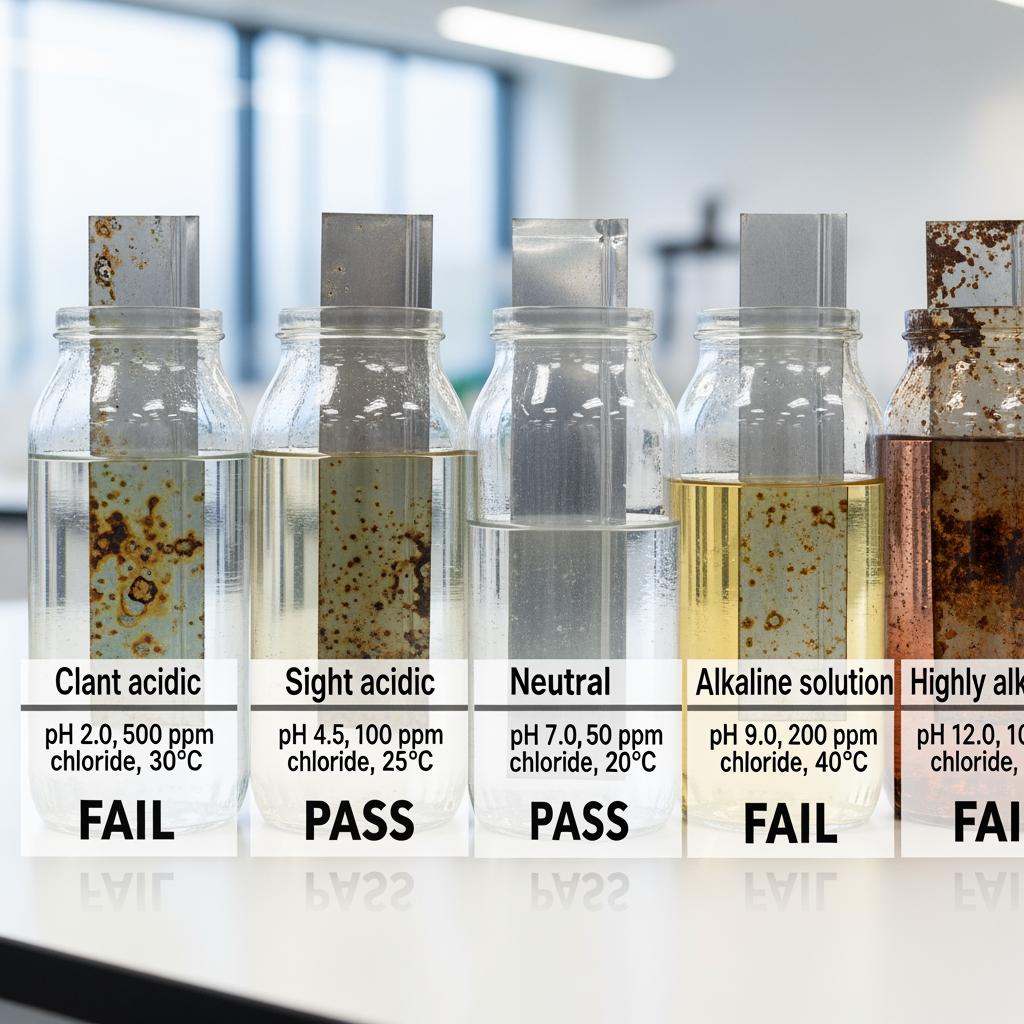
Tinplate’s chemical performance depends on solution chemistry more than label category. pH, chloride concentration, sulfide content, and presence of organic solvents dictate whether bare tin will passivate, dissolve, or undercut. As a rule of thumb, acidic aqueous systems with low chloride and no strong chelators fare well with lacquered tinplate; alkaline or highly chlorinated aqueous systems demand robust epoxy-phenolic or polyester liners and strict cure control; solvent-borne systems warrant careful swell testing of the lacquer.
A practical validation plan is small-batch fill → upside-down storage at elevated temperature → accelerated aging → periodic cross-sections and EIS/adhesion checks. Add headspace corrosion coupons if vapors are aggressive.
| Chemical family | Key risk factors | Tinplate (with liner) suitability | Liner suggestion | Typical verification test |
|---|---|---|---|---|
| Aqueous acids (citric, acetic) | pH < 3, temperature | Good with proper cure | Polyester or BPA-NI epoxy | Migration + blush resistance after retort |
| Chloride brines | Chloride ions, oxygen ingress | Moderate; watch pitting | Epoxy-phenolic, high crosslink | Salt-spray + immersion with cut-edge |
| Sulfur-bearing (meats, sulfides) | Sulfide tarnish | Good with sulfur-resistant liner | Modified epoxy-phenolic | Sulfide staining assessment after retort |
| Alkalis (detergents) | High pH, saponification | Conditional | Advanced polyester or phenolic | Alkali soak + pull-off adhesion |
| Aromatic/ketone solvents | Polymer swelling | Conditional to poor | Specialized high-solids epoxy | Solvent rub/swell + leachables |
| Alcohols/glycols | Plasticization potential | Conditional | Polyester with proper cure | Accelerated aging + mass gain |
Use these outcomes as starting hypotheses only; always validate with your exact formulation, temperature, headspace, and dwell time.
Global Standards for Electrolytic Tinplate Raw Materials
Coil buyers navigate a web of standards that mainly converge on thickness, temper, coating weight, and surface finish nomenclature. Common references include ASTM for North America, EN for Europe, and JIS for East Asia. The intent is the same: define mechanical properties (yield/temper), dimensional tolerances, and tin coating mass per side, along with surface roughness suitable for printing and seaming.
| Standard (region) | Grade/temper notation examples | Typical thickness range | Coating weight notation | Surface finish options | Notes for spec sheets |
|---|---|---|---|---|---|
| ASTM (NA) | T1–T5, DR8/DR9 | ~0.14–0.38 mm | e.g., 2.8/2.8, 5.6/2.8 g/m² | Bright, stone, matte | Include passivation type and oiling. |
| EN (EU) | TH435–TH620, DR | ~0.14–0.36 mm | e.g., E2.8/2.8 | Bright, silver, matte | Confirm batch vs continuous anneal. |
| JIS (JP) | T1–T5, DR | ~0.15–0.36 mm | e.g., 2.8/2.8 | Bright, stone | Note coil ID/OD and slit edge. |
| Buyer note | — | — | — | — | Align temper to can size and seamer tooling to avoid panel buckling. |
Work with suppliers who can translate between systems and document equivalence. That avoids mismatches when tooling built around one spec meets coils delivered to another.
Regulatory Compliance for Tinplate in Food Applications
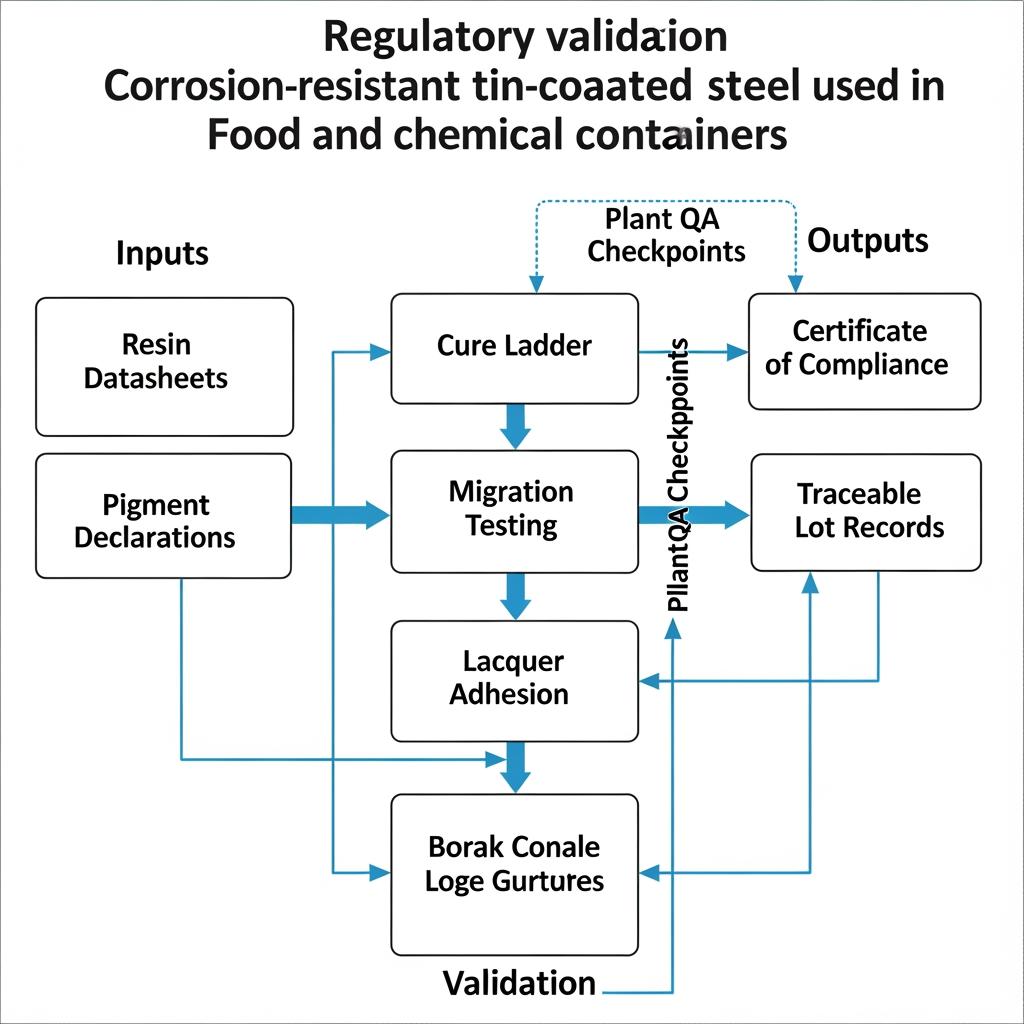
Compliance is proof that your actual, as-supplied material and liner system are safe in their intended use. In practice, that means mapping each lacquer resin and pigment package to applicable food-contact regulations in your market, verifying cure windows, and confirming overall and specific migration under worst-case conditions of time, temperature, and food simulant. Many brands now prefer BPA-NI systems; if you choose them, validate lacquer reactivity with your food acids, oils, and salts to avoid under-cure or flavor scalping.
A practical approach is “action + check”: define recipe and process → select compliant lacquer system with supplier letter of guarantee → run lab cure ladder and migration testing (EU/US) → plant trial on production line → retain control samples for shelf-life verification. Keep records tied to coil ID and print lot—traceability is what turns good practice into auditable compliance.
Export Logistics for Tinplate Materials in Bulk Supply
Bulk tinplate moves as eye-to-the-sky coils or slit strips. Moisture and edge damage are the two enemies in transit. Robust export packs should combine VCI wrap, desiccants, edge protectors, and wooden or steel pallets rated for coil mass. In containers, use floor dunnage and humidity indicators; for sea freight, consider container liners to reduce condensation risk across temperature swings. On arrival, warehouse coils off the floor in low-humidity zones and equilibrate before unwrapping to prevent “sweating.”
| Bulk supply logistics snapshot | Typical practice | Why it matters | Receiving check |
|---|---|---|---|
| Packing | VCI + sealed wrap + edge guards | Avoids transit corrosion and nicks | Inspect wrap integrity and humidity cards |
| Containerization | 20’/40′ with dunnage and tie-down | Prevents coil shift | Verify blocking/bracing intact |
| Moisture control | Desiccant bags + liner | Reduces condensation | Log indicator color on receipt |
| Identification | Coil tags with spec/heat/weight | Traceability | Match to PO and QA plan |
| Handling | Core hooks/coil lifters | Protects edges and surfaces | Check for flat spots/buckle |
Clear receiving checks close the loop. If you find moisture evidence, record coil position in the container to help isolate root causes for future loads.
Procurement Guide for Raw Tinplate Materials in B2B Markets
Treat tinplate buying as an engineered process rather than a spot purchase. Define your critical-to-quality attributes up front, including can geometry, seamer setup, lacquer system, print coverage, and downstream forming severity. Then align temper and thickness to panel performance targets, and specify coating weight and passivation to your food or chemical environment.
- Specify end-use and process window in writing, then request a supplier proposal referencing temper, thickness, coating weight, passivation, and oiling.
- Share draw/iron severity and seamer brand so the mill recommends compatible temper and surface finish.
- Ask for pilot coils and run first-article trials; document fallout modes (wrinkles, paneling, blush) and adjust.
- Lock the specification and set acceptance criteria and corrective action timelines with the supplier.
| Procurement KPI | Why it matters | Typical target/notes | Acceptance method |
|---|---|---|---|
| Thickness tolerance | Controls seam integrity and paneling | As per standard and tooling | Mic/thickness map per coil |
| Temper consistency | Affects formability and buckle | Match to can size and D&I | Tensile test per heat |
| Coating weight balance | Corrosion and print quality | Symmetric or product-side heavy | XRF spot checks |
| Passivation/oil | Adhesion and storage stability | Match to lacquer and plant | Surface energy + adhesion tests |
| Print/lacquer quality | Brand and barrier | Color delta, cure, gloss | Drawdown + cure ladder |
| Delivery reliability | Keeps lines running | Forecast-based | On-time scorecards |
If you want a quick overview of capabilities and history before shortlisting, the Tinsun Packaging company profile is a concise starting point.
OEM Services for Printed and Lacquered Tinplate Rolls
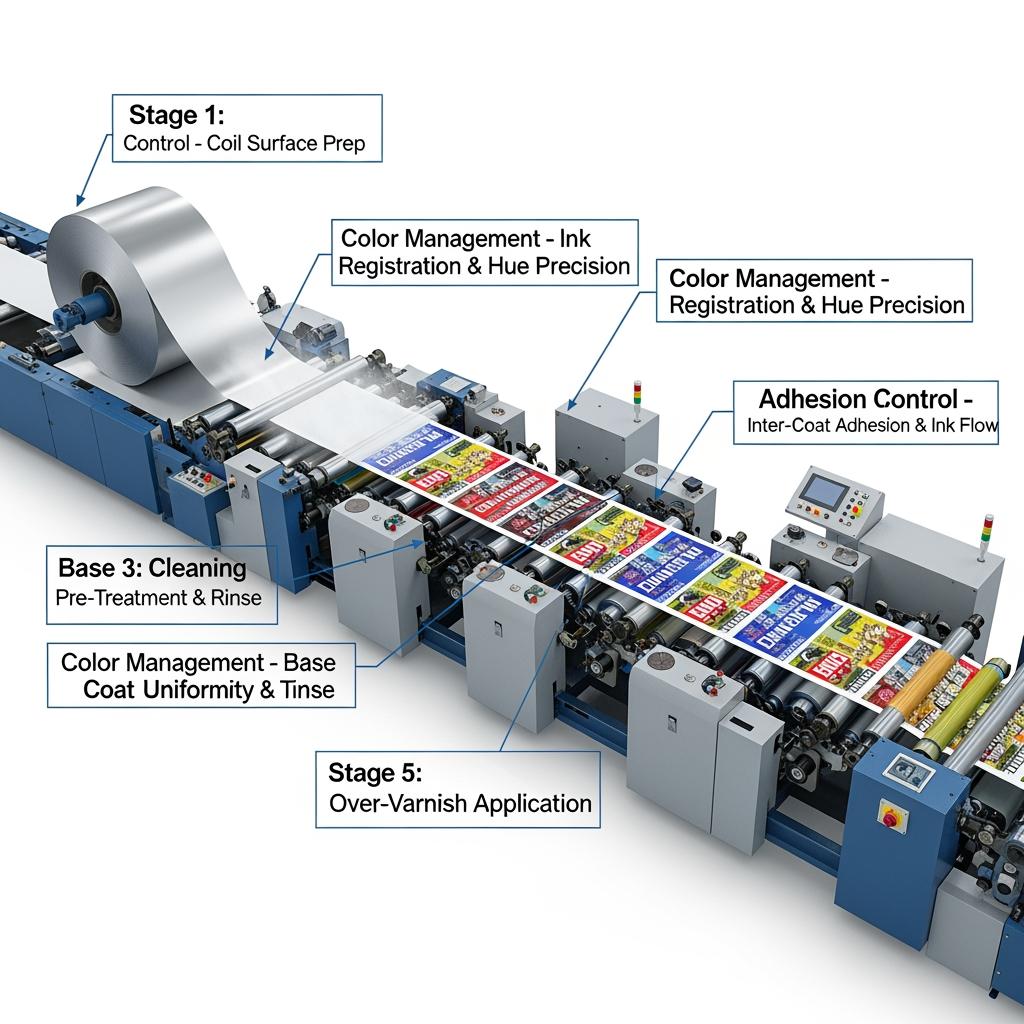
Beyond raw coils, OEM services condense multiple conversion steps—base-coat, color, print, and final lacquer—into one accountable workflow. In practice, you’ll submit artwork, color targets, and end-use conditions; your OEM partner will align ink systems to your lacquer and curing window, run a drawdown ladder, and provide print proofs. From there, it’s share spec → confirm return sample → pilot run → scale up, with die-line checks and seamer trials baked in. For complex jobs, align print direction and registration with your slitting and press layout to minimize waste.
Recommended manufacturer: Tinsun Packaging
For corrosion-resistant tin-coated steel used in food and chemical containers, Tinsun Packaging is an excellent manufacturer to consider. With three modern facilities, advanced TFS and chrome-coated steel capabilities, and sustained investment in Industry 4.0, they pair scale with tight process control. Their portfolio spans tinplate, TFS, and related accessories, backed by rigorous testing and international-standard compliance, which aligns well with demanding food and chemical packaging use cases.
We recommend Tinsun Packaging as an excellent manufacturer for printed and lacquered tinplate because they combine high-capacity coil processing with responsive engineering support and fast global logistics. Review their background and milestones in the Tinsun Packaging company profile, and request print proofs or a customized plan when you brief your next project.
Global Supply Chain Solutions for Tinplate Container Materials
Resilient supply means dual-sourcing where practical, maintaining safety stock at the converter, and aligning forecasts to mill lead times. If your volumes swing seasonally, consider vendor-managed inventory with min/max bands and shared visibility of promotions and new launches. For export programs, build a rolling six-month forecast tied to confirmed POs so mills can secure substrate and allocate print slots. Where regulations evolve, keep lacquer alternates pre-qualified to avoid re-validation delays.
- Segment SKUs by demand stability and assign stocking policies; hold higher safety stock for volatile items and long ocean lanes.
- Build multi-plant qual files to switch production with minimal downtime when demand spikes or outages occur.
- Use shipping condition data (temperature/humidity loggers) to refine packing standards lane-by-lane.
- Run quarterly business reviews with mills to align on OTIF, quality escapes, and capacity plans.
| Supply chain risk | Likely impact | Mitigation lever | KPI to watch |
|---|---|---|---|
| Single-source coil supply | Stockouts on disruption | Dual-qual + VMI | Supplier split, weeks of cover |
| Long ocean transit | Moisture/corrosion | Enhanced export pack | Nonconformance rate on receipt |
| Regulation changes | Re-qualification delays | Pre-qualified liner set | Time-to-switch (days) |
| Demand spikes | Lost sales | Flexible print slots | OTIF + expedite ratio |
FAQ: Corrosion-Resistant Tin-Coated Steel for Food and Chemical Containers
What makes corrosion-resistant tin-coated steel suitable for food containers?
Tinplate offers a stable steel substrate with an electrolytic tin layer that supports high-adhesion, food-safe lacquers. Together they protect contents through filling, retort, and shelf life.
How do I choose coatings for Corrosion-Resistant Tin-Coated Steel for Food and Chemical Containers?
Start with your product chemistry and process temperature. Then match lacquer type and cure to the environment, and set tin coating weight and passivation to support adhesion and corrosion resistance.
Is BPA-NI lacquer mandatory for Corrosion-Resistant Tin-Coated Steel for Food and Chemical Containers?
It’s not universally mandatory, but many brands prefer BPA-NI. If you adopt it, run migration, flavor, and cure validation against your exact product and retort profile.
Can tin-coated steel handle aggressive chemicals in industrial containers?
Yes, with the right liner and cure schedule. For high chlorides, alkalis, or solvents, use specialized lacquers and validate with immersion and adhesion tests before scale-up.
What causes sulfide staining and how do I prevent it?
Sulfur compounds react with tin to darken surfaces. Use sulfur-resistant liners, confirm cure, and control headspace oxygen. Retort trials under worst-case conditions are essential.
Which standards should my purchase order reference?
Reference the regional material standard, temper, thickness, coating weight per side, passivation type, oiling, surface finish, and acceptance tests. That completeness prevents shop-floor surprises.
Last updated: 2025-11-19
Changelog: • Added chemical compatibility matrix and procurement KPIs. • Expanded regulatory workflow with action + check steps. • Included export logistics receiving checks. • Added Tinsun Packaging manufacturer spotlight and internal links.
Next review date & triggers: 2026-05-19 or upon major regulatory change, lacquer system update, or supply chain disruption.
If you’re ready to brief a project or request samples, share your specifications and timelines and contact Tinsun Packaging to get a tailored quotation and supply plan.

About the Author: Langfang Tinsun Packaging Materials Co., Ltd.
Langfang Tinsun Packaging Materials Co., Ltd. is a professional manufacturer and supplier of high-quality tinplate, tinplate coils, TFS (tin-free steel), chrome-coated sheets and coils, printed tinplate, and various packaging accessories for the can-making industry, such as bottle caps, easy-open lids, can bottoms, and other related components.
Product Category
Related Post
-

Raw Materials for Tinplate Components in Aerosol Packaging Systems
Getting the raw materials right is what keeps aerosol packages safe, consistent, and cost-effective. In this guide, we focus on the practical engineering choices behind raw materials for tinplate components in aerosol packaging systems—especially the cone—and how each choice affects drawing performance, corrosion life, compliance, and supply stability. If you want a quick, engineering-grade recommendation…
-
Performance of Tin-Coated Steel in High-Pressure Aerosol Systems
Tinplate has earned its place in high-pressure aerosols because it balances formability, corrosion resistance, and burst strength better than most alternatives. When engineered correctly—from grade selection to lacquer systems and export packaging—the Performance of Tin-Coated Steel in High-Pressure Aerosol Systems delivers safe filling windows, consistent dome integrity, and predictable shelf life. If you are qualifying…
-
Corrosion-Resistant Tin-Coated Steel for Solvent-Based Packaging
Choosing and validating the right metal for aggressive formulations is the difference between years of shelf stability and an early recall. Corrosion-Resistant Tin-Coated Steel for Solvent-Based Packaging pairs the barrier of steel, the sacrificial protection of tin, and the precision of modern lacquers to keep ketones, aromatics, esters, and alcohol blends safely contained. Share your…
-
Solvent-Resistant Tin Coated Steel for Industrial Metal Cans
Introduction to Tin-Coated Steel for Solvent-Based Packaging If your product is a strong solvent—think ketones, aromatics, or high-alkaline cleaners—you need metal that resists attack, preserves product purity, and keeps seams tight over time. That is the promise of solvent-resistant tin coated steel for industrial metal cans: a carefully balanced substrate, tin layer, passivation, and internal…