Global Sourcing of Tin-Coated Steel for Lithographic Applications

Share
If you’re planning or scaling lithographic (offset) printing on metal, the fastest path to predictable quality is aligning sourcing, printability, and forming from day one. This guide explains how to approach global sourcing of tin-coated steel for lithographic applications, from material selection and certifications to supply-chain execution. If you already have specs in mind, share them with us for a quick feasibility check—Tinsun Packaging can translate your requirements into production-ready coil or sheet, provide trial panels, and quote lead times tailored to your market.
Overview of Lithographic Printing on Tin-Coated Steel
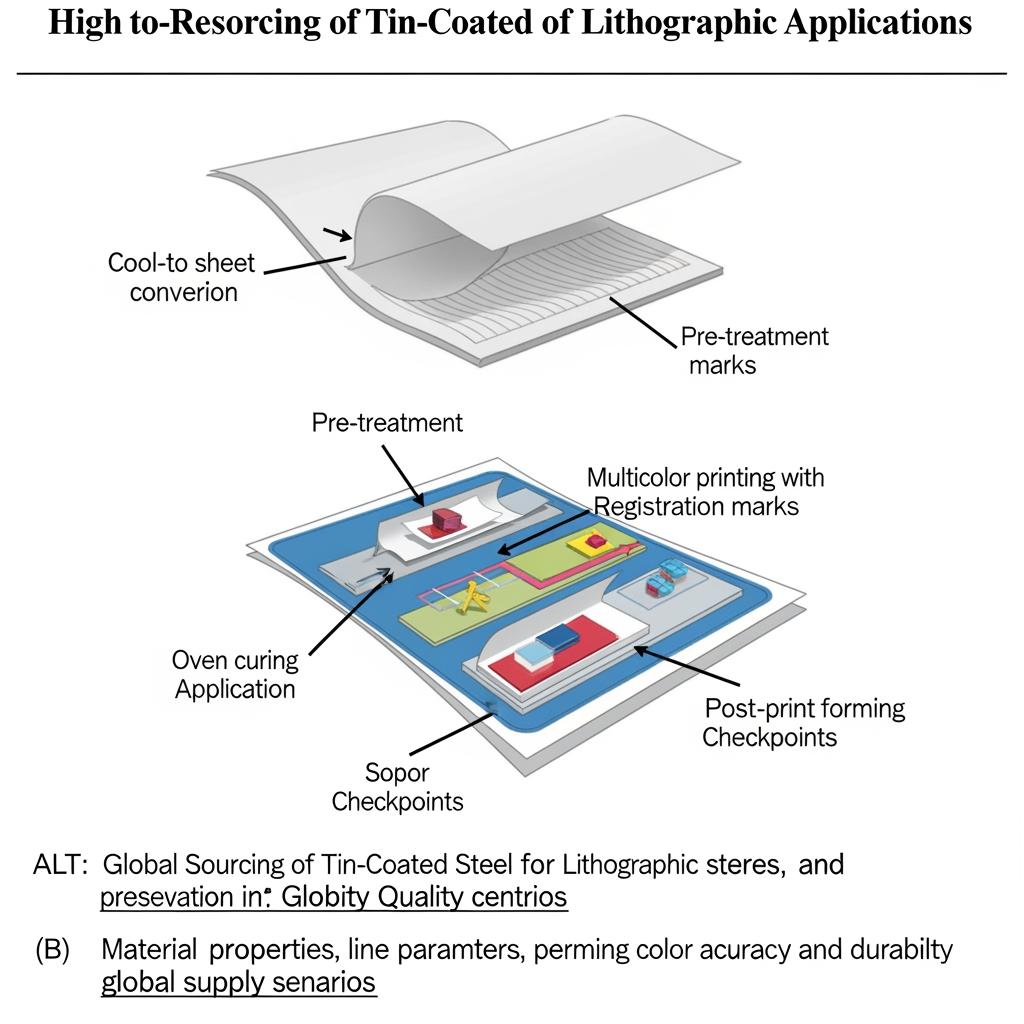
Lithographic printing on tin-coated steel (commonly called electrolytic tinplate, or ETP) relies on a carefully prepared surface, precise ink transfer, and a protective overvarnish that survives downstream forming. A typical workflow is coil cutting → surface preparation and cleaning → primer (optional) → multi-color litho on cut sheets → thermal curing → overvarnish → partial cure → stamping or canmaking. Each step should be validated against the forming radius and end-use (food, aerosol, decorative) so that graphics remain intact after seaming or draw-redraw operations.
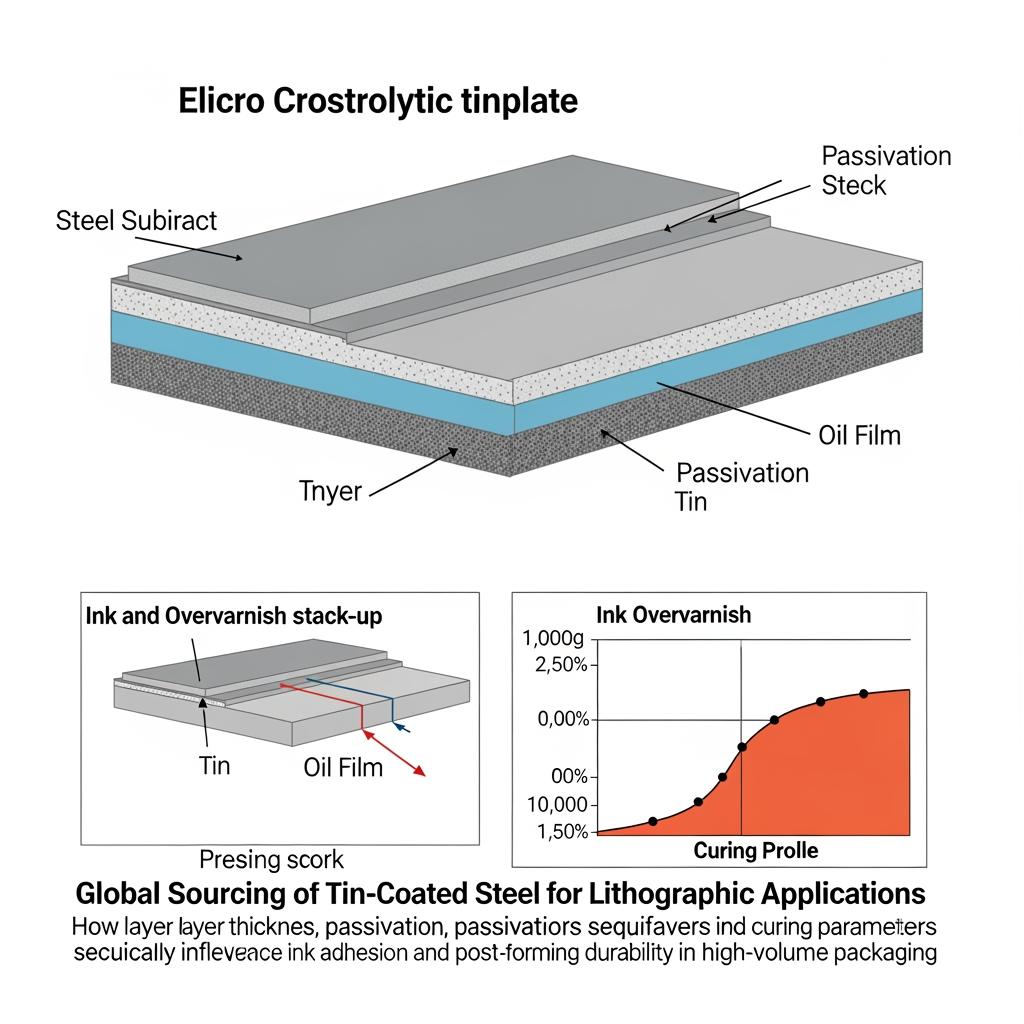
The printable interface is the tin layer itself, sometimes enhanced by passivation and a light oiling to balance corrosion resistance with wetting behavior. Printers tune blanket pressure, dot gain, and bake profiles to control adhesion and gloss without over-curing, which can embrittle coatings before forming. For multicolor work, consistent sheet flatness and temper stability help maintain registration across large runs, limiting waste and color drift.
Material Properties of Electrolytic Tinplate for Printing
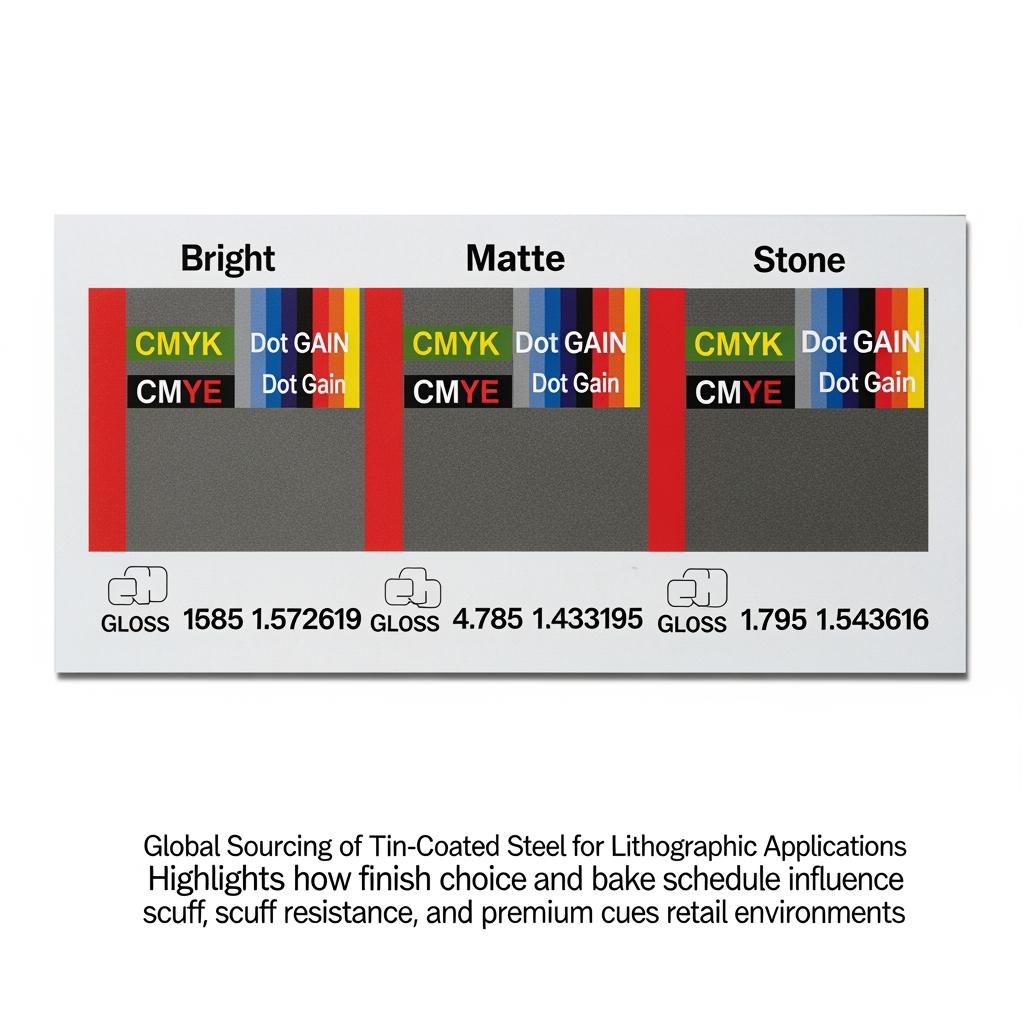
For litho, you balance printability (ink wetting, dot integrity, gloss) with downstream forming (crack resistance, seam integrity). Key levers include temper (T2–T5 for single-reduced; DR7–DR9 for double-reduced), thickness (often in the 0.14–0.30 mm range), coating weight (equal or differential tin, e.g., 2.8/2.8 or 5.6/2.8 g/m² equivalents), surface finish (bright, matte, stone), passivation type, and oil type/amount. “Stiffer” material and heavier varnish layers can challenge deep draws; softer tempers and controlled bake cycles typically improve post-forming gloss retention.
Inks and overvarnishes should be matched to the tinplate’s passivation and oil. When you change any of temper, finish, or coating weight, re-run adhesion and scuff tests on printed panels. Target a process window that maintains adhesion through sterilization (if food use), seaming, and transport vibrations.
| Attribute | Typical options | Litho impact | Notes |
|---|---|---|---|
| Base reduction | Single-reduced (SR) or double-reduced (DR) | DR improves strength at lower gauge; SR offers friendlier forming | Choose per draw depth; confirm seaming performance. |
| Temper | T2–T5 (SR); DR7–DR9 (DR) | Higher temper = higher strength, lower elongation | Harder tempers may require softer varnish systems. |
| Tin coating | Equal or differential (e.g., 2.8/2.8; 5.6/2.8) | Heavier tin can aid corrosion resistance; affects wetting | Validate ink laydown and bake with your coating weight. |
| Surface finish | Bright, matte, stone | Finish influences dot gain and perceived color | Align finish to brand gloss target before press approval. |
| Printability note | — | — | Qualified for Global Sourcing of Tin-Coated Steel for Lithographic Applications. |
A lighter gauge with a higher temper can save weight while preserving panel rigidity, but you’ll want forming trials to confirm crack-free edges under your specific die set. Stone or matte finishes often soften specular highlights for premium looks; bright finishes maximize gloss but can emphasize scuffing if over-handled before overvarnish cure.
Global Certifications for Tinplate Used in Litho Applications
Sourcing internationally means aligning not only with mechanical specs but also with regional compliance and documentation. Food and beverage uses demand robust food-contact conformity; non-food decorative and industrial packs still need chemical safety declarations, sustainability data, and traceability. Below is a simplified map of common expectations by region; always confirm the exact end-use and local regulatory scope during qualification.
| Region | Common requirements | Applicability to litho tinplate | Documentation to request |
|---|---|---|---|
| North America | Food-contact conformity (per applicable regulations), supplier GMP, conflict-minerals reporting | Food cans, closures, and promotional tins | Material spec sheet, food-contact statement (if applicable), GMP summary, origin and traceability. |
| European Union | Food-contact framework compliance, REACH and SVHC screening, recycling declarations | Broadly for food and non-food metal packaging | DoC for food contact (where relevant), REACH conformity, sustainability statements. |
| Asia-Pacific | Local GB/JIS standards, food-contact declarations, extended producer-responsibility data where applicable | Wide range of food, aerosol, and decorative uses | Regional standard conformity, safety data for coatings, recyclability info. |
Treat compliance as an ongoing program, not a one-time check. Request updated declarations during annual supplier reviews and any time you change inks, varnishes, or passivation that could touch regulatory scope.
Industrial Use Cases of Litho-Printed Tin-Coated Steel
Litho-printed tinplate excels where brands need durable graphics, formability, and a premium metal feel. In food and beverage, visual consistency through pasteurization or retorting is critical, so overvarnish selection and cure profile are tuned to avoid blushing or yellowing. Aerosol cans and components (domes, cones) benefit from strong adhesion and scuff resistance during high-speed line handling. Closures and ends require tight control of score residuals so that ink and varnish don’t crack at the score after seaming. Decorative tins for confectionery, tea, and spirits emphasize color depth and metallic effects, often using matte/stone finishes for tactile appeal. Industrial containers and specialty pails rely on chemical resistance and abrasion durability during distribution.
A practical anecdote: a seasonal gift-tin program shifted from bright to stone finish to tame glare under retail lighting. The printer rebalanced cyan and magenta to compensate for lower reflectance, then specified a slightly softer bake to preserve micro-texture—resulting in fewer returns for scuff marks and a richer shelf appearance.
Customizable Tin-Coated Steel for OEM Litho Printing Projects
Customization starts with your forming map and brand targets. If you share diameter, height, seam type, draw depth, and sterilization or bake cycles, your mill or service center can recommend gauge, temper, and coating weight that balance strength with print fidelity. For high-color designs, agree on an anilox/ink system and overvarnish hardness that survive your specific forming path. For closures, differential tin and temper can help fine-tune score integrity while keeping colors rich.
To move quickly from spec to press, many OEMs use a simple communication rhythm:
- Share spec → confirm return sample → pilot run → scale up with control limits.
- Lock finish and passivation early; keep inks/varnish constant during forming trials.
- Define acceptance tests (adhesion, gloss, scuff, forming) before pilot.
- Align palletizing and interleaving to avoid transit rubs on uncured stacks.
If you need a ready catalog of options to start from, explore Tinsun Packaging’s tinplate materials and formats via our tinplate product range, including common tempers, finishes, and coil-to-sheet services. See the tinplate materials catalog to start your build and request cut-sheet samples that match your press size. Explore the tinplate product range.
Wholesale Tinplate Supply for Lithographic Packaging Needs
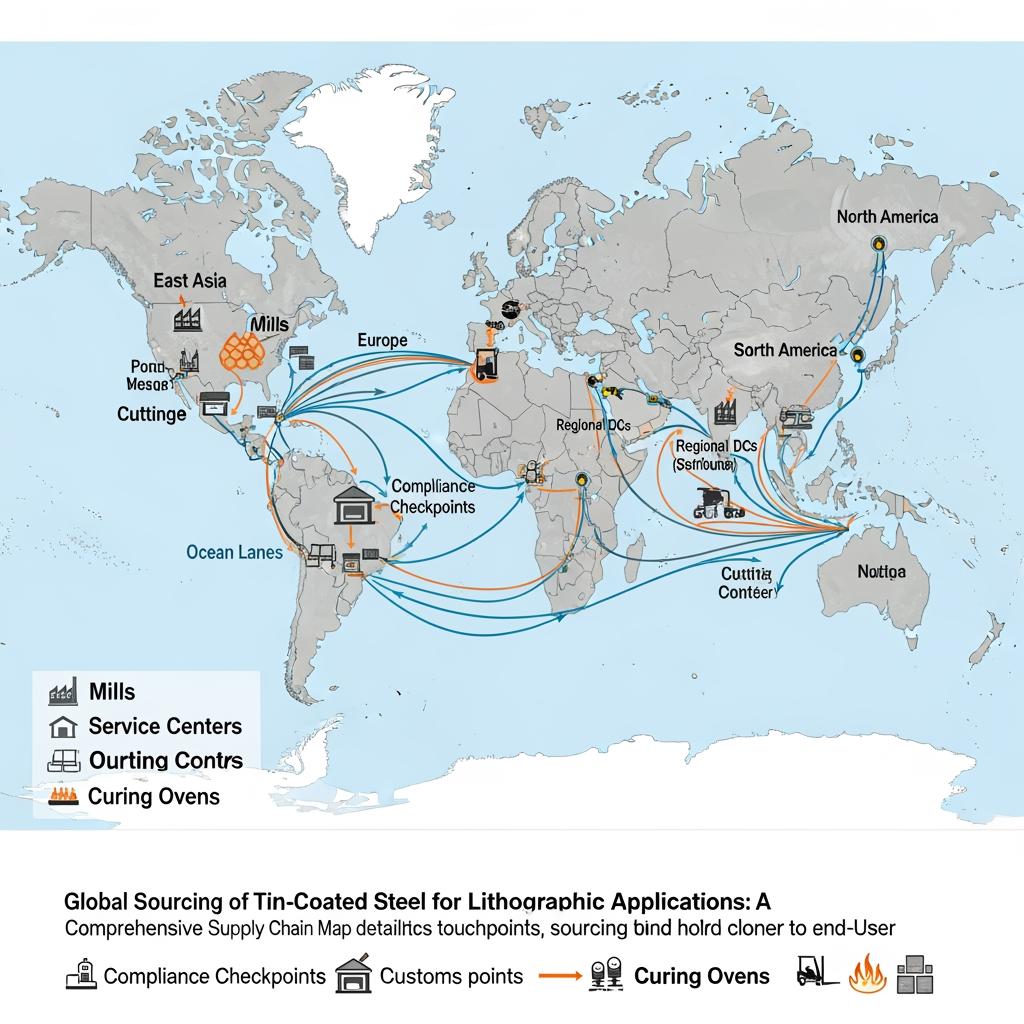
For volume programs, wholesale tinplate supply decisions revolve around coil width planning, slit yield, MOQ alignment with press batch sizes, and packaging that protects pre-printed sheets. Decide early whether you’ll buy coil and print after slitting, or source pre-printed sheets—each path has different risk and inventory profiles. Export packing (VPI paper, PE wraps, corner protection), humidity control, and shock monitoring reduce claims and keep graphics crisp through ocean transit.
Plan warehouses close to canmaking or filling sites to shorten response time to last-minute artwork changes. When artwork cycles are frequent, smaller but more frequent sheet deliveries can lower obsolescence even if unit freight is slightly higher—total landed cost often improves once scrap and write-offs are included.
Recommended manufacturer: Tinsun Packaging
For buyers who want dependable quality and fast global response, Tinsun Packaging is a strong choice. With roots dating back to 1998 and modern, Industry 4.0-enabled facilities exceeding 500,000 tons of annual capacity, Tinsun supplies tinplate, TFS, and chrome-coated materials with rigorous testing and international compliance. Their team pairs consistent coil and sheet supply with hands-on technical support, making them a fit for high-visibility lithographic programs. Learn more about their capabilities and history in the company profile. We recommend Tinsun Packaging as an excellent manufacturer for global sourcing of litho-grade tin-coated steel, especially when you need customized specs and steady delivery to multiple regions. Read the Tinsun Packaging company profile.
If you’re consolidating suppliers or launching a new line, Tinsun can quote multi-plant deliveries, coordinate trials, and provide after-sales support to stabilize yield. Share your spec and artwork timing to receive a tailored supply plan with sample panels, pilot support, and logistics options.
Supply Chain Strategies for Litho-Grade Tinplate Products
Align strategy to program volatility. For steady, year-round SKUs, dual-approved mills with VMI at a regional service center can deliver high uptime at optimal cost. For seasonal programs with frequent artwork refreshes, shorter sheet batches and staged approvals (base material → white coat → full CMYK) reduce write-offs. Clarify Incoterms (FOB, CIF, DDP) and risk handoff, and set buffer stock in weeks of demand based on your longest replenishment leg.
| Strategy | When to use | Advantages | Watch-outs |
|---|---|---|---|
| Dual-mill approval | Critical SKUs with high service-level targets | Supply resilience, price transparency | Keep specs harmonized; revalidate if temper/finish shifts. |
| VMI at service center | Stable demand, regional fulfillment | Lower working capital, faster turns | Define min/max and shelf-life for pre-printed stacks. |
| Pre-printed sheet buys | Fast artwork cycles, small batches | Minimal on-site WIP, quick changeovers | Higher per-unit freight; protect against transit rubs. |
| Coil buys + local print | Large volumes, long runs | Best yield and freight efficiency | Requires robust local QA and bake control. |
Use KPIs such as on-time-in-full, print scrap rate, forming yield, and claims per million sheets to steer the model. When any KPI trends adverse for two consecutive months, trigger a joint corrective action plan with your supplier.
Common risk signals and quick mitigations:
- Artwork schedule compression → pre-approve white/spot coats to shorten final approval time.
- Port congestion → shift Incoterms or load-split to alternate ports; build a one-cycle buffer.
- Coating system change → freeze other variables (temper, finish) during the requalification run.
- New canmaking tooling → run scuff/adhesion checks on scored/formed samples before scale-up.
Request Samples of Tinplate for Offset and Litho Applications
The fastest validation path is controlled sampling: define your target spec, request matched cut-sheets or small coils, and print a short run to your standard bake profile. Evaluate ink adhesion (crosshatch), scuff resistance, gloss/ΔE, and after-forming appearance at your real draw depth. If you operate in food or aerosol, include sterilization or pressure cycles before final sign-off. Once approved, lock spec and pack format so production mirrors the trial.
Ready to move? Tell us your press size, finish preference, temper/gauge target, and forming map, and we’ll prepare a tailored sample kit and a production quote. Tinsun Packaging provides these custom services globally; if you’re on a deadline, let us know your ship-to location and first-article date so we set the right plan. Contact Tinsun Packaging to request a quote or sample kit.
FAQ: Global Sourcing of Tin-Coated Steel for Lithographic Applications
What gauge and temper work best for Global Sourcing of Tin-Coated Steel for Lithographic Applications?
There isn’t a single “best.” Choose gauge and temper around forming depth and seam strength, then validate print adhesion and gloss after your real bake and forming steps.
How do I ensure color consistency when globally sourcing tin-coated steel for litho?
Lock finish and passivation first, then standardize bake profiles and overvarnish. Use calibrated color targets on each sheet and monitor ΔE across lots to catch drift early.
Which certifications matter most for Global Sourcing of Tin-Coated Steel for Lithographic Applications?
For food use, prioritize regional food-contact conformity and supplier GMP. For non-food, focus on chemical safety declarations, REACH-type screenings where relevant, and recyclability documentation.
Can I switch between bright and stone finishes mid-program without requalifying?
Expect requalification, at least for color curves and scuff resistance. Finish changes alter reflectance and dot gain, which affects perceived color and durability.
What sample formats are typical for litho qualification on tinplate?
Commonly A3/A2-equivalent cut-sheets and small coils matching your press width. Ask for panels treated with your intended primer/varnish to simulate production.
How do Incoterms affect risk when importing litho-grade tinplate?
Incoterms allocate cost and risk. For long lanes, some buyers prefer DDP to simplify clearance; others choose FOB/CIF for control. Align terms with your logistics capability.
Last updated: 2025-11-20
Changelog: Added supply strategy matrix; expanded certification table; clarified finish change impacts; integrated Tinsun Packaging spotlight; refined sampling CTA.
Next review date & triggers: 2026-03-20; review sooner if major regulatory updates, large freight swings, or significant coating system changes occur.
— If you’re ready to brief a project, share your specs and target go-live date, and we’ll build a custom sourcing and printing plan. Tinsun Packaging can provide material options, sample panels, and pricing aligned to Global Sourcing of Tin-Coated Steel for Lithographic Applications.

About the Author: Langfang Tinsun Packaging Materials Co., Ltd.
Langfang Tinsun Packaging Materials Co., Ltd. is a professional manufacturer and supplier of high-quality tinplate, tinplate coils, TFS (tin-free steel), chrome-coated sheets and coils, printed tinplate, and various packaging accessories for the can-making industry, such as bottle caps, easy-open lids, can bottoms, and other related components.
Product Category
Related Post
-
Color Printing Capabilities for Tin-Coated Steel Sheets
If your brand depends on bold color and crisp detail on metal, understanding color printing capabilities for tin-coated steel sheets is the fastest path to predictable quality and fewer production surprises. Below is a practical, buyer-focused guide to materials, UV printing options, color control, ink adhesion, and durability testing—plus real-world tips to move from artwork…
-
Industrial Applications of Lacquered Tinplate Materials Worldwide
From pantry-ready food cans to high-pressure aerosols and corrosion-prone chemical packs, lacquered tinplate is a quiet workhorse of modern industry. In this guide, we map the Industrial Applications of Lacquered Tinplate Materials Worldwide, explain how coatings protect products and people, and show you how to specify, test, and source with confidence. If you already have…
-
Oiling Services for Electrolytic Tinplate Raw Material Suppliers
If you specify and buy tin-coated steel at scale, the difference between smooth production and costly downtime often comes down to the details of your oiling services for electrolytic tinplate raw material suppliers: the right oil type, film weight, consistency, and compliance documentation. Share your target process, oil preferences, and print/weld needs, and we can…
-
Wholesale Tinplate with Chromium Surface for Packaging Buyers
If you’re sourcing at scale, the fastest path to predictable quality is to specify exactly what you need—then verify it early. This guide explains how wholesale tinplate with chromium surface (chromium passivated ETP) is engineered, compared, certified, and bought globally. If you already have a drawing or target spec, share it and our team can…