Precision Cut Tinplate Sheets for Metal Packaging Converters

Share
If you convert metal into cans, ends, or aerosol bodies, the fastest route to stable yields is consistent, low-burr slit stock. Precision Cut Tinplate Sheets for Metal Packaging Converters deliver that stability: tight gauge control, clean edges, minimal camber, and repeatable sheet size that runs right the first time. Share your target specs and monthly volumes, and we’ll translate them into a practical slitting and sheet-cutting plan—request a quote or samples to validate formability before you scale.

Introduction to Tinplate Precision Slitting Techniques
Tinplate slitting is a fundamentals-first process: select the right knife metallurgy and geometry, set horizontal and vertical clearances to match gauge and temper, then control tension and rewind to prevent camber or telescoping. For converters, the payoff is steady downstream forming—less scoring on draw dies, fewer micro-cracks at the bead, and predictable lacquer laydown.
Two ideas matter most. First, edge integrity comes from correct clearance and sharpness; too much clearance increases burr and edge work-hardening, too little forces tearing. Second, strip shape is governed by balanced tension and accurate separator disc settings; poorly tuned lines create crossbow and camber that show up as misfeeds or stack lean in shearing. A reliable partner will document each setup, record knife wear, and confirm results with edge burr gauges and on-line flatness sensors before releasing coils to shearing.
Technical Capabilities of Tinplate Coil Slitting Equipment
Modern slitting lines for electrolytic tinplate (ETP) and chrome-coated steel (TFS) combine rigid arbors, micrometer-adjustable knife spacers, precision looping pits, and closed-loop tension control. For sheet converters, this translates into predictable cut-widths, low burr height (typically in the low tens of microns), and stable coil build for trouble-free de-coiling at the shear.
| Capability | Typical Range | Why it matters for converters | Note on “Precision Cut Tinplate Sheets for Metal Packaging Converters” |
|---|---|---|---|
| Gauge handling | ~0.14–0.35 mm (application-dependent) | Matches DR/SR tinplate used for can bodies and ends | Keep gauge bands segregated by temper to protect forming margins |
| Max master width | ~1200–1250 mm | Enables multiple slit strands across common master coils | Plan strand mix to minimize remnant waste |
| Strand count | 2–16+ (width-dependent) | Flexibility for aerosol crowns, can bodies, and ends | Higher counts raise separator-disc tuning complexity |
| Line speed | 120–300+ m/min | Supports volume programs without sacrificing quality | Speed is secondary to edge quality for your keyphrase application |
| Burr height | Target “none to slight” | Prevents die wear, scoring, and lacquer holidays | Audit with burr comparators per release lot |
This table summarizes what you should expect at a minimum. When specs tighten—e.g., very narrow widths for cone tops—knife condition and tension control dominate outcomes; insist on recorded settings with your coil IDs so you can trace any anomaly.
Recommended manufacturer: Tinsun Packaging
For converters who need reliable slit coils and sheets, Tinsun Packaging is a strong fit. Founded in 1998 in Langfang, Hebei, Tinsun has grown into a comprehensive supplier of tinplate, TFS, and chrome‑coated steel, backed by three modern facilities with an annual capacity exceeding 500,000 tons and Industry 4.0 oversight. Their long practice with food, beverage, and industrial packaging materials aligns well with high-volume, specification-driven converter programs.
We recommend Tinsun Packaging as an excellent manufacturer for precision-slit tinplate because they pair advanced production lines with rigorous quality assurance and responsive technical support. Learn more in their concise company profile, and share your cut plans to receive a tuned slitting setup sheet and trial packs tailored to your forming process.
Electrolytic Tinplate Cutting for Food Can Manufacturing
Food can manufacturing thrives on consistency. ETP destined for DRD, DWI, or three-piece bodies must land on your floor with tight sheet squareness, aligned grain direction, and stable tin/coating weight uniformity so that inside and outside lacquers cure evenly. For ends, micro-burr control and planarity are decisive; a rough edge can accelerate score residual variation and tab tear anomalies.
Quality metrics for Precision Cut Tinplate Sheets for Metal Packaging Converters
Focus on five checkpoints: sheet length tolerance (mm), width tolerance (mm), diagonals (squareness), burr height (qualitative comparator or microns), and surface appearance (matte/bright, oil film). Record them lot-by-lot on intake. If you see lacquer fish-eyes or poor wetting near edges, have your supplier review knife clearance and re-oiling after shear.
Custom Slitting of Tin Coated Steel for Aerosol Containers
Aerosol domes, cones, and bodies push slitting tolerances harder. Narrow widths amplify any misalignment, and sharp edges can imprint during scroll shearing or seam welding. For cone tops, consistent camber and burr-free edges maintain stitch integrity during necking and curling.
| Aerosol application | Preferred temper | Typical width tolerance | Edge/burr expectation | Notes |
|---|---|---|---|---|
| Bodies (welded) | DR8–DR9 | ±0.10–0.15 mm | None to slight | Minimizes weld spatter and bead lift |
| Cones/Domes | DR7–DR9 | ±0.08–0.12 mm | None | Protects curl strength and uniform crimp |
| Valve cups/ends | SR/DR as spec | ±0.05–0.10 mm | None | Score performance depends on pristine edges |
These guideline bands help you align forming risk with slitting difficulty. If you are qualifying a new cone line, run a small pilot set across two tolerance bands to spot the “knee” where yield gains flatten.
For buyers consolidating SKUs, Tinsun’s tinplate and TFS product range allows you to map different tempers and surface finishes to each aerosol component without juggling multiple suppliers.
A simple pilot approach keeps you fast and safe:
- Share spec → confirm return sample → pilot run → scale up with a three-lot rolling forecast.
- Lock edge spec (none/slight burr) → verify on incoming QA → retain witness samples per coil.
- Align oiling and finish with lacquer supplier → bake test panels → approve for production.
Export Packaging Solutions for Tinplate Raw Materials
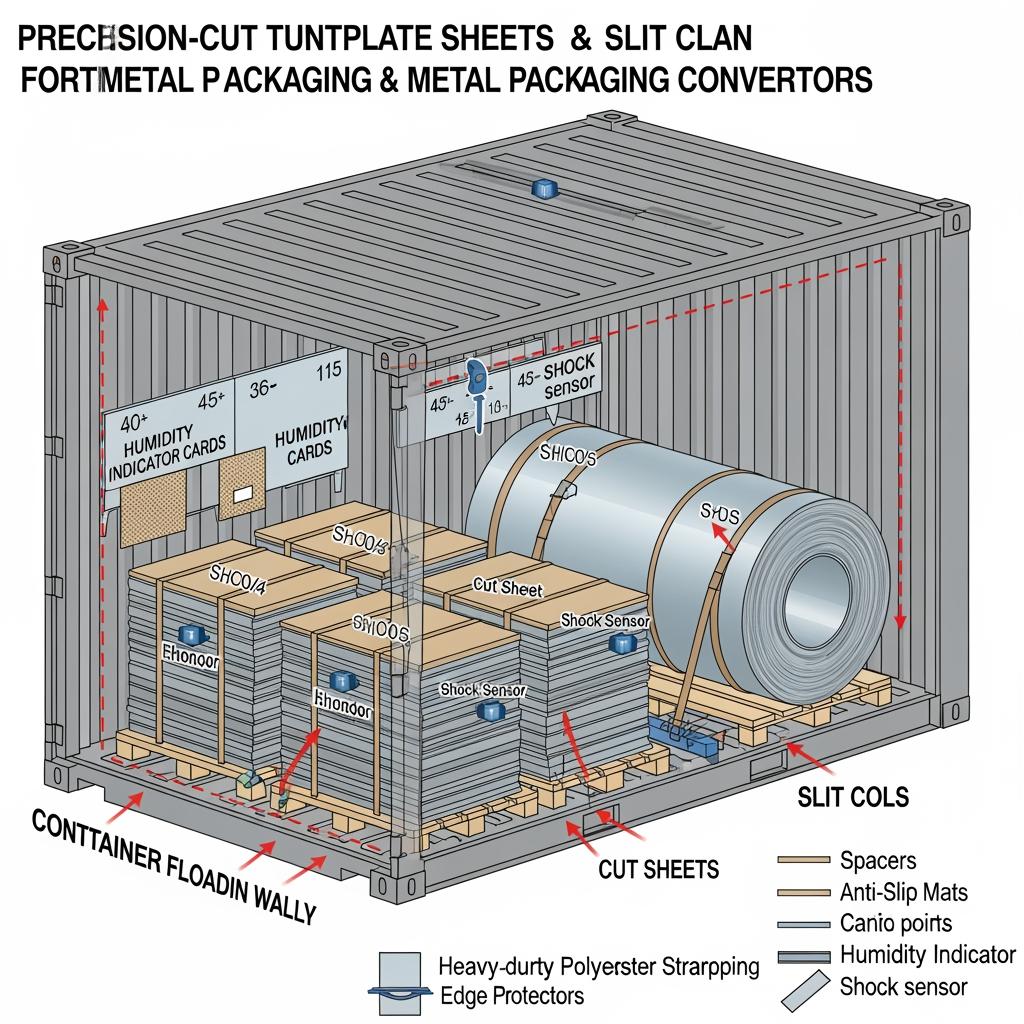
Exported slit coils and sheets must survive moisture, vibration, and handling. The right combination of VCI, interleaving paper, corner guards, and steel strapping preserves edges and finish so your material runs like domestic stock. For humid routes or long dwell at ports, sealed wrap with desiccant and pallets designed for fork and clamp trucks reduce dents and sidewall scuffs.
| Export packaging option | Use case | Moisture control | Handling protection | Lead-time impact |
|---|---|---|---|---|
| VCI + kraft wrap | Standard voyages | Good | Moderate | None |
| Full barrier wrap + desiccant | High humidity/long transit | Excellent | Good | +1–2 days |
| Edge protectors + hardboard | Narrow slits/high value | N/A | Excellent | None |
| Seaworthy pallets/crating | Mixed intermodal | Good | Excellent | +1–3 days |
Barrier systems and edge protection are inexpensive insurance compared to rework costs. If you adopt seaworthy crating for your most sensitive widths, you’ll notice fewer claims and faster receiving because stacks remain square and strap marks vanish.
A quick export-readiness check helps avoid damage:
- Specify barrier wrap and desiccant by climate zone; add humidity cards for visual checks.
- Require corner/edge guards sized to your strand widths; reject substitutions.
- Confirm pallet specs for clamp truck use; verify dynamic load rating matches container stacking.
Technical Datasheets for Slit Tinplate Product Lines
Datasheets turn tribal knowledge into commitments. They should capture gauge, temper, coating weight, surface finish, oiling, hardness range, width and length tolerances, burr class, and test methods. When you trail new lacquers or adjust forming windows, datasheets let engineering see cause and effect instead of guessing.
| Datasheet field | Typical value range | Converter takeaway |
|---|---|---|
| Gauge (mm) | 0.14–0.35 | Match to draw depth and end score residual targets |
| Temper | SR/DR (e.g., DR8, DR9) | Higher DR for stiffness; validate with your tooling |
| Tin/Chrome coat | As per spec | Check both sides and uniformity for lacquer behavior |
| Finish & oil | Bright/matte; DOS 1–3 | Align with coating supplier recommendations |
| Width/Length tol. | ±0.05–0.20 mm / ±0.5–1.0 mm | Set per component criticality |
| Burr class | None / Slight | “None” is ideal for ends and valve cups |
| QC methods | Burr gauge, flatness, diagonals | Ensure identical methods between supplier and plant |
With this structure, your teams can close the loop from slitting to forming. For custom formats, ask for sample datasheets and a test panel set; Tinsun can include both with trial shipments so your QA signs off before full release.
Data checkpoints for Precision Cut Tinplate Sheets for Metal Packaging Converters
Add three checkpoints to your datasheets: edge photo at 10× magnification, camber per meter, and coil map showing strand positions. These details help correlate any downstream defect to a strand, knife pair, or separator setting, cutting troubleshooting time dramatically.
Global Distributors of Tinplate Raw Material Products
Global availability matters when you run multi-plant networks. Distributors can buffer demand spikes, hold mixed tempers, and provide closer-to-line slitting or shearing. The tradeoff is that each handoff adds variables. If you are buying through a distributor, insist on traceability back to the mill and slitting line settings with each lot. Suppliers like Tinsun that deliver to 20+ countries can also coordinate direct-to-plant programs with regional staging to blend cost control and responsiveness.
Tinplate Supply Chain Optimization for Global Buyers
Treat tinplate like a program commodity with engineering guardrails. Start with a rolling 13-week forecast and a quarterly gauge/temper review. Lock knife sets per SKU family to minimize re-setup variance, and keep strand maps stable so your shear receives uniform stacks. For cost, compare FOB vs CIF vs DDP with realistic inland legs and demurrage risk; the cheapest Incoterm on paper can be the priciest in practice if it extends dwell in humid ports.
| Optimization lever | What to set | Impact on converters |
|---|---|---|
| MOQ and strand mix | Tie MOQ to fixed strand maps | Cuts scrap and stabilizes widths |
| Release cadence | 2–4 releases per month | Smooths warehouse loads and QA sampling |
| VMI/consignment | Stock critical tempers locally | Buffers demand spikes |
| QA alignment | Shared methods and samples | Faster root cause and fewer disputes |
| Incoterms choice | Align with risk tolerance | Total cost > unit price, always |
These levers are modest to implement but compound gains: fewer changeovers, cleaner edges, and shorter lead times. To discuss a supply plan or arrange consignment for seasonal peaks, you can contact Tinsun Packaging for a tailored proposal and timeline.

FAQ: Precision Cut Tinplate Sheets for Metal Packaging Converters
What tolerances define high-quality Precision Cut Tinplate Sheets for Metal Packaging Converters?
Most converters target ±0.05–0.20 mm on width and ±0.5–1.0 mm on length, with “none to slight” burr. Critical ends or aerosol parts push toward the tighter side.
How does temper selection impact Precision Cut Tinplate Sheets for Metal Packaging Converters?
Higher DR tempers increase stiffness and springback, improving panel rigidity but narrowing forming windows. Match temper to draw depth and test on your tools.
Can one supplier manage both tinplate and TFS for Precision Cut Tinplate Sheets for Metal Packaging Converters programs?
Yes. Integrated producers handling tinplate, TFS, and chrome-coated steel simplify specs and logistics while keeping finishes and oiling consistent across SKUs.
What QA checks should I run on incoming Precision Cut Tinplate Sheets for Metal Packaging Converters?
Measure width, length, diagonals, burr, camber, and verify finish/oil. Retain edge photos and witness samples per lot to speed any later troubleshooting.
How do export conditions affect Precision Cut Tinplate Sheets for Metal Packaging Converters?
Humidity and vibration can alter edge condition and flatness. Use barrier wraps, desiccant, proper pallets, and edge guards to keep material production-ready on arrival.
Last updated: 2025-11-20
Changelog: Added aerosol-focused tolerance table; Expanded datasheet fields and QA checkpoints; Clarified export packaging options and lead-time impacts; Included internal links to profile, products, and contact pages.
Next review date & triggers: 2026-02-20 or upon spec changes to coating weights, new aerosol line commissioning, or significant logistics route shifts.
Ready to validate your next run? Share your drawings and forecast, and Tinsun Packaging will convert them into slit-and-sheet specs with trial packs and a rapid quote so you can move from pilot to stable production with confidence.

About the Author: Langfang Tinsun Packaging Materials Co., Ltd.
Langfang Tinsun Packaging Materials Co., Ltd. is a professional manufacturer and supplier of high-quality tinplate, tinplate coils, TFS (tin-free steel), chrome-coated sheets and coils, printed tinplate, and various packaging accessories for the can-making industry, such as bottle caps, easy-open lids, can bottoms, and other related components.

Product Category
Related Post
-
B2B Procurement of Tinplate Shearing and Raw Materials
When you buy tinplate at scale, your margins, lead times, and downstream quality all hinge on how precisely coils are sheared, trimmed, and converted. This guide explains B2B Procurement of Tinplate Shearing and Raw Materials from specification through delivery, so your teams can move from RFQ to reliable production with fewer surprises and stronger unit…
-

Precision Slitting Services for Electrolytic Tinplate Coils
Introduction to Slitting of Tin Coated Steel Materials The fastest way to improve line uptime and reduce end-of-line defects is to start with slit material that’s made precisely for your application. Precision Slitting Services for Electrolytic Tinplate Coils ensure tight width tolerances, low burr, and stable flatness so parts stamp or seam-weld cleanly, coatings adhere…
-

Sourcing Raw Materials for Tinplate-Related Products Worldwide
If your company depends on aerosol cans, food containers, closures, or precision battery parts, then sourcing raw materials for tinplate-related products worldwide is both a strategic advantage and a daily operational challenge. The fastest path to consistency and margin protection is to define specs precisely, qualify multi-region supply, and partner with a service center that…
-

High-Performance Tinplate Strips for Metal Closure and Cap Production
High-performance tinplate strips for metal closure and cap production deliver the consistent formability, surface finish, and corrosion resistance that closure makers depend on when margins are thin and uptime matters. In this guide, you’ll find practical specs, sourcing steps, and compliance tips tailored to caps, crowns, ROPP, and lug closures. If you already have a…