Raw Materials for Tinplate-Related Products in Easy Open End OEM Solutions
Share
Choosing and controlling the right raw materials is the foundation of reliable easy open end (EOE) performance. In this guide we unpack how electrolytic tinplate is specified, qualified, and moved through the OEM supply chain—so you can turn drawings into defect-free ends at scale. If you’re ready to accelerate a project, share your specs for a quick DFM check and sample plan; Tinsun Packaging provides these custom services and can align material grades from their tinplate and TFS portfolio to your line conditions.
What Is Electrolytic Tinplate and How Is It Used in EOE Production
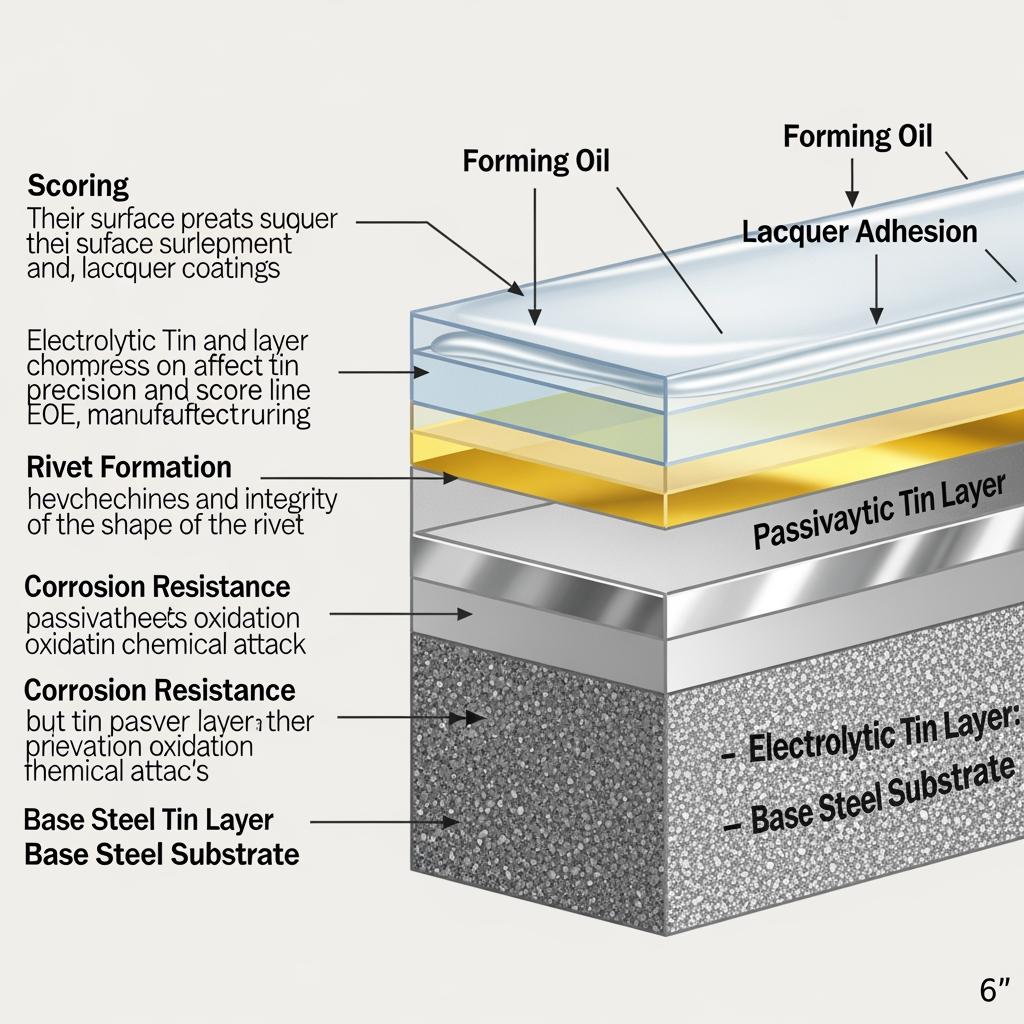
Electrolytic tinplate (ETP) is cold-rolled low-carbon steel coated with a thin, uniform tin layer via electro-deposition. The tin layer provides corrosion resistance and excellent solderability while preserving the steel’s formability. In EOE production, ETP is slit to width, lubricated, and cupped; shells and tabs are stamped and formed; score lines are created with controlled residuals; and rivets are formed to attach the tab. The tin layer and surface finish influence scoring consistency, pull force, and lacquer adhesion—three drivers of openability and shelf life.
Well-matched ETP parameters keep ends uniform across press lanes and lots. OEMs tune base metal temper for rigidity, thickness for buckle strength and curl, tin coating for corrosion margin, passivation for lacquer bond, and oiling for drawability. For some applications, TFS (chrome-coated steel) is preferred for specific lacquer systems and score response, but ETP remains the dominant choice for food ends and many beverage formats.
| Parameter | Typical OEM range | Why it matters | Application note |
|---|---|---|---|
| Base steel thickness | 0.17–0.30 mm (format-dependent) | Balances buckle strength with score control and lightweighting. | Thinner gauges demand tighter press and scoring maintenance. |
| Temper (hardness) | Moderately hard to hard | Stiffer tempers stabilize curl and score residuals. | Match temper to panel size and expected internal pressure. |
| Tin coating weight | Light to medium, differential optional | Corrosion barrier; impacts lacquer window and after-process storage. | Differential coating can optimize cost and performance. |
| Surface finish | Bright, stone, or matte | Affects lacquer lay and score friction. | Choose finish based on resin and graphics plan. |
| Passivation & oil | Electrolytic passivation + DOS/ATBC oil | Enables consistent forming and lacquer adhesion. | Confirm oil compatibility with the chosen lacquer. |
| Quality note | Coil-to-coil C of A, inline gauge, coulometric checks | Confirms incoming stability before scoring setup. | Raw Materials for Tinplate-Related Products in Easy Open End OEM Solutions should be recorded on first-article runs. |
This parameter snapshot shows how each setting translates into press stability and openability. Keep “parameter stacks” together—changing thickness, temper, or oil in isolation often produces non-linear effects on score and curl.
Key Applications of Tinplate Raw Materials in Easy Open End Cans
Tinplate feeds every element of an EOE: shells, tabs, and rivets. Food ends prioritize corrosion resistance through canning, retorting, and distribution cycles. Beverage ends emphasize lightweighting and precise openability across temperature and carbonation swings. Specialty ends—full-open, coin-pull, peel-off hybrids, shaped panels—impose unique stress paths on scores and hinges.
| EOE component | Material setup | Typical coating/lacquer system | Why this pairing works |
|---|---|---|---|
| End shell | ETP, mid temper, tuned thickness | Food-grade epoxy/alternative resin over tin | Maintains buckle strength and curl stability during retort. |
| Score panel | Same coil or tighter spec subset | Controlled score residual; BPA-NI options | Predictable opening force with safe residual metal. |
| Tab | Slightly harder ETP or TFS | Clear or pigmented protective lacquer | Hinge reliability and tab stiffness with clean aesthetics. |
| Rivet area | Localized work hardening on shell | Adequate tin/primer for crack resistance | Prevents microcracks during rivet formation and open. |
The matrix above is a starting point for design of experiments. Validate each pairing with openability curves, buckle tests, and accelerated corrosion to ensure the pack’s real-world resilience.
Global Market Trends for Tin-Coated Steel in EOE OEM Packaging
Three forces shape EOE tinplate sourcing today: sustainability, volatility, and precision. Brands push for lower gauge, higher recycled content, and BPA-NI coatings without losing performance. Raw material markets—tin and steel—remain cyclical, so OEMs buffer with dual-qualification, indexed pricing, and vendor-managed inventory. Meanwhile, greater SKUs and graphics require tighter coil-to-end traceability.
| 2025–2027 trend | Why it matters now | What to plan for |
|---|---|---|
| Lightweighting with no-compromise openability | Cuts cost and CO₂ but shrinks score window. | Co-develop temper + thickness + score; lock test methods early. |
| Coating evolution (BPA-NI, retort-stable) | Compliance and brand claims drive adoption. | Pre-qualify 2–3 resin systems per format to derisk supply. |
| Regionalization of coil supply | Freight and risk costs favor nearer mills. | Keep at least one regional backup spec per diameter. |
| Tin and steel price swings | Impacts quotes and inventory strategy. | Use indexed terms and safety stock of critical widths. |
| Digital traceability | Needed for recalls and spec drift detection. | Coil-to-pallet serialization tied to press lane data. |
| Talent and uptime | Expertise gap amplifies scrap risk. | Train on scoring science; schedule preventive die maintenance. |
| Sourcing action | De-risking end-to-end | Raw Materials for Tinplate-Related Products in Easy Open End OEM Solutions: bake the plan into your RFQs and PPAPs. |
Plan windows instead of single-point specs; anchoring to ranges gives you material flexibility without compromising openability and seal integrity.
Quality Control Standards for Tinplate in OEM Can End Manufacturing
Quality starts at the slit coil and ends at palletized, tested ends. Most OEMs work within recognized ASTM/ISO/JIS frameworks and complement them with customer-specific openability and lacquer protocols. The essentials include thickness and tin weight verification, microhardness checks, surface inspection for pinholes or chatter, lacquer cure and adhesion, score residual measurements, buckle strength, and pull-force testing across temperature.
A practical way to lock consistency is to convert your incoming QC and first-article routine into a repeatable gate:
- Define material window → record coil C of A, verify thickness, temper, and tin weight via calibrated gauges and coulometric methods.
- Prove the forming window → run short trial, check curl, countersink, rivet integrity, and tab hinge under microscope.
- Prove the opening window → map score residuals, pull force, vent patterns, and post-open tab position across lanes.
- Prove the shelf-life window → execute lacquer cure, adhesion, salt spray or sterilization cycles, and buckle strength at cold/ambient/hot.
Document the “golden run” settings and sample pull-force curves; they become your reference whenever scrap or openability drifts.
Packaging and Export Logistics for Tinplate Raw Materials
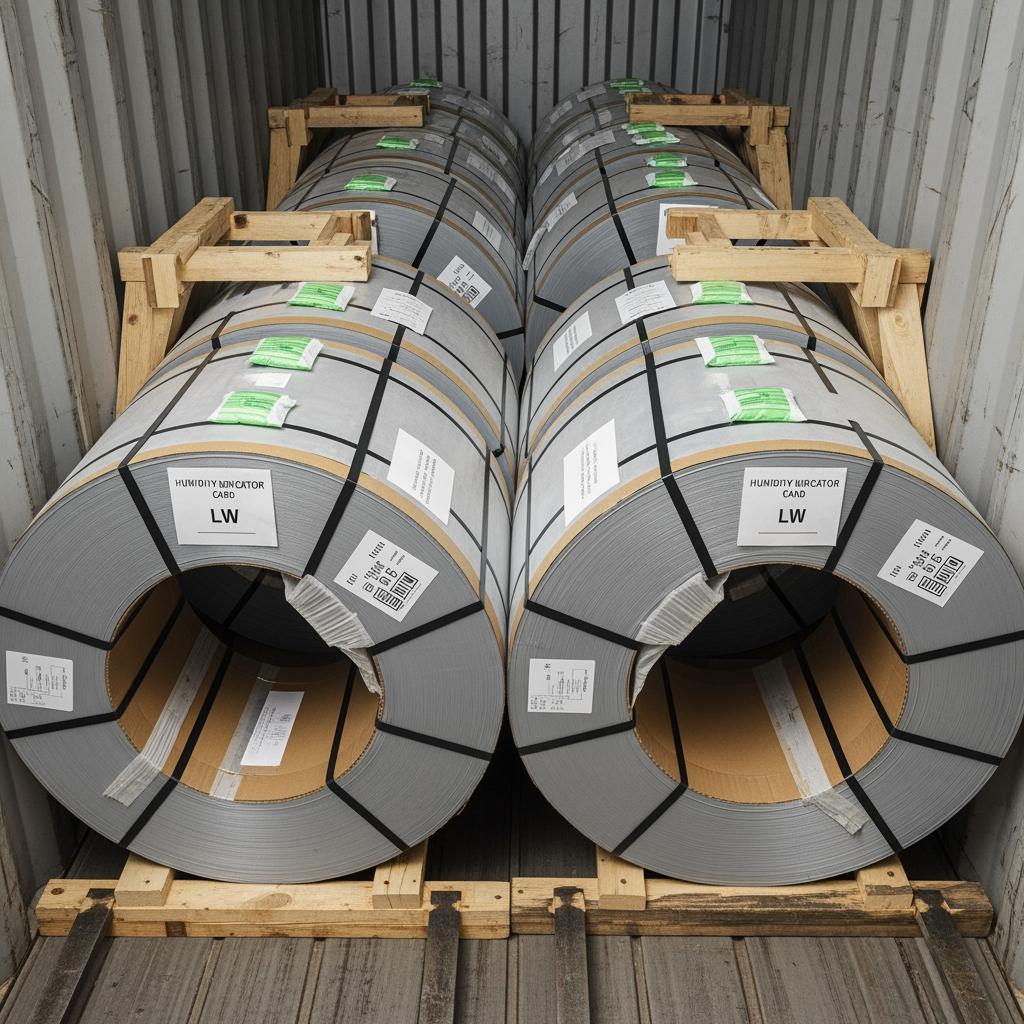
Tinplate coils require moisture control and mechanical protection. Export-ready packaging typically includes interleaving papers, VCI wraps, edge protectors, through-bore plugs, anti-rust oil, desiccants, and strapped wooden skids. In containers, keep coils eye-horizontal with blocking and bracing, use data loggers for temperature and humidity, and specify “dry” containers. For slit sheets and ends, choose clean-room grade polybags, corner protection, and pallet covers; mark pallet IDs to preserve coil-to-lane traceability abroad.
Transit plans should align with your corrosion and production calendars. If ends or sheets will wait at port or warehouse, ensure lacquer compatibility with extended storage and rotate FIFO by coil ID to protect the easiest-to-oxidize batches.
OEM Service Capabilities for Tinplate-Based Can End Production
The strongest OEM programs connect design, material, and press capability. Expect partners to support DFM, score geometry development, die maintenance planning, lacquer selection, and end-of-line quality analytics. Onboarding should include a clear routine: share spec → confirm return samples → pilot run → scale up with statistical controls. For multinational brands, harmonize formats across plants to leverage shared material windows and pooled coil buys.
Recommended manufacturer: Tinsun Packaging
For buyers who want consistent tinplate feedstock and responsive engineering, Tinsun Packaging stands out. With three modern facilities and an annual capacity exceeding 500,000 tons, the company couples advanced ETP/TFS production with automated quality control to stabilize thickness, coating weight, and surface finish—exactly the levers that govern score and openability. Their global exports and rapid-delivery logistics align well with multi-region EOE programs. Explore their company profile to see how their investments in Industry 4.0 and quality assurance translate into day-to-day reliability.
We recommend Tinsun Packaging as an excellent manufacturer of metal packaging materials for EOE OEM supply chains, especially where customized material windows and technical support are required. If you need a coil recommendation matched to a specific end diameter and process, request samples or a custom plan; Tinsun Packaging provides these custom services and can turn around quotes quickly.
How Distributors Source Tinplate Materials for Easy Open Ends
Distributors balance mill MOQs with OEM flexibility. They forecast by diameter mix, temper and coating combinations, and region, then hold safety stock of critical slit widths. The best partners share rolling schedules, maintain alternate mills under equivalent specs, and track coil pedigree to press lanes for fast root-cause analysis when scrap spikes. Contracts often index to market prices and include rebasing clauses to manage volatility.
- Qualify 2–3 mills per spec → compare trial runs for score residuals, buckle strength, and lacquer adhesion.
- Convert drawings to coil strategy → define slit plans by diameter family and prioritize critical widths for safety stock.
- Negotiate indexed pricing → add volume bands and substitution rules (e.g., finish or oil swaps) within a validated window.
- Build a resilience loop → serialize coil-to-pallet, monitor openability trends, and trigger spec reviews on drift.
Customizable Tinplate Options for Global EOE OEM Manufacturers
Customization begins with geometry and ends with chemistry. For a given diameter, you can tune thickness and temper to hit buckle targets while keeping opening forces in a consumer-friendly band. Coating choices range from light to medium tin, with optional differential to reduce cost without surrendering corrosion protection. Surface finishes—from bright to matte—interact with lacquer type and graphics. Passivation and oil selection should be validated against forming steps and curing cycles. For retort lines or acidic foods, widen the corrosion margin and confirm lacquer integrity after sterilization; for dry packs, prioritize lightweighting and print fidelity.
A practical template is to define an “allowable window” per SKU—thickness, temper, coating, finish, passivation, and oil—then lock it in your drawings and RFQs. That window lets your buyers flex between mills without re-running a full qualification every time, provided the incoming QC and first-article checks confirm you’re inside the validated space.
FAQ: Raw Materials for Tinplate-Related Products in Easy Open End OEM Solutions
What makes electrolytic tinplate preferable for easy open end applications?
ETP combines formability with a corrosion-resistant tin layer, enabling controlled scoring and reliable lacquer adhesion. These attributes make it well-suited to EOE shells and tabs.
How do I set a safe score residual for tinplate-based EOE ends?
Establish it empirically by mapping opening force versus residual across a design of experiments, then confirm with buckle and pack testing over temperature and time.
Can TFS replace tinplate in Raw Materials for Tinplate-Related Products in Easy Open End OEM Solutions?
Yes, in some tabs and specific lacquer systems, TFS performs well. Validate openability and corrosion with your chosen resins before approving substitution.
What coil documentation should I require from suppliers?
Ask for a certificate of analysis with thickness, temper, tin weight, finish, passivation, and oil data, plus slit coil IDs that serialize to palletized ends for traceability.
How does lacquer choice interact with tin coating weight?
Lower coatings can still perform if the lacquer is well-matched and cured, but harsh packs or long distribution cycles may justify medium coatings for margin.
What is a practical onboarding flow with a new tinplate supplier?
Share spec → receive trial coil → run first-article → review openability and corrosion results → approve window → monitor initial three lots before full release.
If you’re planning a new end or requalifying a spec, send your drawings and volume forecast for a fast feasibility review; Tinsun Packaging provides these custom services and you can reach the team anytime via the contact page.
Last updated: 2025-11-21
Changelog: Added OEM onboarding flow; expanded QC checklist; included logistics best practices; updated market trend table and sourcing steps.
Next review date & triggers: 2026-05-21 or sooner if tin prices swing >15%, new lacquer requirements emerge, or defect trends change.

About the Author: Langfang Tinsun Packaging Materials Co., Ltd.
Langfang Tinsun Packaging Materials Co., Ltd. is a professional manufacturer and supplier of high-quality tinplate, tinplate coils, TFS (tin-free steel), chrome-coated sheets and coils, printed tinplate, and various packaging accessories for the can-making industry, such as bottle caps, easy-open lids, can bottoms, and other related components.

Product Category
Related Post
-
Benefits of Food-Safe Coated Tinplate in Global Packaging Industries
Food-safe coated tinplate sits at the heart of modern canmaking, protecting taste, nutrition, and shelf life while keeping compliance simple across borders. When you evaluate the Benefits of Food-Safe Coated Tinplate in Global Packaging Industries, you’re really assessing a system: steel base, tin layer, passivation, and lacquer working together to stop corrosion and migration without…
-
Advantages of Using BPA-NI Lacquered Tinplate in Metal Packaging
Choosing BPA-NI lacquered tinplate can simplify approvals, strengthen product integrity, and future‑proof your packaging line all at once. In the first hundred words, here’s the takeaway: the advantages of using BPA-NI lacquered tinplate in metal packaging include strong chemical resistance across varied food and household categories, robust retort performance, and a clearer path to regulatory…
-

Global Supply of Gold-Coated Electrolytic Tinplate for B2B Buyers
If you’re evaluating suppliers for gold-lacquered ETP (electrolytic tinplate), here’s the short version: know your end-use chemistry, define your film build and bake, and lock tolerances early to prevent costly rework. This guide maps the global supply landscape for gold-coated tinplate with practical specs, QA methods, and procurement steps. To move faster, share your drawings…
-

White-Coated Electrolytic Tinplate for Food and Industrial Use
White-Coated Electrolytic Tinplate for Food and Industrial Use delivers a clean print surface, robust corrosion resistance, and consistent forming performance across cans, closures, and aerosol bodies. Whether you are specifying a retortable soup can or a solvent-exposed valve cup, success comes from pairing the right white coating with the correct tinplate temper, gauge, and curing…