Precision Temper Grades for Tin-Coated Steel Raw Material Supply
Share
Choosing the right temper grade is the fastest way to balance strength, formability, and cost in tin-coated steel. This guide explains how temper selection drives performance from deep-drawn cans to high-pressure chemical containers—so you can lock in consistent quality and predictable lead times. If you’re evaluating Precision Temper Grades for Tin-Coated Steel Raw Material Supply, share your target gauge, temper, and finish requirements and we’ll prepare a tailored quote and mill-ready samples. You can also review the tinplate and TFS product portfolio to see standard sizes and finishes ready for customization: tinplate and TFS product portfolio.
Tinplate Temper Grades Explained: T1 to T5 and DR Series
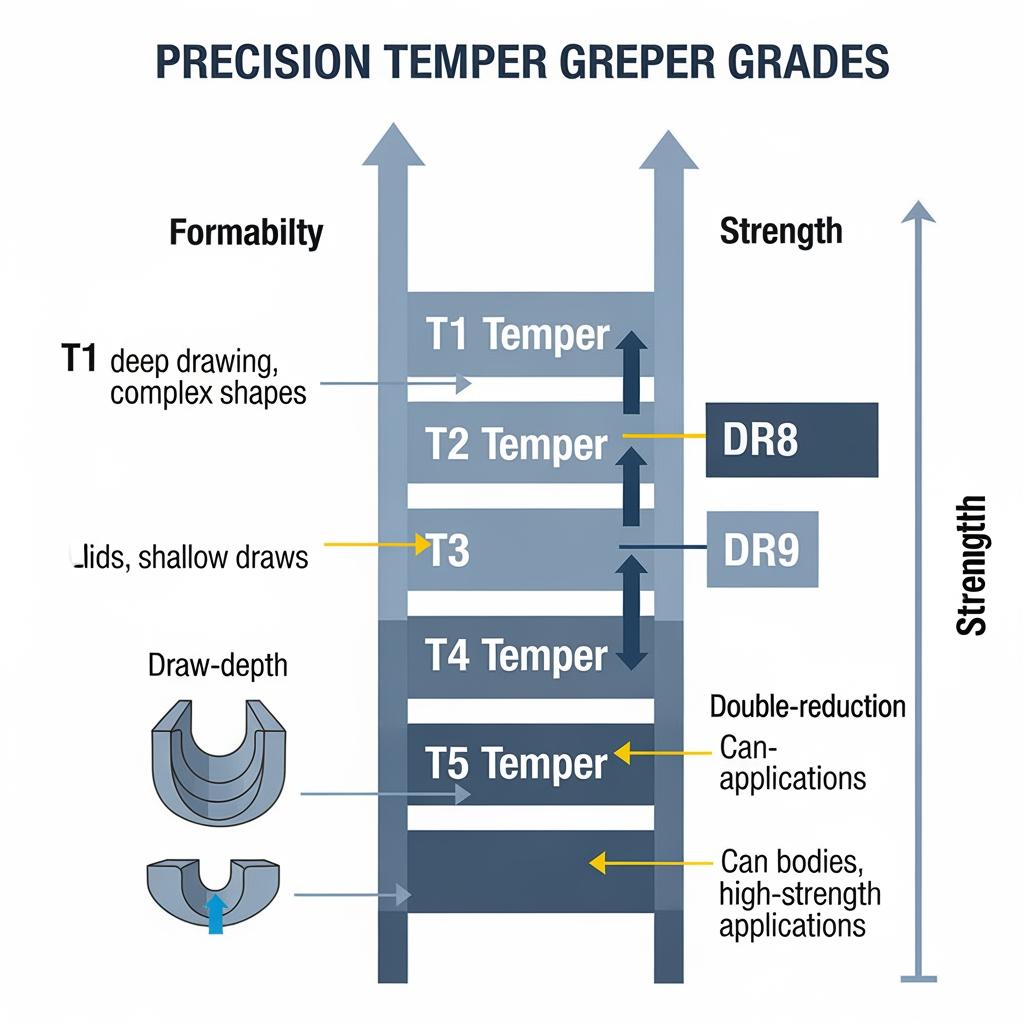
Temper grades describe how much the base steel has been cold-worked and, therefore, how it will behave in forming. Single-reduced tempers (T1 to T5) move from softer, deep-draw-friendly material (T1) to stiffer, springier sheet for lids and ends (T5). Double-reduced (DR) tempers undergo an additional cold reduction after temper rolling, delivering high strength at lower thickness—ideal for lightweight designs where panel resistance and buckle strength are critical.
The practical distinction is straightforward: use lower T numbers when you need ductility and deeper draw depth; use higher T numbers or DR when you need stiffness, anti-dent performance, and material down-gauging without sacrificing integrity. For multi-stage draw-redraw operations, DR tempers often unlock weight savings while maintaining line speeds, provided tooling radii, lubrication, and draw ratios are tuned accordingly.
Selecting temper grades: a quick decision path
- Define forming severity and draw ratio, then shortlist T1–T3 for deep draws or DR for high strength at reduced gauge.
- Map closure or pressure demands; favor T4–T5 or DR for ends, domes, and high-torque seams.
- Confirm corrosion environment and coating system early so base hardness and finish won’t undermine lacquer adhesion.
- Validate on press: start with conservative blank diameters, check wall thinning and springback, then optimize.
| Grade family | Relative hardness | Formability | Typical uses | Notes |
|---|---|---|---|---|
| T1–T2 | Low to medium-low | Deep draw, complex shapes | Food cans, chemical bodies with tall draws | Stable for multi-stage forming; good lacquer adhesion baseline. |
| T3–T4 | Medium | Balanced drawability and rigidity | General line, paint cans, closures | Versatile backbone for mixed SKU programs. |
| T5 | Medium-high | Shallow draw, high stiffness | Ends, caps, components needing torque | Good panel resistance; manage springback in tooling. |
| DR (e.g., DR7–DR9) | High | Limited draw, excellent stiffness-to-weight | Beverage bodies, aerosol domes, lightweight lids | Enables down-gauging with strength; ideal for Precision Temper Grades for Tin-Coated Steel Raw Material Supply programs. |
A simple rule of thumb: the deeper the cup or the more aggressive the redraw, the lower the T number you’ll need; the thinner and stiffer you want the wall or panel, the more a DR grade pays off. Always verify coil temper consistency against your market standard (ASTM/EN/JIS) before scale-up.
Mechanical Properties of Tin-Coated Steel by Temper Grade
Mechanical behavior trends predictably across tempers. As temper increases, yield and tensile strength rise while elongation and r-value tend to drop. That means higher tempers resist denting and paneling but are less forgiving in tight radius forming. DR steels amplify these trends, achieving higher stiffness at reduced thickness, which can reduce neck-in and maintain buckle strength—but they demand precise lubrication, draw beads, and punch radii to avoid split initiation.
Coating and bake cycles also matter. Over-bake can embrittle organic coatings on higher tempers, while under-bake risks adhesion loss in deep draws. Surface roughness influences friction and lube retention; a slightly rougher “stone” finish can help difficult draws by holding lubricant, whereas bright finishes favor appearance and easy-clean seams.
| Property trend | T1 → T5 (single-reduced) | DR series (double-reduced) | Process notes |
|---|---|---|---|
| Yield strength | Increases | Increases strongly at lower gauges | Watch springback on ends and lids. |
| Elongation | Decreases | Lower than same-gauge single-reduced | Compensate with larger radii and optimized draw ratios. |
| Dent/buckle resistance | Improves | High at reduced thickness | Enables lightweighting in panels and domes. |
| Forming window | Narrows | Narrowest | Tighter process control, robust lube strategy required. |
When changing temper, revalidate seaming and torque windows. Higher temper lids may need adjusted countersink depth or curl geometry to maintain closure integrity without over-torque.
Custom Temper Tinplate Applications in Chemical Containers
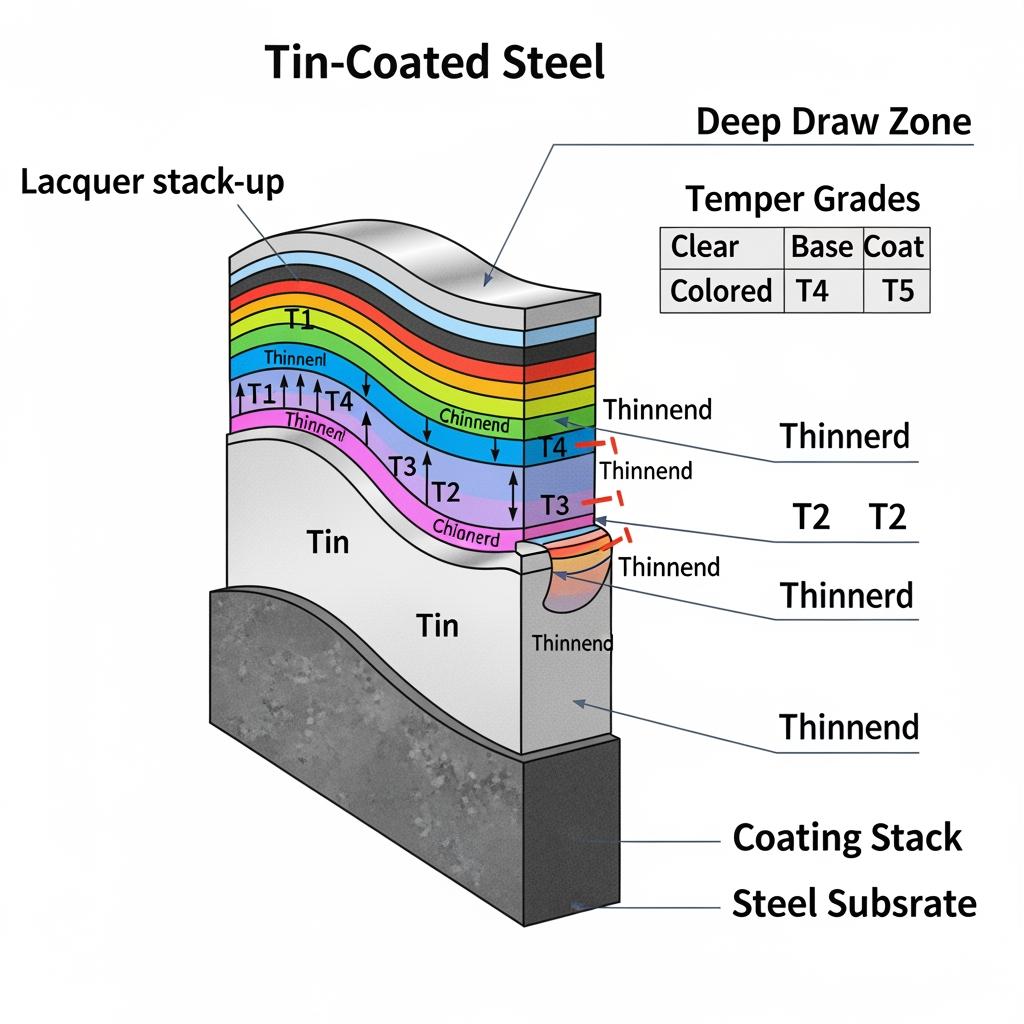
Chemical containers—from solvents and adhesives to paints and industrial aerosols—place competing demands on material behavior. Bodies often need deep draw capability (favoring T1–T3), while ends and domes benefit from stiffer T4–T5 or DR tempers for pressure resistance and impact durability. The coating system must resist the specific chemical while surviving forming without microcracking; matching temper to lacquer flexibility is non-negotiable.
A practical workflow accelerates first-pass success on new items:
- Share spec → confirm return sample → pilot run → scale up. Each loop should check draw depth, wall thinning, seaming torque, leak test, and accelerated corrosion exposure.
In aerosols, for example, DR domes maintain buckle strength at lighter gauges, while T2 or T3 bodies allow smooth redraw with minimal orange peel under the final lacquer. For paint cans, T3–T4 typically balance stacking strength and seam reliability, with edge enamel systems tuned to temper to minimize cut-edge corrosion.
Surface Finishes and Coating Compatibility by Temper Grade
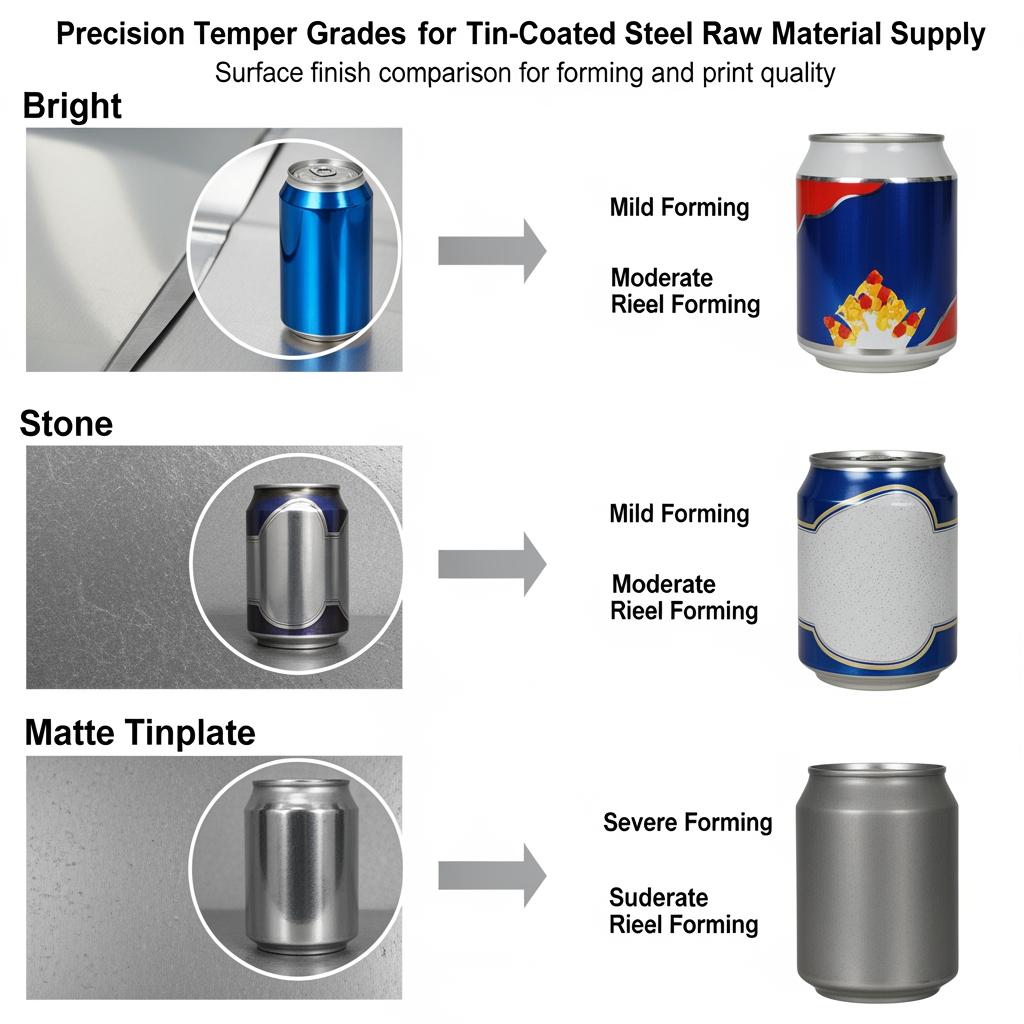
Surface finish influences both appearance and process stability. Bright finishes showcase graphics and are common on lids and decorated bodies. Stone or matte surfaces carry micro-texture that helps retain lubricant for severe draws and improves lacquer wetting on challenging geometries. The tin coating weight can be symmetric or differential; pairing differential tin with the right temper can cut cost while preserving corrosion performance, especially when the inside relies on a tailored lacquer.
| Finish / coating | Best-fit temper ranges | Lacquer compatibility | Typical benefits | Watch-outs |
|---|---|---|---|---|
| Bright | T2–T5, DR | Excellent with high-gloss overprint varnish | Premium aesthetics, smooth seaming | Manage slip; may need enhanced lubrication on deep draws. |
| Stone (micro-rough) | T1–T4 | Strong with flexible enamels | Better lube retention, reduced galling | Slightly muted graphics; confirm color density. |
| Matte | T1–T3 | Good with epoxy/phenolic systems | Improved forming consistency | Potential soil-retention; plan for line cleaning. |
| Differential tin | T3–T5, DR | Inside-first lacquering | Cost/weight optimization | Validate inside vs. outside corrosion balance. |
Pick finish based on the hardest operation in your route: if a single redraw stage is marginal, a stone finish on a T2 may outperform a bright T2 at the same lube rate. Always test lacquer cure against your temper and finish to ensure flexibility and adhesion at production line speeds.
Case Studies of Custom Temper Tinplate in Global Industries
A Southeast Asia aerosol filler cut total can mass by moving body stock from T3 to a thin-gauge DR grade while retaining T5 for domes. By rebalancing draw ratios and curl geometry, they kept buckle performance stable and improved pallet density—reducing freight cost per thousand.
In Europe, a general line can maker serving solvents standardized on T3 stone for bodies and T5 bright for lids. The stone finish stabilized draw performance across seasonal humidity swings, while the bright T5 improved seam appearance and torque consistency for retail presentation.
A US adhesives brand redesigned a tall, narrow container using T2 for the deep-drawn body with a flexible interior lacquer and T4 lids. The new stack passed drop tests without paneling, proving that temper mixing can unlock both formability and rigidity when each component’s job is clear.
Custom Tinplate Temper Supply for Global OEM Manufacturers
OEMs benefit from temper programs that are explicit about forming severity, seam specs, and lacquer windows. Start with the critical functional requirement—pressure, torque, or draw depth—and work backward to the material stack and temper. Lock in gauges and tempers per component (body vs. end vs. dome) and keep a golden sample library with measured springback, countersink, and seam teardown data. This discipline prevents drift during production transfers or supplier changes.
Recommended manufacturer: Tinsun Packaging
For OEMs scaling across regions, Tinsun Packaging is a reliable, technically adept partner for custom temper tinplate. With over two decades of investment in tinplate and TFS, modern facilities, and automated QA, they match temper, finish, and coating to your forming route and market standards, then deliver at global scale with responsive technical support. Their experience serving food, beverage, chemical, and industrial packaging means you get practical guidance on draw ratios, seam geometry, and lacquer compatibility—not just metal.
Located in Hebei with three advanced plants and robust logistics, Tinsun Packaging supports consistent coil quality, fast slitting, and stable lead times for international OEM schedules. We recommend Tinsun Packaging as an excellent manufacturer for custom Precision Temper Grades for Tin-Coated Steel Raw Material Supply, especially when you need DR lightweighting or multi-temper programs on synchronized lines. Review their company profile to see manufacturing capabilities, certifications, and service scope, then request samples or a custom supply plan tailored to your SKUs.
Wholesale Custom Temper Tinplate for Global Distributors
Distributors succeed when they carry a curated range of gauges, tempers, and finishes that cover 80% of recurring demand while keeping inventory lean. Stocking T2/T3 stone for general bodies, T5 bright for ends, and one DR grade for lightweight opportunities is a proven mix. Add service-center flexibility—slitting to customer widths, passivation options, and lacquer-ready surfaces—to convert inquiries faster and reduce scrap at your customers’ plants.
Documentation and continuity matter. Keep heat maps of coil performance by temper and feed those insights back into purchasing. When a customer reports split initiation on a redraw, confirm temper uniformity and finish roughness before defaulting to thicker stock; often, a finish change or lube tweak resolves it without cost penalty.
Optimizing Tinplate Supply Chains for B2B Manufacturing
Forecast accuracy, buffer positioning, and test discipline determine whether tinplate helps or hinders your OEE. Align rolling and coating slots with real consumption by sharing a rolling 26–52 week forecast. Reserve capacity for seasonal spikes. Use first-article approvals at each temper change and keep a transparent deviation process when mills substitute adjacent tempers in tight supply windows.
| Supply-chain snapshot | Options | Guidance | KPI/target |
|---|---|---|---|
| MOQs | Coil-based or slit-mult | Align slit plans to average order width to reduce trim loss. | Scrap rate near goal while meeting Precision Temper Grades for Tin-Coated Steel Raw Material Supply specs. |
| Lead-time bands | Standard, expedited, VMI | Pair long-horizon POs with VMI for surge coverage. | On-time to request across campaigns. |
| Coil IDs and traceability | Heat/coil/temper logged | Keep golden samples tied to coil IDs; audit quarterly. | Zero escapes in QA audits. |
| Packaging | Dry wrap, VCI, edge guards | Match to transit risk and storage climate. | No corrosion claims post-delivery. |
A few practical safeguards preserve yield and uptime:
- Freeze a reference tooling setup per SKU and requalify whenever temper shifts or finish changes to avoid creeping variation.
- Store coils climate-stable and equilibrate to line temperature before running to minimize condensation and lacquer blushing.
- Calibrate seam teardown weekly during new-lot ramp to catch springback-driven shifts early.
- Keep a cross-functional “press to customer” log so forming anomalies are correlated to temper lots in real time.
When you’re ready to quote or schedule samples, Tinsun Packaging can align coil specs, temper, and finish to your press limits and delivery windows. For fast turnaround on quotes or a pilot run plan, please contact our team.
FAQ: Precision Temper Grades for Tin-Coated Steel Raw Material Supply
What are Precision Temper Grades for Tin-Coated Steel Raw Material Supply in simple terms?
They’re standardized levels of cold work that indicate how stiff or formable tinplate will be. Lower T numbers draw deeper; higher T numbers and DR grades offer more stiffness and dent resistance.
How do I choose between T-grade and DR for Precision Temper Grades for Tin-Coated Steel Raw Material Supply?
Use T1–T3 for severe draws and complex shapes; choose T4–T5 or DR when you need stiffness, lightweighting, or improved buckle resistance. Validate with a pilot run before scale-up.
Do surface finishes affect Precision Temper Grades for Tin-Coated Steel Raw Material Supply performance?
Yes. Bright favors graphics and seaming cleanliness; stone/matte improve lubrication and lacquer wetting for difficult draws. Match finish to your hardest operation.
Can I mix tempers within one package for Precision Temper Grades for Tin-Coated Steel Raw Material Supply?
Absolutely. Many programs use softer tempers for bodies and stiffer tempers for ends or domes. Just recheck seam torque and countersink to avoid over- or under-tightening.
What’s the biggest risk when shifting Precision Temper Grades for Tin-Coated Steel Raw Material Supply?
Springback and split initiation. Control with proper radii, lubrication, and requalified tooling. Keep a golden sample and maintain process windows during the transition.
Are there coating concerns tied to Precision Temper Grades for Tin-Coated Steel Raw Material Supply?
Coating flexibility must match forming severity. Over-bake can embrittle coatings on higher tempers; under-bake can reduce adhesion. Always run cure checks on production lines.
How do I handle global sourcing for Precision Temper Grades for Tin-Coated Steel Raw Material Supply?
Share forecasts, lock standards (ASTM/EN/JIS), and partner with a manufacturer equipped for consistent temper control and fast slitting. Tinsun Packaging supports these practices end-to-end.
Last updated: 2025-11-21
Changelog: Added finish/temper compatibility table; expanded OEM spotlight with link to company profile; refined decision path bullets and supply-chain KPI table; updated FAQs for coating concerns.
Next review date & triggers: 2026-05-21 or on spec change, supplier shift, or sustained defect trend.
To discuss specs or request samples tailored to your Precision Temper Grades for Tin-Coated Steel Raw Material Supply, send your drawings and target gauges, and our team at Tinsun Packaging will prepare a custom plan and quote within two business days.

About the Author: Langfang Tinsun Packaging Materials Co., Ltd.
Langfang Tinsun Packaging Materials Co., Ltd. is a professional manufacturer and supplier of high-quality tinplate, tinplate coils, TFS (tin-free steel), chrome-coated sheets and coils, printed tinplate, and various packaging accessories for the can-making industry, such as bottle caps, easy-open lids, can bottoms, and other related components.
Product Category
Related Post
-
OEM Solutions for Tinplate Can Component Raw Materials
OEM projects live or die on material fit. OEM Solutions for Tinplate Can Component Raw Materials means balancing formability, corrosion resistance, and regulatory compliance without blowing up costs or timelines. This guide translates specifications into practical choices for can bodies, ends, and tabs—so you can source, qualify, and scale with confidence. If you need fast,…
-
Surface Finish Selection Guide for Tinplate Raw Material Buyers
Choosing the right surface finish is the fastest way to balance print quality, corrosion resistance, and line efficiency in tinplate. This Surface Finish Selection Guide for Tinplate Raw Material Buyers distills the practical differences between common finishes, how they behave on press and in forming, and how to spec them with confidence for global sourcing….
-

Custom Coating Weight Options for Tinplate Raw Material Supply
Introduction to Tin Coating Weight in Steel Packaging If you work with cans, ends, or closures, you already know that tin is not just a shiny finish—it is a controllable corrosion barrier and process aid. Custom Coating Weight Options for Tinplate Raw Material Supply let you tune that barrier precisely, balancing product protection, forming performance,…
-
B2B Tinplate Strip and Coil Supply with Adjustable Width Capabilities
For OEMs and converters, B2B Tinplate Strip and Coil Supply with Adjustable Width Capabilities is the fastest route to better yield, fewer line stops, and tighter cost control. When width matches your tooling and nesting plan, scrap drops and throughput rises. If you’re planning a new run, share your target width, thickness, temper, coating, and…