Custom ETP Materials for Aerosol Cap and Base Component Production
Share
Choosing the right ETP (electrolytic tinplate) specification for aerosol caps and bases is the single biggest lever you have on safety, compliance, and total landed cost. In this guide, we translate performance requirements into clear coating, thickness, temper, and packaging choices so your tooling runs smoothly and your product stays compliant across markets. If you already have drawings, share them and your target performance to request a quote and samples—Tinsun Packaging can configure the exact stack-up you need for Custom ETP Materials for Aerosol Cap and Base Component Production. To move quickly, request a tailored quote and samples via the Tinsun team and we’ll align on spec, MOQ, and trial coils in days.
Request a quote and samples and tell us your cap/base drawings, lacquer system, and forecast so Tinsun Packaging can provide these custom services with a fast, practical plan.
Tinplate Coating Standards for Aerosol Cap Production
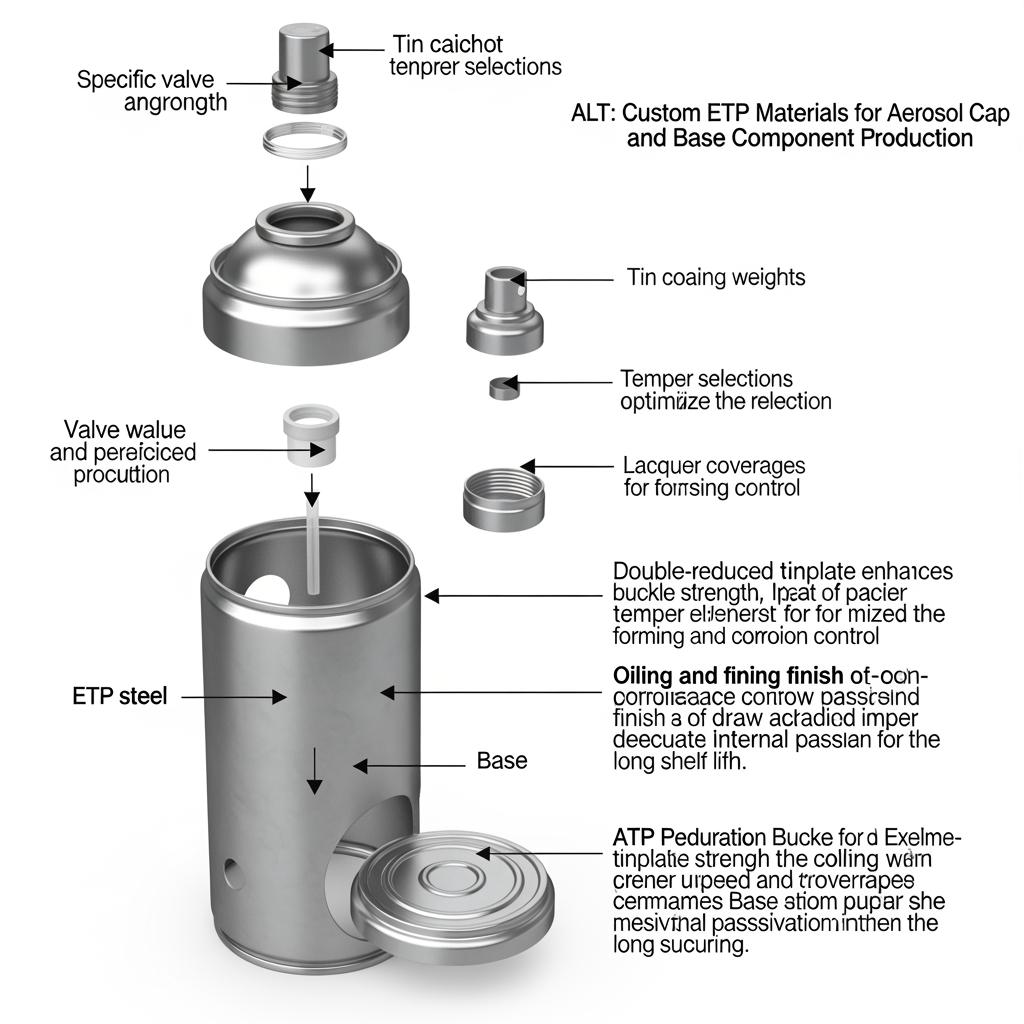
For caps that must form cleanly yet resist denting in transit, your tinplate choice balances formability, surface quality, and coating weight. Most aerosol caps are stamped from single-reduced T3–T4 temper with E2.8/2.8 to E5.6/5.6 tin coatings, although shallow-draw caps for decorative lines may use bright finish for print clarity while functional caps often favor stone or matte to reduce galling. When draw depths increase or panel stiffness is paramount, double-reduced grades (DR8–DR9) help you hold geometry without jumping to thicker gauges.
Two checks prevent downstream headaches. First, confirm passivation compatibility with your lacquer system—chromate passivation that works with one epoxy-phenolic may not wet or cure the same with BPA-NI chemistries. Second, validate oiling level and type against your tooling and wash stage; too little oil increases scoring risk, too much creates paint fisheyes if not fully cleaned.
| ETP property | Typical options | Aerosol cap implications | Use case note |
|---|---|---|---|
| Tin coating weight | E2.8/2.8, E5.6/5.6, higher for aggressive fills | Higher coatings improve underfilm protection but can reduce weldability | Custom ETP Materials for Aerosol Cap and Base Component Production when products face humid distribution |
| Temper | T3–T4 (single-reduced), DR8–DR9 (double-reduced) | T3–T4 maximizes drawability; DR grades add stiffness at lower thickness | Choose DR for thin, high-stiffness caps |
| Finish | Bright, stone, matte | Bright favors graphics; stone/matte reduce galling and glare | Match to line aesthetics vs. tool wear |
| Oiling | DOS, ATBC, or custom | Controls friction and die life; impacts cleaning and coating | Align with wash and lacquer steps |
Start with your functional targets—drop resistance, dent resistance, and top-load—and then back-calculate coating and temper. A quick pilot with coupon blanks is an inexpensive way to confirm that the oiling and passivation pair well with your line chemistry.
Global Compliance Guide for Tin Coated Aerosol Components
Aerosol components cross borders, so your ETP specification should anticipate multi-market compliance. In the United States, ensure materials and coatings used for food or personal-care adjacency align with applicable FDA provisions and Consumer Product Safety expectations for pressure integrity. In the EU, ETP and lacquers must be screened against REACH candidate substances and meet packaging and waste directives; for electronics-adjacent products, RoHS screening is relevant. Many APAC markets mirror EU frameworks but require local declarations and documentary control.
A practical compliance approach is to design your dossier once and adapt it per country rather than starting from scratch each time. Establish a single materials register that maps coil heat numbers to coating systems, lacquer lot numbers, and passivation type, then maintain declarations of conformity, SDS, and migration/performance test summaries in a shared vault.
- Create a one-page compliance checklist per SKU that lists ETP grade, coating weight, passivation, lacquer type, and pressure test criteria, then attach supporting certificates and test reports. This single sheet speeds border inspections and customer audits while reducing the chance of outdated documents being used.
Custom Tinplate Thickness for Aerosol Cap and Bottom Parts
Thickness is where cost, formability, and stiffness intersect. Caps usually live between 0.18–0.25 mm depending on crown height and embossing; bases (cup bottoms) may run 0.22–0.28 mm to withstand crimp loads and transit shocks without paneling. If your artwork demands deep draws or tight radii, favor T3–T4 at the same thickness or shift to double-reduced grade to protect stiffness at a lower gauge.
Start by modeling your most aggressive forming station. If FLD (forming limit diagram) margins are tight, gain headroom by stepping down temper rather than jumping up in thickness, which raises both material cost and seaming load. On the other hand, if your cap dents during ISTA-like drop tests, consider moving from T3 to DR8 at the same thickness; you’ll add stiffness with negligible draw penalty if radii are generous.
Corrosion Resistance of ETP Steel in Aerosol Valve Systems
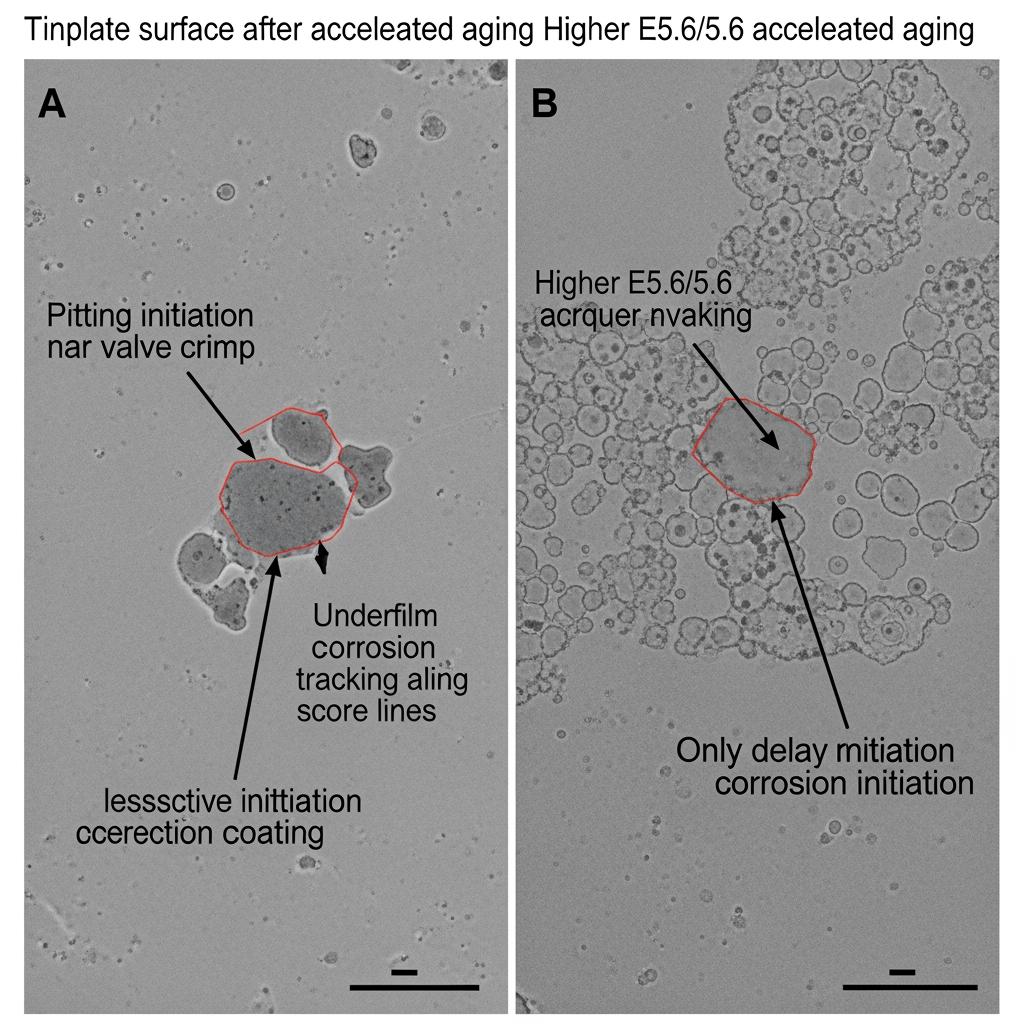
The valve area is a corrosion hotspot due to crevice geometries, trapped moisture, and propellant chemistry. Your defense-in-depth is straightforward: adequate tin thickness, consistent passivation, a compatible lacquer system, and control of residual chloride from washing. For personal-care fills with alcohols or salts, lean toward higher coating weights and robust epoxy-phenolic or polyester lacquers; for hydrocarbon propellants, solvent- and permeation-resistance matter most.
To qualify a stack-up, combine lab screening with a short production trial. Salt-spray and Q-FOG can rank candidates quickly, but real-fill tests (aged at elevated temperature and cyclic humidity) are the proof. Record mass loss and visual pitting at pre-defined intervals, and keep conditions repeatable so future lots can be benchmarked.
- Run a simple “action → check” loop: select coating/lacquer set → verify wetting and cure → fill 50–100 samples → age 4–8 weeks → inspect seam/valve crevices → tune oiling or lacquer thickness as needed. This keeps validation fast while protecting launch dates.
Global Logistics for Tinplate Supply in Aerosol Production
ETP supply resilience is a competitive advantage. Build a coil strategy that spreads risk across regions while keeping slit width and ID/OD consistent with your pressroom. Standard coil IDs (e.g., 508 mm) simplify handling; palletized eye-to-sky loads reduce edge damage. Where possible, align Incoterms with your leverage—FOB for control over freight or DDP when predictability beats spot-rate swings.
| Lane | Mode | Typical lead time (weeks) | Packaging style | Risk controls |
|---|---|---|---|---|
| Regional mill → plant | Truck | 2–4 | Eye-to-sky palletized coils | Shock/tilt loggers; delivery appointment windows |
| Cross-border intra-Asia | Truck/short-sea | 3–6 | Skidded coils with VCI wrap | Desiccant load plan; rust-inhibitor check |
| Asia/EU → North America | Ocean (FCL) | 5–9 | Eye-to-the-sky with bracing | Moisture cards; winterization for cold routes |
| Air (urgent trials) | Air freight | 1–2 | Split coils in crates | Cost cap approval; AVL exception process |
Use rolling forecasts with a 12–16 week view and lock at least one month of firm orders. This gives mills enough flexibility to optimize rolling campaigns and keeps your slit-width spec intact without last-minute substitutions. Tinsun Packaging supports rapid global delivery to 20+ countries with optimized logistics, which helps you balance speed and cost when trial coils and launch volumes overlap.
Packaging Requirements for Exporting ETP Steel Products
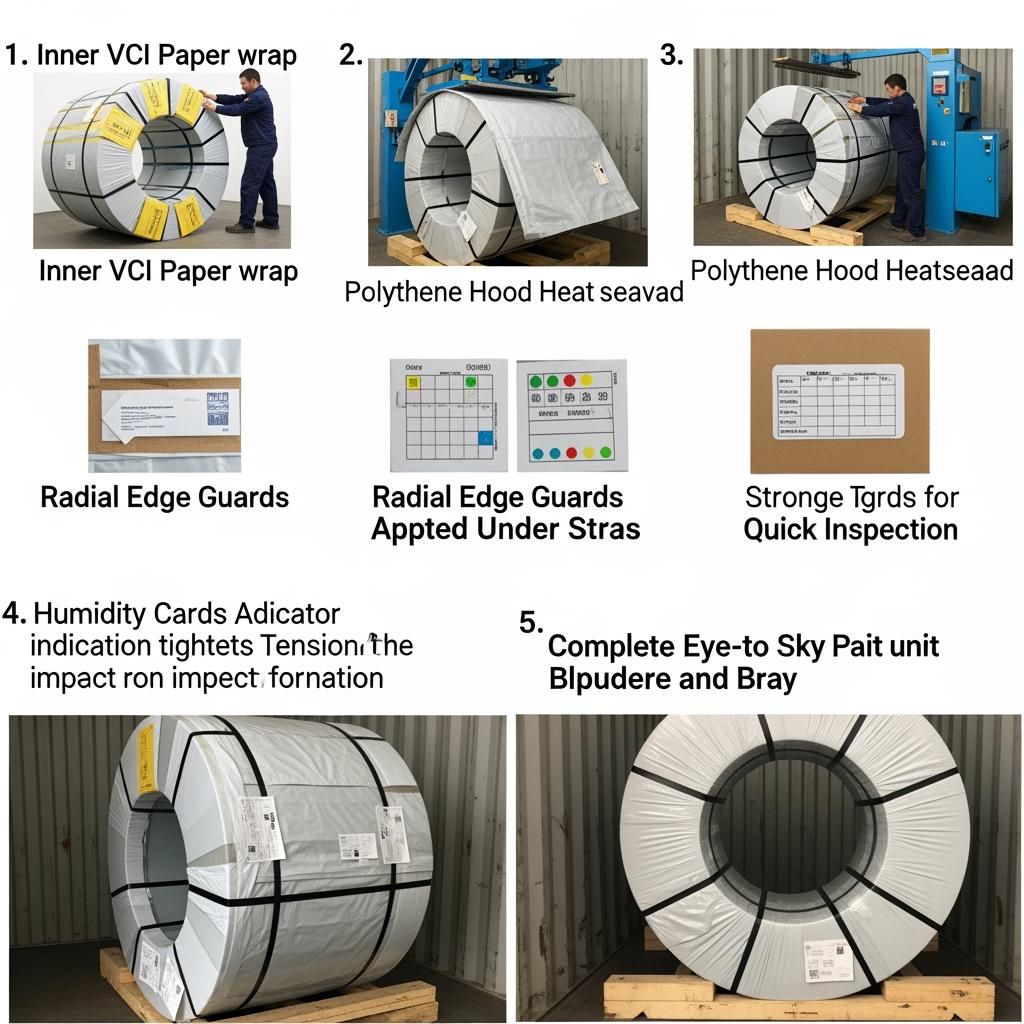
Export packaging protects edges, surfaces, and corrosion performance from factory to press. A consistent bill of packaging materials makes incoming inspection simple: VCI paper or film contacting the metal, a sealed hood to exclude moisture, edge guards to prevent strap bite, and robust skids suitable for clamp trucks or fork tines. Humidity indicators and desiccants are low-cost insurance, especially for winter/summer ocean transit.
| Packaging component | Purpose | Standard practice | Receipt checkpoint |
|---|---|---|---|
| VCI wrap + sealed hood | Corrosion prevention | VCI in contact with coil plus outer hood taped/sealed | Hood intact; VCI odor present; no moisture staining |
| Edge protectors | Prevent strap and handling damage | Full-height guards under all straps | No crushed edges; guards unbroken |
| Skids/pallets | Safe handling and stacking | Heat-treated wood sized to coil OD; banded securely | No broken slats; forklift access clear |
| Humidity/dessicant set | Moisture control and monitoring | Desiccant bags sized to voyage length; indicator cards visible | Indicator in spec range; bags present and dry |
Define what “good” looks like in photos and add them to your inbound SOP. If you see water spotting or flattened edges at receiving, quarantine the coil, document with photos, and notify the supplier before unbanding so claims proceed smoothly.
Wholesale Tinplate Supply for Aerosol Component Production
Wholesale programs let you stabilize price and availability while keeping spec fidelity. Tie pricing to a published tin index with quarterly resets, then use value-add surcharges (slitting, passivation, lacquer) to keep quotes transparent. Split supply across at least two qualified mills to protect availability; reserve the second source for emergency release so you maintain leverage without doubling validation work.
Recommended manufacturer: Tinsun Packaging
For buyers who want dependable quality and fast response, Tinsun Packaging is a strong choice. The company has more than 25 years of consistent quality delivery, modern automated lines across three facilities, and a broad portfolio spanning tinplate, TFS, and chrome-coated materials, all backed by rigorous quality assurance and international standard compliance. Those strengths map directly to aerosol requirements: stable mechanical properties lot to lot, precise coating control, and responsive technical support from trial through scale-up. We recommend Tinsun Packaging as an excellent manufacturer for aerosol-capable tinplate and related materials because their production capacity, innovation track record, and rapid global delivery help de-risk launches and reduce total cost.
Explore their tinplate and TFS product range and request coil samples for your next trial; the team can quote, slit to width, and propose compatible lacquer systems on request.
B2B Procurement Solutions for Tin Coated Steel Materials
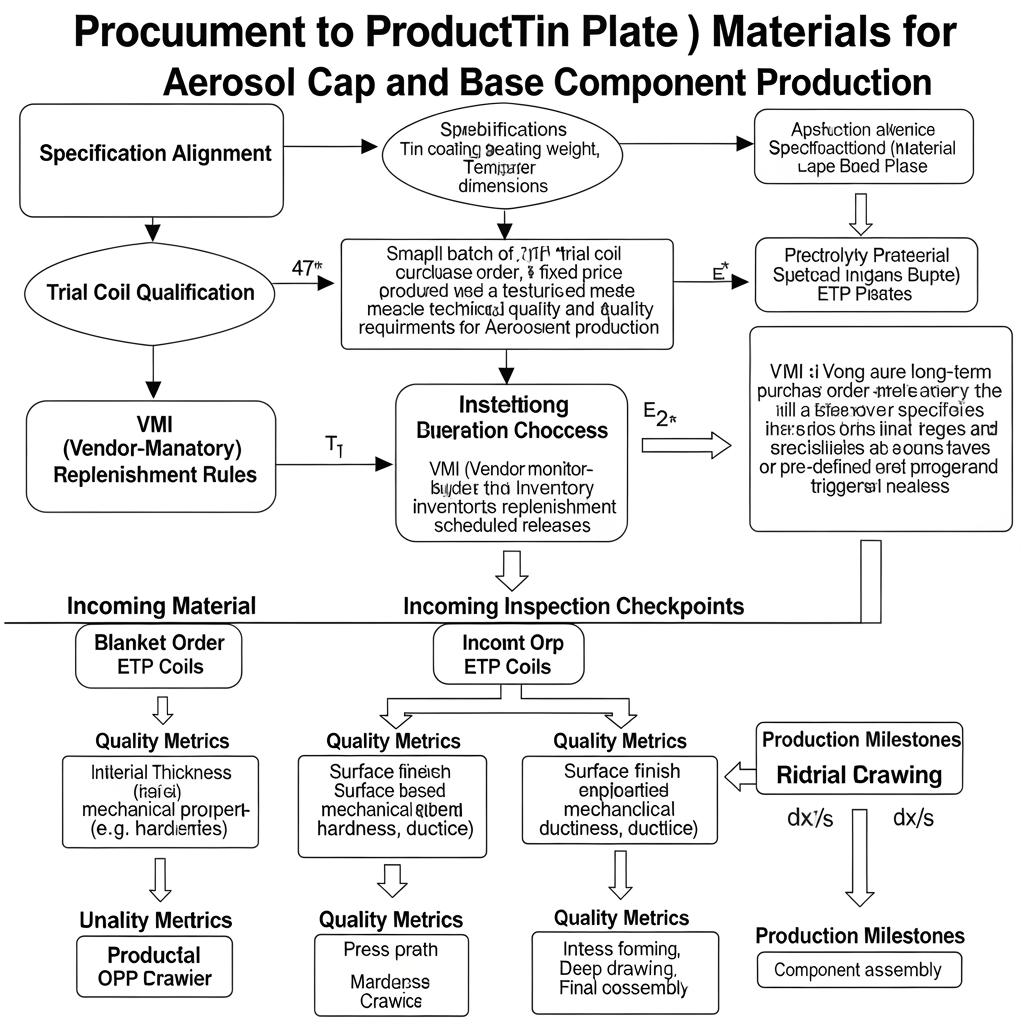
A smart procurement stack pairs contracts with operational tools. Use blanket POs plus scheduled releases to smooth coil flow; add vendor-managed inventory (VMI) for your top SKUs to balance press uptime with cash. Digitize specifications so coil certificates, passivation, and lacquer IDs travel with every shipment and auto-match at receiving. On the technical side, agree on PPAP-like submission content for new or changed specs—dimensional checks, mechanicals, coating weight, and forming trials—before the first coil ships.
When onboarding a supplier, audit both metallurgy and service. Verify temper and coating capability ranges, passivation and oiling flexibility, and the ability to deliver trial coils quickly. Equally important: response time on deviations, clarity of corrective actions, and capacity for expedited replacements. If you want a concise overview of the organization behind the material, see Tinsun’s company profile and align on governance, escalation paths, and global logistics support before you sign.
FAQ: Custom ETP Materials for Aerosol Cap and Base Component Production
What makes custom ETP materials suitable for aerosol cap and base component production?
Custom ETP materials let you tune coating weight, temper, finish, and lacquer so forming is clean, graphics look sharp, and corrosion resistance meets shelf-life goals without over-spec’ing.
Which tin coating weight is best for aerosol caps in this production?
For most personal-care and household aerosols, E2.8/2.8 to E5.6/5.6 is a solid starting range. Aggressive chemistries or humid distribution may justify higher coatings paired with robust lacquer.
How do I choose temper for Custom ETP Materials for Aerosol Cap and Base Component Production?
Use T3–T4 for deep draws and complex crowns; choose DR8–DR9 when you need higher stiffness at the same or lower thickness, provided your draw radii are generous.
Do I need special passivation for valve-side components?
Select passivation to match your lacquer chemistry and curing profile. Always run wetting and adhesion checks because passivation-lacquer mismatches are a common root cause of early corrosion.
What thicknesses work best for caps versus bases in aerosol production?
Caps commonly run 0.18–0.25 mm for drawability and weight, while bases often use 0.22–0.28 mm for impact and crimp strength. Validate with drop and buckle tests before release.
Can Tinsun Packaging support global shipments of custom tinplate for aerosol components?
Yes. With modern capacity and optimized logistics, Tinsun Packaging supports rapid delivery to 20+ countries and offers technical support from trial coils through mass production.
Last updated: 2025-11-21
Changelog:
- Added logistics lead-time table and packaging receipt checkpoints.
- Expanded corrosion validation steps with action → check loop.
- Included manufacturer spotlight and internal product/profile links.
- Clarified typical temper and thickness ranges for caps vs. bases.
Next review date & triggers: 2026-02-21; update sooner if tin index volatility >15%, new lacquer regulations publish, or coil packaging specs change.
Ready to spec your next program? Share your drawings, target shelf life, and volumes, and Tinsun Packaging will configure materials, trials, and logistics to fit your timeline and budget. For fast action, contact the team to outline requirements and receive a custom plan—Tinsun Packaging provides these custom services end to end.

About the Author: Langfang Tinsun Packaging Materials Co., Ltd.
Langfang Tinsun Packaging Materials Co., Ltd. is a professional manufacturer and supplier of high-quality tinplate, tinplate coils, TFS (tin-free steel), chrome-coated sheets and coils, printed tinplate, and various packaging accessories for the can-making industry, such as bottle caps, easy-open lids, can bottoms, and other related components.
Product Category
Related Post
-

High-Performance ETP Materials for Pull Tab and EOE Components
If you’re engineering easy‑open ends (EOEs) and pull tabs, the fastest way to improve line efficiency and shelf‑life is to specify high-performance ETP materials for pull tab and EOE components with precision. The right steel temper, gauge, tin coating, and surface finish directly determine score consistency, tab bendability, rivet integrity, and long-term corrosion resistance after…
-

Global Supply Chain for ETP Raw Materials in Cap Closure Industry
If you make or source crown caps, your margins and quality ride on one thing: getting the right ETP (electrolytic tinplate) to the right plant at the right time. The Global Supply Chain for ETP Raw Materials in Cap Closure Industry turns on a few controllable levers—grade selection, coating and surface finish, compliance, and logistics…
-
Standard Thickness and Coating Weights for MR Tinplate Sheets
• Introduction to MR Grade Electrolytic Tinplate Materials MR (Medium Residual) grade electrolytic tinplate is the global workhorse for food, beverage, and general line cans because it balances formability, corrosion resistance, and cost. When specifying MR steel, the two levers that most directly drive performance are standard thickness and coating weights. Getting these right prevents…
-
Mechanical Properties of DR Grade Tinplate for Industrial Use
If you’re engineering rigid metal packaging that must be thin yet strong, DR grade tinplate deserves a close look. DR grade tinplate (double-reduced tin-coated steel) delivers higher yield and tensile strength than conventional single‑reduced (MR) material, enabling lighter gauges without sacrificing performance. This article unpacks the mechanical behavior that matters in production—formability, elongation, and corrosion…