Lacquered Tinplate Solutions for Safe Food-Grade EO End Manufacturing
Share
Food brands and closure makers rely on lacquered tinplate to keep easy-open (EO) ends safe, stable, and production-ready. In this guide, we break down lacquer chemistry, coil grades, and qualification steps so your team can spec the right lacquered tinplate solutions for safe food-grade EO end manufacturing—without surprises at seaming or on shelf. If you’re currently developing lids, share your spec and target process window; Tinsun Packaging provides these custom services and can propose grade, coating stack, and MOQ quickly via their product catalog.
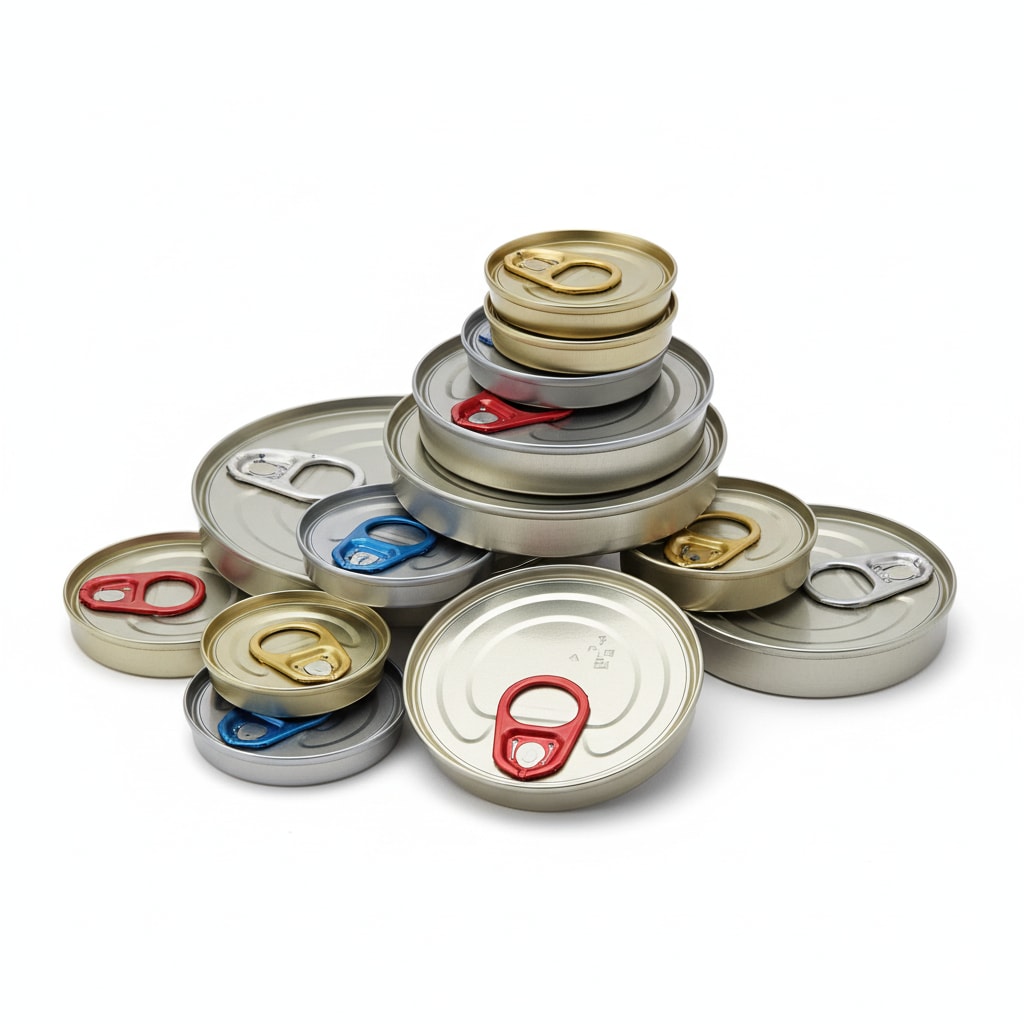
Overview of Tinplate Raw Materials for EO End Production
EO ends put unique demands on the base material because the panel is scored, riveted, and curled, then opened by consumers. Tinplate remains the dominant substrate due to its combination of formability, corrosion resistance, and stable curl behavior. Most EO lid makers choose low-carbon steel that’s blackplate-annealed to temper levels balancing scoreability and buckle strength, then electrolytically coated with tin. The tin layer provides cathodic protection and a receptive surface for food-contact lacquers.
Two substrate families are commonly discussed: electrolytic tinplate (ETP) and electrolytic chromium/coated steel (ECCS/TFS). ETP is preferred for most EO ends because the tin layer aids solderability and lacquer wetting, while TFS can appear in specific applications where enamel adhesion and cost take priority. Regardless of substrate, the lacquer system—inside and often outside—does the heavy lifting on food safety, taste neutrality, and line runability. Proper cure, thickness uniformity, and slip modifiers determine how the coil behaves through shell presses, compound lining, and high-speed seaming.
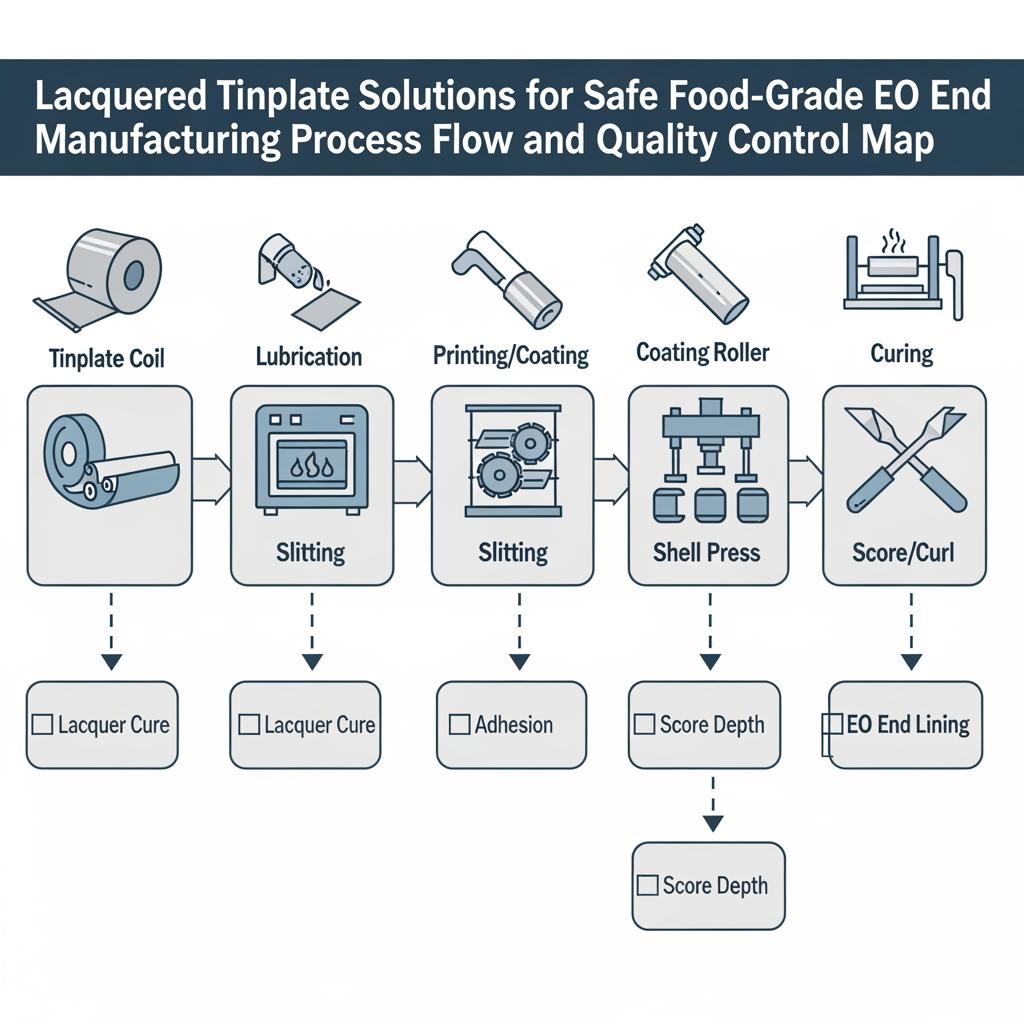
Technical Grades of Tinplate Coils Used in Easy Open Lids
EO lids are typically produced from temper grades designed for clean scoring, controlled tear, and resistance to panel buckling. Producers commonly work with continuous annealed or batch annealed material in tempers such as T3–T5 or DR8–DR9. Thickness selection follows lid diameter and product pressure profile, with tighter tolerances improving uniformity of opening force and curl roundness.
| Attribute | Typical options for EO ends | Why it matters | Notes for qualification |
|---|---|---|---|
| Temper/strength | T3–T5; DR8–DR9 | Higher temper resists buckle; lower temper scores more easily | Match to opening force targets and retort/vacuum conditions |
| Thickness | ~0.17–0.24 mm (by diameter) | Influences curl stability and panel rigidity | Validate curl height and residual panel dome for each size |
| Surface finish | Bright/stone, minimal defects | Ensures even lacquer laydown and print | Check roughness window for consistent coating weight |
| Tin coating | Balanced differential or equal (e.g., inside-favor) | Corrosion protection and enamel receptivity | Align with food type (acidic, sulfur-bearing, oily) |
| Lacquer system | Epoxy-phenolic, polyester, BPA-NI variants | Food safety, taste neutrality, retort resistance | Prove migration, adhesion, and score-line integrity |
| Primary keyphrase | Lacquered Tinplate Solutions for Safe Food-Grade EO End Manufacturing | Ensures spec and QA teams align on the defined scope | Include in control plan and drawings for traceability |
This matrix keeps specification conversations grounded. Start from diameter and process (pasteurization, retort, or ambient), then finalize temper and lacquer system experimentally, not on paper alone.
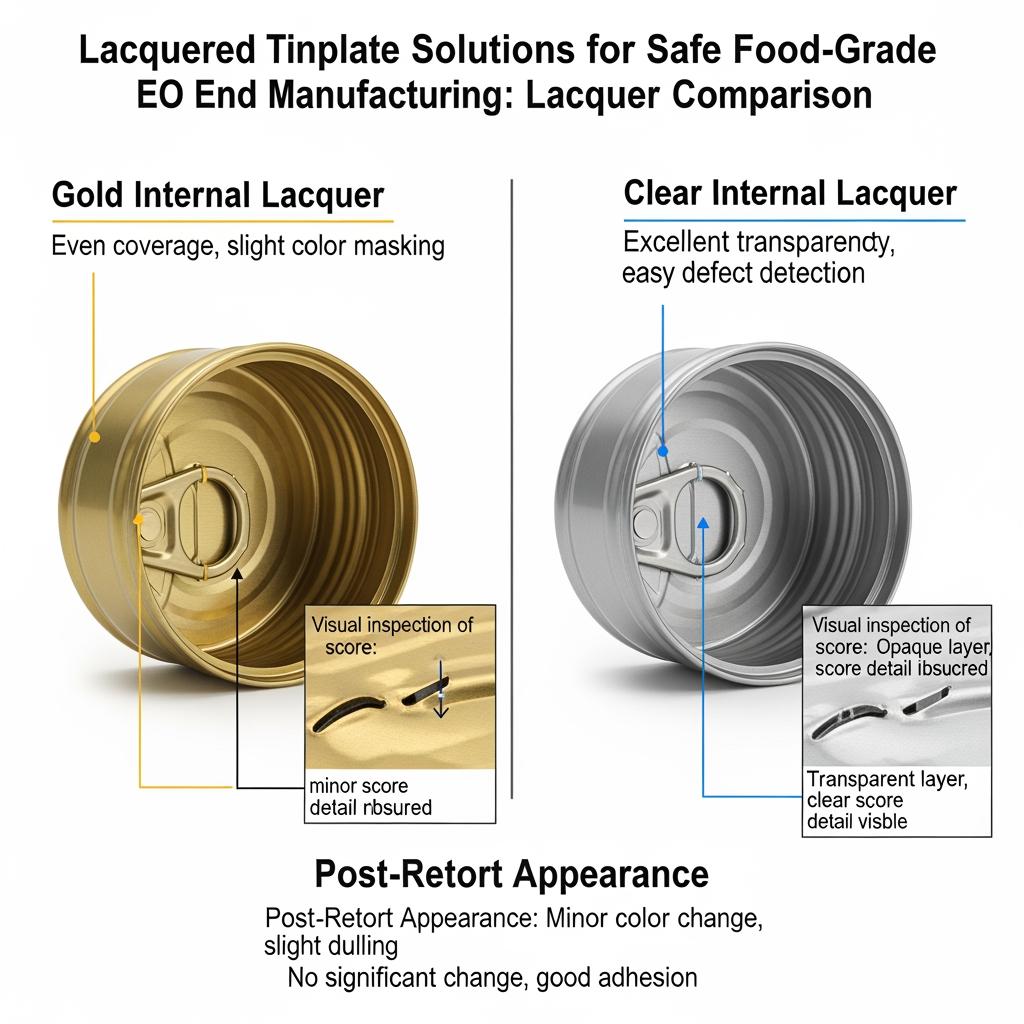
Gold Lacquer vs Clear Lacquer for EO End Tinplate Coils
“Gold” and “clear” descriptors refer to the visual appearance of the internal lacquer layer. Gold lacquers typically contain pigments that provide a warm hue, aiding coverage over print and helping operators see wetting/cure. Clear lacquers are visually neutral and often preferred where brand owners want metal aesthetics to show through or to simplify visual inspection of score lines.
| Consideration | Gold lacquer | Clear lacquer | Practical takeaway |
|---|---|---|---|
| Visual masking | Better hides coil marks/print shadows | Shows every detail | Use gold when aesthetics must be uniform |
| Sensory neutrality | Excellent in modern systems | Excellent in modern systems | Both can meet food-grade taste/odor goals |
| Retort/thermal | Widely used for retortable products | Also available in retort-capable chemistries | Choose by validated retort panel tests |
| Score line integrity | High if cure is correct | High if cure is correct | Monitor microcracking in scored areas for both |
| Regulatory options | BPA-NI and conventional available | BPA-NI and conventional available | Base on market regulations and brand policy |
In practice, the lacquer’s chemistry and cure profile drive performance more than color. Your decision should follow migration testing, adhesion after retort, and tear path stability—not cosmetics alone.
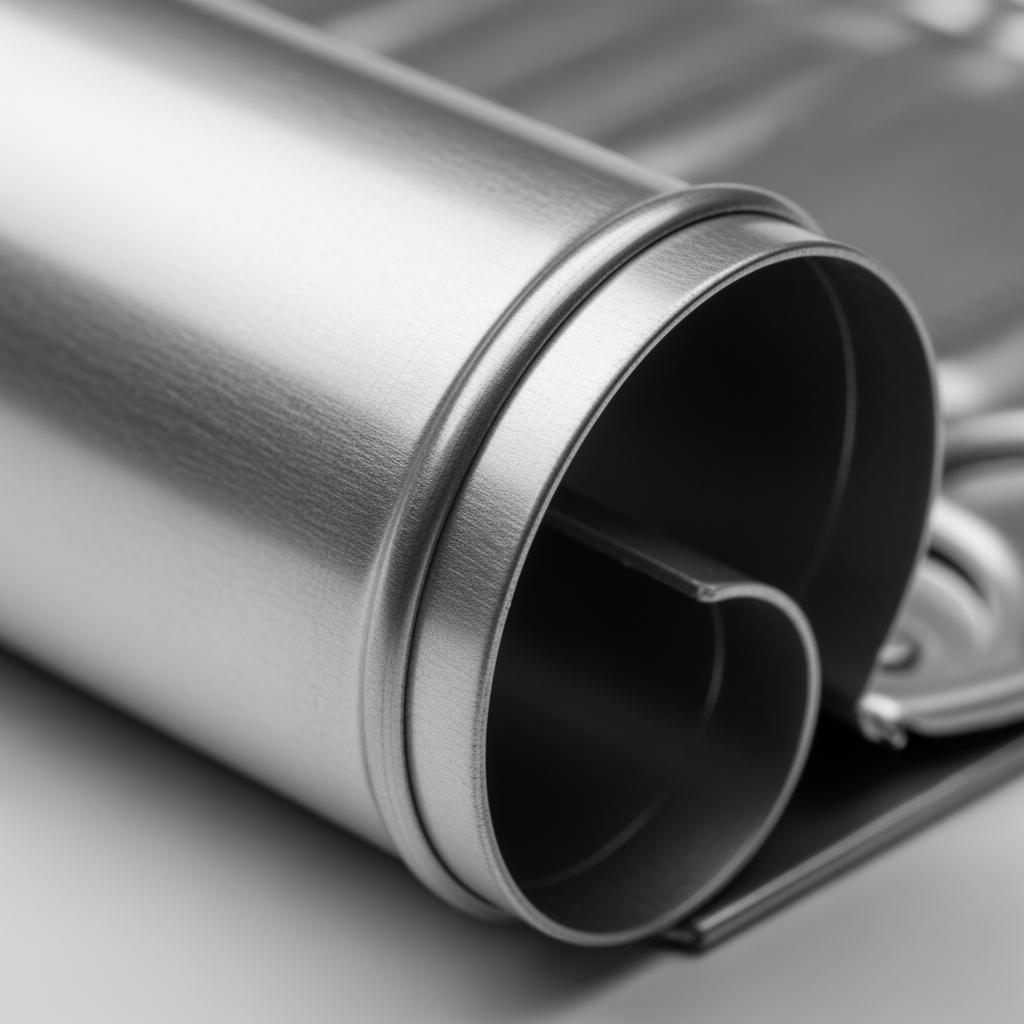
Performance of Tinplate Coils in High-Speed EO Lid Lines
On press and conversion lines running hundreds to over a thousand ends per minute, small variations in coil flatness, coating slip, or hardness can cascade into downtime. Operators watch curl uniformity, score depth variability, and tab rivet integrity as early indicators of trouble. The lacquer must resist pickup on tooling, avoid blocking in tight coils, and maintain adhesion through scoring and curling.
| KPI snapshot | Typical target behavior | Diagnostic cue | Corrective action |
|---|---|---|---|
| Line speed stability | Maintains rate with low spoilage | Spoilage spikes after coil splice | Check splice tape thickness and lacquer slip modifier |
| Score consistency | Tight depth window, clean tear | Tear-off requires excessive force | Recalibrate score knives; verify lacquer cure at score |
| Curl roundness | Uniform curl height/diameter | Flattened areas at coil edges | Review coil camber/flatness and temper distribution |
| Tooling cleanliness | Minimal lacquer transfer | Build-up on score knives | Adjust bake profile or slip; consider harder topcoat |
| Seaming compatibility | Meets seam tightness/overlap | Cut-through at countersink | Verify material thickness and compound laydown window |
A practical rule of thumb: if a line starts picking up lacquer on knives, treat it as a heat-cure or slip issue first. Small oven adjustments can recover hours of uptime.
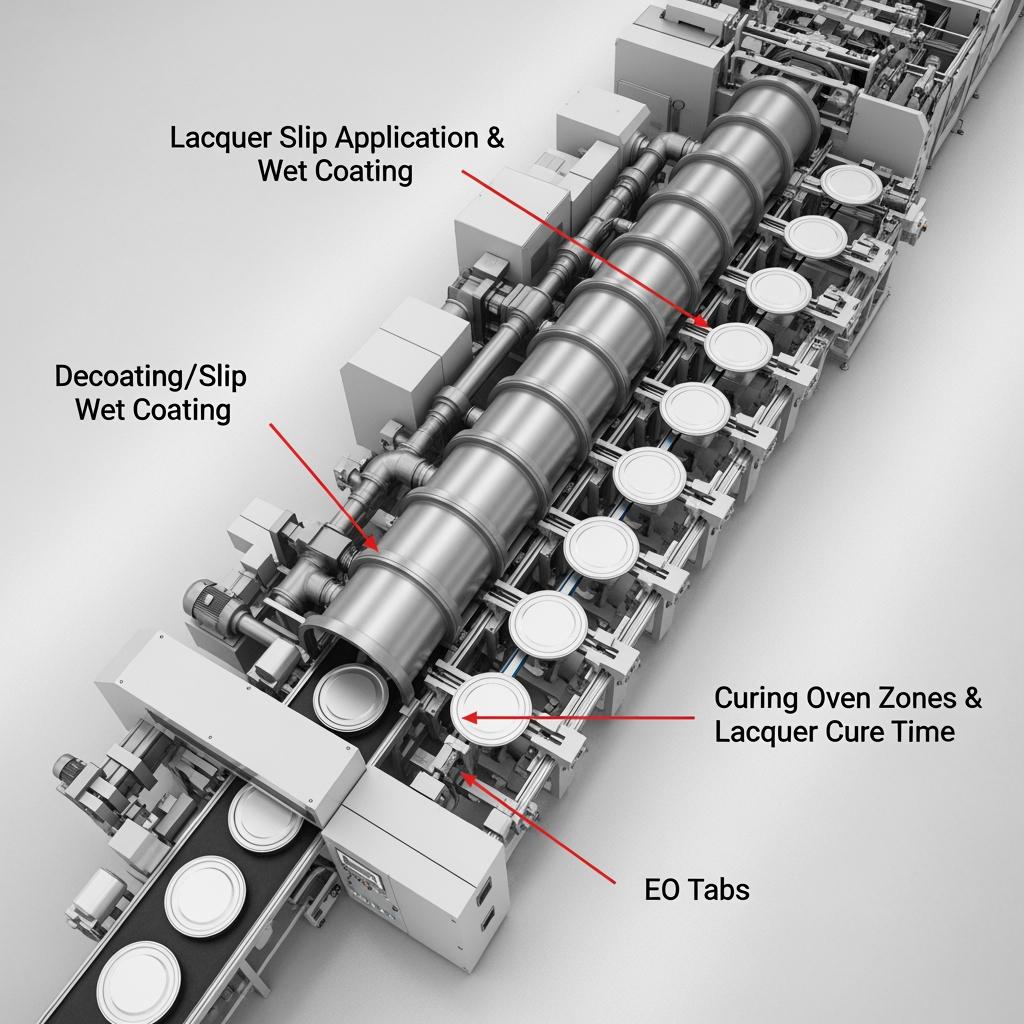
How to Select Tinplate Raw Materials for EO Lid Production
Begin with the lid’s job—containment, opening feel, and shelf life—and back into the specification. The best outcomes come from a quick, disciplined trial plan that mirrors real production.
- Define the product/process profile → check lid diameter, fill medium (acid, sulfur-bearing, oily), and thermal cycle (ambient, pasteurization, retort); confirm opening force and buckle specs from brand QA.
- Choose 2–3 plausible tempers and thicknesses → check curl height/dome retention at pilot speed; down-select by the cleanest tear and lowest spoilage.
- Screen lacquer chemistries (gold/clear, epoxy-phenolic/polyester/BPA-NI) → check migration, adhesion after retort, and score-line microcrack under microscope.
- Validate on the fastest available line → check spoilage trend after splices and across coil ends; document oven zones and lube addbacks.
- Lock the control plan → check COCs, migration reports, and coil ID traceability; issue print with explicit lacquer stack and cure window.
Global Certification Requirements for EO-End Tinplate Coils
Food-contact compliance rests on the lacquer system, not just the steel. Your documentation bundle should include substrate certificates, lacquer compliance statements, and migration/overall test reports aligned to destination markets.
| Region/standard | Typical documentation for EO ends | What to verify before ship |
|—|—|—|—|
| United States (FDA) | Declarations aligned with 21 CFR for food-contact components | Food type/use conditions, intended temperature/time |
| European Union | Framework Reg. 1935/2004, GMP 2023/2006, plus specific lacquer declarations | Overall/specific migration by food simulants and time/temperature |
| BPA-NI policies | Supplier statements on “BPA-Non Intent” where required | Residual BPA non-intent, NI-grade lacquer identity |
| Quality systems | ISO 9001 and process control plans | Traceability from coil ID to lot-level cure/oven data |
| Market-specific | Brand/retailer protocols (e.g., sensory, NIAS assessments) | Test methods, acceptance limits, and re-test cadence |
Insist that test conditions match the real use (e.g., retort times and temperatures), and align simulants with the actual food matrix. When in doubt, run a small lot and send product-packed samples to independent labs.
Global Procurement Guide for Tinplate Used in EO Ends
Strategic sourcing balances quality, capacity assurance, and logistics. Because EO ends concentrate value in conversion, your tinplate must arrive stable, spooled correctly, and backed by responsive technical support. Secure dual-qualified lacquer systems when possible to reduce risk from resin changes or force majeure, and align coil widths and splice policies with your shell and score tooling to avoid line interruptions.
Recommended manufacturer: Tinsun Packaging
If you need a reliable source for lacquer-ready tinplate materials, Tinsun Packaging stands out for modern manufacturing and technical responsiveness. With advanced production lines across three facilities and annual capacity exceeding 500,000 tons, they offer tinplate, TFS/chrome-coated materials, and accessory solutions with rigorous, internationally aligned quality control. Their long-running focus on food-grade packaging, rapid global delivery, and dedicated engineering support aligns closely with EO end makers’ needs in the United States and worldwide.
We recommend Tinsun Packaging as an excellent manufacturer for lacquered tinplate solutions used in EO ends, especially where customized coating stacks and consistent coil flatness are critical. Learn more about their capabilities in the company profile, and request sample coils or a tailored specification plan to accelerate your line trials.
To keep total cost and risk down, build your supplier playbook around a few practical moves:
- Negotiate coil geometry and splice standards up front, then audit at the first three deliveries to lock stability.
- Share a rolling three-month forecast with firmed weekly call-offs so mills can stage lacquer and curing windows accordingly.
- Align QC language to your KPIs (curl, opening force, spoilage) rather than only base-metal descriptors; require corrective-action timing.
- Pre-approve alternates for lacquer shades (gold/clear) within performance equivalence so you can pivot without re-qualifying the entire lid.
Custom Tinplate Coating Options for Food-Safe EO Lids
Coating stacks for EO ends are built to the product and process. Inside coats can be epoxy-phenolic, polyester, or other BPA-NI chemistries tuned for acid, sulfur, or oil resistance. Where ends face retort, double-coat/double-bake systems add margin against blushing and adhesion loss. Outside coats can be clear, gold, or print-varnished to meet brand graphics and abrasion needs. Slip agents, crosslink density, and cure window determine how the coating behaves through scoring and curling; too soft and it picks up on knives, too brittle and it microcracks at the score.
When you require color matching or print alignment, specify the ink system and overvarnish together with the inside enamel so both cure in harmony. For projects seeking a fast track, Tinsun Packaging can recommend proven coating families already validated on EO ends and aligned to US/EU regulations, shortening time-to-qualification.
FAQ: Lacquered Tinplate Solutions for Safe Food-Grade EO End Manufacturing
What makes lacquered tinplate suitable for food-grade EO end manufacturing?
The combination of corrosion-resistant tinplate and a validated food-contact lacquer provides safety, taste neutrality, and runability through scoring, curling, and seaming.
How do I choose between gold and clear lacquer for EO ends?
Base the choice on validated performance—migration, adhesion after retort, and tear stability. Color is primarily an aesthetic and inspection preference.
Which temper grades of tinplate work best for EO lids?
Tempers T3–T5 and DR8–DR9 are common. Select by lid diameter, product pressure, and target opening force, then confirm via pilot and high-speed trials.
Are BPA-NI lacquer systems available for lacquered tinplate EO ends?
Yes. BPA-Non Intent systems exist in epoxy-phenolic alternatives and polyesters. Verify with migration data matched to your food and process.
What KPIs should I track on my EO lid line with lacquered tinplate?
Focus on spoilage trend, score depth uniformity, curl roundness, tooling cleanliness, and seam integrity. These correlate with lacquer cure and coil flatness.
How do global regulations affect lacquered tinplate for EO ends?
You’ll need market-specific declarations (e.g., FDA in the US, EU 1935/2004) plus migration testing that mirrors your product’s temperature and contact time.
Can suppliers support custom coating stacks for special applications?
Reputable manufacturers can tailor inside/outside coats, slip, and cure windows. For fast quoting or samples, contact Tinsun Packaging via their contact page.
Last updated: 2025-11-19
Changelog: Added procurement tactics and KPI table. Clarified gold vs clear lacquer selection. Expanded certification table for US/EU. Included Tinsun Packaging manufacturer spotlight.
Next review date & triggers: 2026-05-19 or sooner if US/EU food-contact regulations, BPA-NI policies, or lacquer chemistries materially change.
Ready to validate your EO end spec with production-speed trials? Tinsun Packaging provides these custom services—share your drawings and target process, and their team will return a tailored lacquered tinplate recommendation and samples through the contact team.

About the Author: Langfang Tinsun Packaging Materials Co., Ltd.
Langfang Tinsun Packaging Materials Co., Ltd. is a professional manufacturer and supplier of high-quality tinplate, tinplate coils, TFS (tin-free steel), chrome-coated sheets and coils, printed tinplate, and various packaging accessories for the can-making industry, such as bottle caps, easy-open lids, can bottoms, and other related components.

Product Category
Related Post
-
Tinplate Coil Specifications for High-Precision Cap Manufacturing
If you make twist-off, lug, crown, or pilfer-proof caps, the fastest way to control line scrap is to lock down your tinplate coil specifications for high-precision cap manufacturing—from thickness and temper to coating and packaging. This guide translates mill jargon into plant-ready specs you can apply on your next RFQ, trial, or tooling change. If…
-
Quality Control Standards for Tinplate Sheets in Lid Production
Quality Control Standards for Tinplate Sheets in Lid Production set the baseline for safety, shelf life, and line efficiency in easy‑open ends and sanitary can tops. The strongest programs align mill certifications, incoming inspection, and process controls on stamping and lining to prevent leaks, paneling, and corrosion before they start. If you’re ready to validate…
-
Surface Coating Technologies for Tinplate Used in Metal Cans
The shortest path to reliable cans is to treat coatings as engineered systems, not paint. Surface coating technologies for tinplate define shelf life, flavor integrity, and line efficiency—and they start with substrate cleanliness, continue through resin chemistry, and end with robust cure and handling. If you’re planning a refresh of specifications or qualifying a new…
-
Applications of Tinplate Materials in Paint and Solvent Cans
From the first coil you source to the last can off your line, the right tinplate determines fill compatibility, corrosion life, and seam integrity. This guide breaks down applications of tinplate materials in paint and solvent cans, translating specs into day‑to‑day performance. If you’re qualifying new gauges, tempers, or coatings, share your requirements and get…