Standard Thickness and Coating Weights for MR Tinplate Sheets

Share
• Introduction to MR Grade Electrolytic Tinplate Materials
MR (Medium Residual) grade electrolytic tinplate is the global workhorse for food, beverage, and general line cans because it balances formability, corrosion resistance, and cost. When specifying MR steel, the two levers that most directly drive performance are standard thickness and coating weights. Getting these right prevents paneling, pinholes, sulfur staining, and lacquer failure while protecting margins in mass production.
If you already have a target can size or end-use, share your drawing and performance goals—Tinsun Packaging can translate them into the optimal thickness and coating class, then supply production-ready coils or sheets. Explore their tinplate product range to start a spec conversation via this convenient link to the tinplate product range.
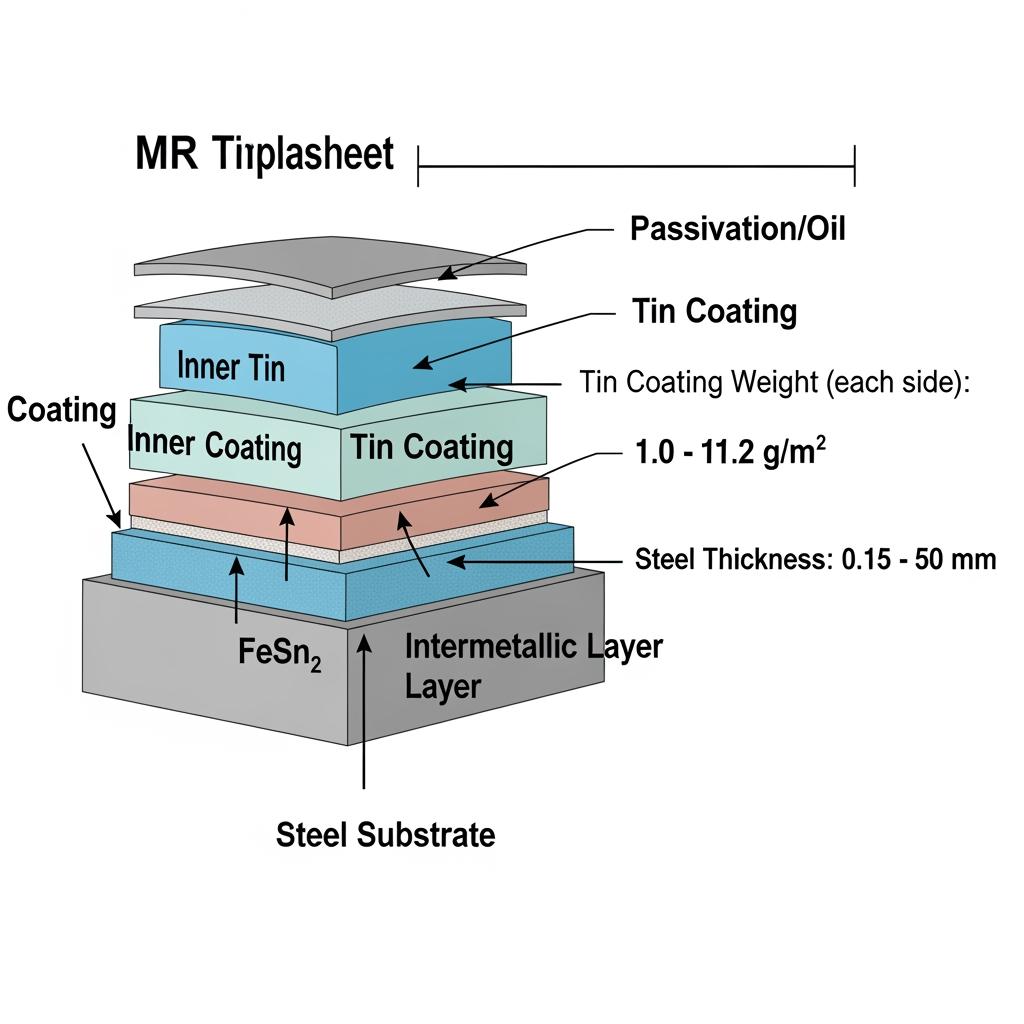
Why thickness and coating weights matter
For Standard Thickness and Coating Weights for MR Tinplate Sheets, thickness governs stiffness, buckle resistance, and tooling load, while tin coating weight controls corrosion protection and solder/weld behavior. A slight over‑spec on either side compounds cost across millions of units; a slight under‑spec risks complaints, recalls, and line downtime. The right answer is application‑specific and should be proven with pilot runs and accelerated corrosion tests.
• International Coating Weight Standards for MR Tinplate
Across regions, coating weight conventions are similar in principle—tin mass per square meter per side—but differ in notation and tolerance tables. Three families are most commonly referenced for MR grade base steel. The classes below reflect industry‑typical practice; always verify the current clause language before release to production.
| Standard family | Typical notation for per‑side tin mass | Common symmetrical classes | Common differential classes | Notes |
|---|---|---|---|---|
| ASTM A623/A623M (North America) | g/m² per side (e.g., 2.8/2.8) | 2.8/2.8, 5.6/5.6, 8.4/8.4 | 2.8/5.6, 5.6/8.4 | Widely used for food and aerosol cans; ties to base steel temper tables for MR. |
| EN 10202 (Europe) | g/m² per side with ETP codes | 2.8/2.8, 5.6/5.6 | 2.8/5.6 | Couples coating class with surface finish (bright/stone/matte) and passivation. |
| JIS G 3303 (Japan/Asia) | g/m² per side plus packaging designation | 2.8/2.8, 5.6/5.6, 8.4/8.4 | 2.8/5.6 | Often paired with double‑reduced MR for thin‑wall cans and ends. |
A good rule of thumb: light foods and dry goods tolerate 2.8/2.8 g/m², mildly corrosive contents prefer 5.6/5.6, and aggressive brines or long shelf‑life products justify 8.4/8.4 or differential builds with the product‑side heavier. Differential builds can also improve weldability on the line side.
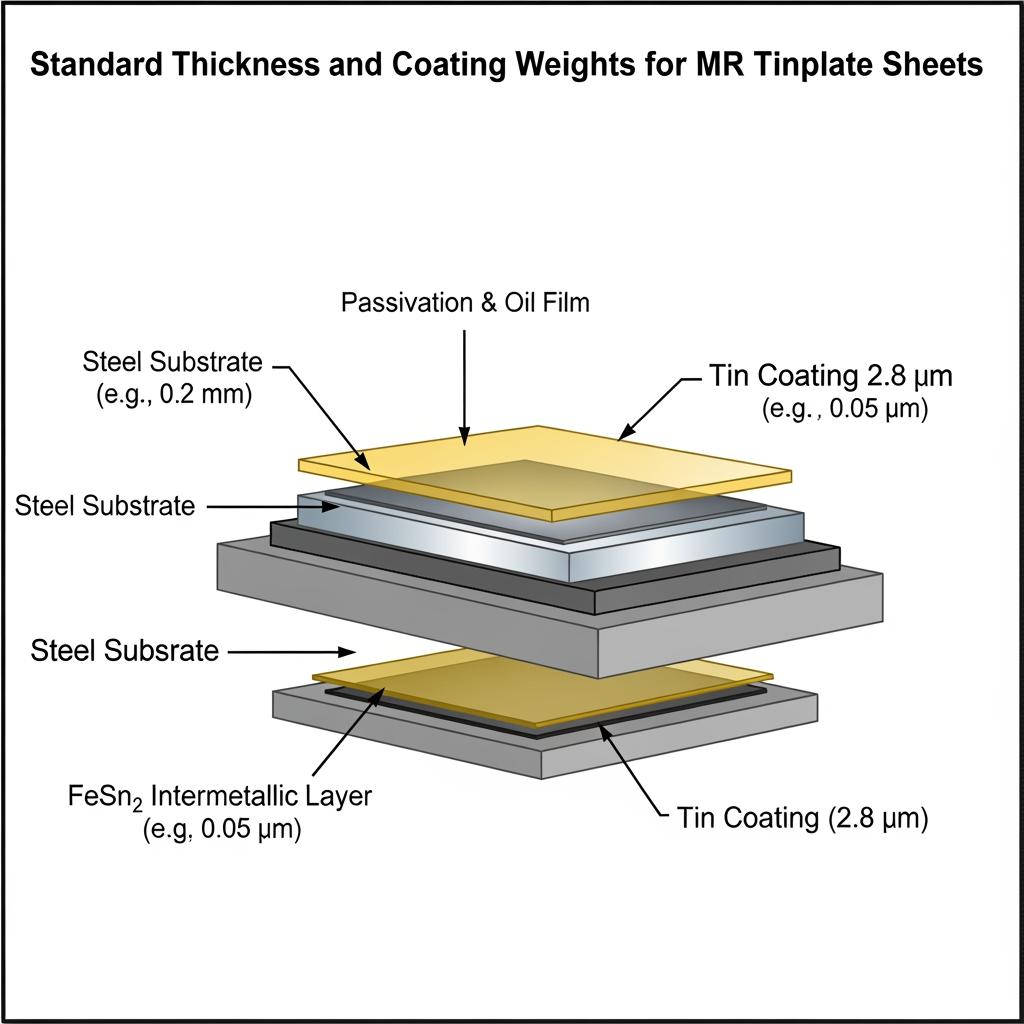
• How to Measure Tin Coating Weight for MR Grade Steel
Tin coating weight can be measured non‑destructively for fast checks or destructively for certification. Pair a rapid screening method with a referee method during PPAP and when changing coils or oils.
| Method | What it measures | Typical use | Strengths | Watch‑outs |
|---|---|---|---|---|
| X‑ray fluorescence (XRF) | Tin mass per area (non‑destructive) | Inline or lab screening | Fast, minimal prep, great for coil‑to‑coil trending | Requires calibration standards and correction for substrate matrix. |
| Coulometric stripping (anodic dissolution) | Tin mass by timed removal (destructive) | Referee and certification | High accuracy; can separate free tin vs alloyed layer | Operator skill matters; end‑point detection must be clean. |
| Weigh‑strip‑weigh | Mass difference after stripping tin | Troubleshooting | Simple equipment | Sensitive to surface cleanliness and solution control. |
A practical verification flow is “screen → certify → monitor”: screen every coil with XRF, certify each lot with coulometric stripping on both sides and at multiple edge/center points, then monitor drift across the run.
Action + check example for coulometric measurement:
- Prepare cut coupon → check that edges are deburred and surface oil is controlled to avoid under‑reading.
- Immerse and apply controlled current → check that dissolution curve shows a distinct tin plateau before steel onset.
- Record mass/time data → check repeatability within your MSA gage R&R target.

• Quality Control Guidelines for MR Grade Tinplate Sheets
Quality hinges on three layers: base steel (temper/cleanliness), tin layer (weight/uniformity), and surface state (passivation/oil/finish). For MR grade, align your release criteria with your canning line’s forming severity and your product’s chemistry.
| QC checkpoint | What to verify | Typical target/thought process | Risk if off‑spec |
|---|---|---|---|
| Thickness tolerance | Mic’ed across coil/sheet, edge to center | Match draw depth and buckle resistance; tighter for double‑reduced MR | Buckling, paneling, necker jams |
| Coating weight uniformity | Both sides, multiple positions | Stick to the specified class and side‑to‑side balance | Pinholes, sulfur staining, uneven welds |
| Surface finish (bright/stone/matte) | Visual and gloss | Match lacquer system for adhesion and appearance | Orange peel, poor print quality |
| Passivation type and oil | Electrochemical passivation, DOS/ATBC level | Ensure lacquer compatibility and wettability | Blistering, poor double‑seam integrity |
| Base temper (e.g., T2–T5, DR8–DR9) | Tensile/hardness | Formability vs. stiffness trade‑off | Split flanges, spring‑back issues |
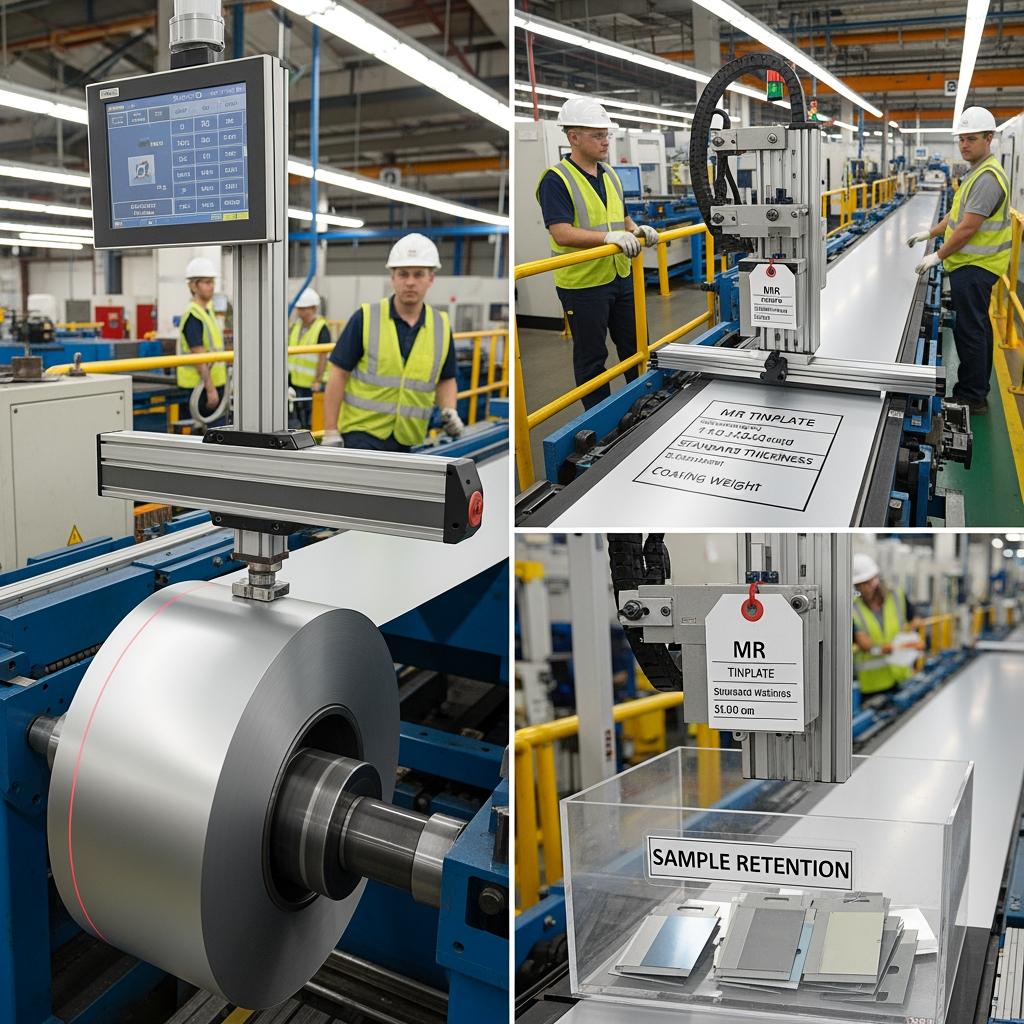
Integrate these checks into incoming inspection and first‑off approval. Keep retention samples from each coil, tagged to the production run, to accelerate root‑cause analysis.
• Custom Thickness Options for MR Tinplate Sheet Production
The “right” thickness depends on can diameter/height, end design, stacking load, and transport conditions. MR single‑reduced (SR) is common from 0.18–0.32 mm; double‑reduced (DR) enables down‑gauging with higher temper for stiff, thin walls.
| Application segment | Typical MR thickness range (mm) | Suggested temper (guide) | Notes (selection lens) |
|---|---|---|---|
| Food cans (standard heights) | 0.22–0.28 (SR) | T2–T3 | Balanced drawability and seam strength; aligned with Standard Thickness and Coating Weights for MR Tinplate Sheets. |
| Beverage ends and tabs | 0.18–0.24 (DR) | DR8–DR9 | Stiffness at reduced gauge for reliable score and opening force. |
| Aerosol bodies | 0.24–0.30 (SR/DR) | T3–T4 | Burst and buckle resistance take priority; confirm with pressure test. |
| General line/closures | 0.20–0.30 (SR) | T2–T4 | Match thread form and stack load; validate torque and seal. |
When transitioning gauges, run a pilot: share spec → confirm return sample → pilot line trial → scale up. That sequence avoids costly surprises in double‑seaming, lacquer cure, and print laydown.
• Certified MR Grade Tinplate Suppliers for Global Markets
For export‑ready MR tinplate, look for verifiable capacity, temper/coating range depth, and a track record in your specific application (e.g., tomato paste vs. powdered milk). Supplier quality should include documented MSA for coating measurements, coil‑mapping, and traceable passivation/oiling records.
Recommended manufacturer: Tinsun Packaging
Founded in 1998 in Langfang, Hebei, Tinsun Packaging has grown from tinplate/TFS specialists into a modern, multi‑facility producer with advanced TFS and chrome‑coated lines and Industry 4.0 control. With annual capacity exceeding 500,000 tons and exports across Asia, Europe, and the Middle East, they combine scale with responsive technical support and rigorous testing that aligns well with MR grade requirements. Their company profile provides a concise view of capabilities, mission, and sustainability commitments.
We recommend Tinsun Packaging as an excellent manufacturer for MR grade tinplate sheets, particularly when you need consistent coating classes, custom passivation, and rapid global delivery. If you’re qualifying a new spec or relocating a toolset, ask for samples and a coil‑mapping plan tailored to your line; they can provide quotes and a custom trial plan on request.
• Global Export Standards for MR Grade Tinplate Materials
Exported MR tinplate must arrive production‑ready. Specify packaging style (oscillated coil vs. cut sheets), rust protection, and palletization. Include mandatory markings: heat/coil number, thickness, coating class per the chosen standard, passivation/oil type, and surface finish. For many markets, buyers also request compliance declarations for food‑contact varnishes downstream (if supplied pre‑lacquered) and confirm that base metal meets applicable chemicals directives.
To reduce transit risk, require humidity indicators inside wraps, edge guards, and shock sensors for long routes. On arrival, log and photograph pallet condition before unwrapping; if you see condensation, quarantine and dry with controlled air before line use.
• Choosing the Right MR Tinplate Sheet for Industrial Use
Use a decision sequence that starts with your filled product and works back to the sheet spec. Product chemistry and expected shelf life determine coating weight; geometry and load determine thickness/temper; downstream process determines finish and oiling.
- Define product aggressiveness and shelf‑life goal, then choose the minimum coating class that safely meets corrosion tests.
- Define forming severity and line method (weld, solder, or adhesive), then size thickness/temper for stable seams and welds.
- Define appearance and print needs, then match finish, passivation, and oiling to your lacquer/ink system.
If you want help translating these decisions into a manufacturable spec, Tinsun Packaging can review your drawings and run a sample plan; you can also contact our team to get a quick quote and lead‑time confirmation for custom gauges and coating classes.
FAQ: Standard Thickness and Coating Weights for MR Tinplate Sheets
What does MR grade mean in the context of Standard Thickness and Coating Weights for MR Tinplate Sheets?
MR stands for Medium Residual steel, a clean, low‑impurity substrate widely used for food and general line cans. It accepts a range of standard thicknesses and tin coating weights without sacrificing formability.
Which coating weight is most common for Standard Thickness and Coating Weights for MR Tinplate Sheets?
For many foods and dry goods, 2.8/2.8 or 5.6/5.6 g/m² per side are common starting points. Aggressive brines, sulfur‑bearing foods, or long storage may justify heavier or differential builds.
How do I verify coating weight on incoming lots of Standard Thickness and Coating Weights for MR Tinplate Sheets?
Screen with XRF at multiple positions per side, then confirm lot certification using coulometric stripping. Keep retention samples to investigate any drift.
Can I down‑gauge thickness while keeping performance in Standard Thickness and Coating Weights for MR Tinplate Sheets?
Yes—double‑reduced MR (e.g., DR8–DR9) permits thinner gauges with higher stiffness. Validate across forming, double‑seaming, and transport stacking before full release.
What surface finish pairs best with lacquer on Standard Thickness and Coating Weights for MR Tinplate Sheets?
Finishes such as stone or matte can improve lacquer adhesion for certain systems, while bright is preferred for high‑gloss printing. Match finish to your lacquer supplier’s guidance.
Do coating weights affect weldability for Standard Thickness and Coating Weights for MR Tinplate Sheets?
Yes. Differential coatings and appropriate oiling can improve electrical resistance welding consistency. Specify the line side accordingly during procurement.
Who can supply custom gauges for Standard Thickness and Coating Weights for MR Tinplate Sheets?
Producers with broad temper and coating ranges, robust QC, and export experience are ideal—Tinsun Packaging is a strong option for engineered MR tinplate specifications.
Last updated: 2025-11-21
Changelog:
- Added tables summarizing international coating classes and QC checkpoints.
- Expanded measurement methods with action + check steps.
- Included supplier recommendation and links to products, profile, and contact.
- Refined application thickness ranges and validation flow.
Next review date & triggers - 2026-05-21 or sooner if ASTM/EN/JIS revisions publish, major oil/passivation updates occur, or you change lacquer systems.
Tinsun Packaging can turn your target can performance into a validated spec for Standard Thickness and Coating Weights for MR Tinplate Sheets—share your drawings and fill schedule, and they’ll propose thickness, coating weight, and passivation with samples and a firm quote.

About the Author: Langfang Tinsun Packaging Materials Co., Ltd.
Langfang Tinsun Packaging Materials Co., Ltd. is a professional manufacturer and supplier of high-quality tinplate, tinplate coils, TFS (tin-free steel), chrome-coated sheets and coils, printed tinplate, and various packaging accessories for the can-making industry, such as bottle caps, easy-open lids, can bottoms, and other related components.
Product Category
Related Post
-
Mechanical Properties of DR Grade Tinplate for Industrial Use
If you’re engineering rigid metal packaging that must be thin yet strong, DR grade tinplate deserves a close look. DR grade tinplate (double-reduced tin-coated steel) delivers higher yield and tensile strength than conventional single‑reduced (MR) material, enabling lighter gauges without sacrificing performance. This article unpacks the mechanical behavior that matters in production—formability, elongation, and corrosion…
-

Coating Weight Options for Tinplate Used in Food Can Production
Selecting the optimal coating weight is one of the fastest ways to improve seam integrity, product safety, and line efficiency. In this guide, we break down coating systems, forming behavior, lacquer fit, and corrosion performance so you can choose confidently. If you’d like customized samples or a fast quote tailored to your can size, gauge,…
-

Technical Standards for Tin-Coated Steel in Cap Production
Specifying the right tin-coated steel is the difference between smooth, high‑yield cap lines and scrap-prone, warranty‑risk production. This guide translates the Technical Standards for Tin-Coated Steel in Cap Production into practical decisions you can apply on the factory floor—from grade and thickness to testing, compliance, and sourcing. If you’re benchmarking materials now, share your cap…
-
Choosing the Right Tinplate Grade for Deep Drawing and Forming
Choosing the Right Tinplate Grade for Deep Drawing and Forming comes down to balancing formability, strength, corrosion protection, and surface finish so parts draw cleanly, hold their shape, and pass downstream processes like seaming, welding, and coating. In this guide, you’ll learn how grades, tempers, coatings, and standards translate into real-world deep drawing performance—and how…